Where Saints Are Made

Where Saints Are Made

Young St. Francis kept trying to leave home to pursue greatness. Dazzled by the heroism of knights and soldiers, St. Francis attempted twice to enter into battle or to join the military. Sickness, imprisonment, and the continued call to return home became his lot instead of armed valor and glory. While he did eventually travel great distances, St. Francis grew to be great by condescending to become very little.

On a recent pilgrimage to Italy, I was near the castle fortress overlooking Assisi as I took in the quiet beauty of the medieval town as the sun slowly lowered. The place of burial for St. Francis was awash in warm light and I soaked up the stillness of the moment. As my mind rifled through memories from the past few days, I thought of the holy places I had visited and the different talks and tours I had taken in. A simple thought came to mind and I made a note on my phone so as to not forget it.

“St. Francis kept trying to leave home to do great and noble things. Instead, it was in Assisi that he became a saint.”

It was in Assisi, the place where the follies of his youth were known and the place where people were aware of his flaws, that the Lord chose to craft Francis into St. Francis. In many ways it is easier to go elsewhere to become holy. To be holy at home, where your lack of holiness is clearly known, is one of the most difficult things. Yet it was this point that the Lord wanted to remind me of as I stood at the end of my pilgrimage. Home is where we can become holy.

I, too, like Francis often find myself wanting to run off to some corner of the world and do great and heroic things. Noble missions or bold adventures or grand quests for the Lord are enticing. To do something enduring and memorable seems to be a desire within all humans, even if what we consider memorable varies from person to person. Yet here the Lord was reminding me that in our native place, in our homes, among the people who know us, He can and does make us holy, if we permit Him.

Continue reading “Where Saints Are Made”

He understood it well

He understood it well

But Jesus would not trust himself to them because he knew them all, and did not need anyone to testify about human nature. He himself understood it well.

John 2:24

I keep thinking of those rocks that are rough, with edges that snag on anything softer which passes by it. Any sort of fabric which flutters nearby is caught in the crevices of the rock, pulling and tearing with an immovable stoicism. Like when you sit on a wooden bench and the sneaky slivers of wood grasp the fabric of your skirt or shirt when you stand up, leaving you with clothing pierced through and a snarled bunch of threads.

This type of rock keeps coming to mind, I think, because it seems to be a fitting comparison for my heart and, hopefully not, but perhaps also, yours, too. It seems too easy for my hard little heart to find itself getting snagged on the people and things which pass by. And I’d really like to blame it on the others instead of looking at the roughness which resides within. I want to say, Maybe you shouldn’t have done this thing or You got too close to this hard edge or Why did you mercilessly punch your finger into this wound? If death and taxes are two absolutes, experience dictates that another absolute is our hearts running our own rough edges into the craggy contours of others’ hearts.

When matters appear to be going swimmingly, I find myself discovering another flaw or brokenness or wound through the oblivious words and actions of others. Even in situations where the other person is entirely to blame (which, admittedly, is quite rare), I still must reconcile with what that particular interaction has revealed. The fault may be theirs, but the roughness it has revealed is still certainly mine.

This season of Lent provides the perfect opportunity to look more realistically at these tangled threads, these areas where I find myself torn by the simple experience of living in a community of fallen humans. It creates the opening for mercy and grace, the chance to see how the Lord is inviting me to let my rough edges be smoothed by the crucible of life. I almost never run towards these chances the Lord offers. Instead, I find myself resisting with the vigor of one fighting for her life. I don’t want this roughness to be dragged along the pavement, aching until it succumbs to smooth surrender. I’m more prone to dig in, to harden my heart, to prickle at the first hint of pressure, to worm my way safely into caverns which cannot easily be reached.

Continue reading “He understood it well”

Like A Lamb in the Midst of Wolves

Like A Lamb in the Midst of Wolves

In Luke 10, Jesus speaks of how He is sending His disciples, the few laborers for the abundant harvest, out like lambs in the midst of wolves. When I heard this at Mass several days ago, an image leapt into my mind which has been with me ever since. I imagined a little lamb, still with softly spun small coils of wool, walking down a path surrounded by wolves, growling menacingly at the tender lamb. Yet the lamb moved forward, head held high, and seemed unfazed by the danger that lurked around it.

I considered how vulnerable this lamb was, unable to defend itself from the predators and with little strength to offer on its own behalf. And I thought that perhaps that was exactly the point. Maybe this image of the lamb in the midst of wolves is exactly what Jesus desires for us. This little lamb is aware of its weakness and it is likely this knowledge of its weakness which is its greatest strength. If it fixated on the vicious wolves that surround it, the sheep could never move forward. It is rather gentle by nature, with no claws or sharp teeth to maim an attacker. The lamb surrounded by wolves finds its strength in knowing that the Shepherd will provide.

The moments or situations in life where I have known God placed me in a particular situation, and yet I felt wholly unqualified for the task at hand, are the situations where I have needed to rely entirely on the Lord. In this reliance, there is a strength that is given. I don’t know that I was a better teacher ten years ago, but I was far more likely to storm Heaven prior to a difficult class or to beg for guidance in the midst of students’ questions. It isn’t that I don’t ask for God to help me now, but I’m more confident in my own abilities than I used to be. Yet the littleness, the weakness I felt as a new teacher was also a source of strength. I’ve experienced the same in different ministries or experiences which forced me to offer the Lord unrestricted access, imploring Him to provide in the places where I saw an abundant lack.

Continue reading “Like A Lamb in the Midst of Wolves”

We Know Not How

We Know Not How

The kingdom of God is like a seed.

The Gospel for this Sunday focuses on a common image in the parables of Jesus. A little seed yields abundance and the kingdom of God that Jesus is proclaiming is like that.

Jesus said to the crowds: “This is how it is with the kingdom of God; it is as if a man were to scatter seed on the land and would sleep and rise night and day and through it all the seed would sprout and grow, he knows not how. Of its own accord the land yields fruit, first the blade, then the ear, then the full grain in the ear. And when the grain is ripe, he wields the sickle at once, for the harvest has come.”

Mark 4: 26-29

What strikes me the most in this passage is how the silence and waiting bring about a harvest. A seed is scattered on the land, but unlike some parables, the focus isn’t on the soil. Rather, the emphasis is on the seed. Despite the sleeping and rising of the farmer, the seed flourishes and gives rise to a harvest for him to gather. Does the farmer understand it? The Gospel proclaims “he knows not how” the seed sprouts and grows.

The same is true in us. God’s work is slow and gradual and we know not how He does it. Like the child who plants a seed and then looks eagerly each day, expecting immediate growth, if we are fixated on seeing magical growth, we will be disappointed. The seed of God grows in us, slowly and almost imperceptibly. Weeks or months or years later, we have the joy of looking back and seeing how God moved and worked. In the particular moment, we don’t always see the movement or the purpose.

The work of God is silent. So much takes place beneath the surface before we even see any fruit. But the Lord loves to work in the quiet. An immense work is happening in wombs and Eucharistic holy hours and monastic life and a night’s sleep and the quiet of the early morning. We often want the Lord to be striking and bold. Sometimes He is. But sometimes He is thirty hidden years at Nazareth, cared for a father with no recorded words in Scripture and a mother who is so often pondering things in her heart. A hushed unfurling of God’s word in our hearts leads us into a love that is not showy or boisterous but rooted and deep.

In so many areas of my life, I want things to happen quickly. I don’t like the struggle of the waiting or the in between, the time of growth that is often painful as we develop roots to sustain us in later storms. The act of starting is so often delayed because I fear what happens once something is set in motion. Or sometimes it is the opposite fear: what won’t happen despite the steps taken. But if the kingdom of God is like this little seed, then the same could be applied to God’s kingdom dwelling within me. It grows, step by slow step, in the hidden hours, though I know not how.

Continue reading “We Know Not How”

Let Our Desires Be Big

Let Our Desires Be Big

He complains much of our blindness, and cries often that we are to be pitied who content ourselves with so little.

The Practice of the Presence of God, Brother Lawrence

This Lent, I want to not settle. I’ve been slowly plodding through The Practice of the Presence of God and I find little bits of wisdom, such that makes me want to savor the book and not just rush through it, although it is brief. As I’ve been seeking to delve into a new relationship with the Lord during this new season of grace, I’ve been moved by this plea of Brother Lawrence to not content myself with so little. My “big” desires turn out to be not so big in light of what the Lord desires. In fact, it turns out that I want too little instead of wanting too much.

It would seem that Our Lord finds our desires not too strong, but too weak. We are half-hearted creatures, fooling about with drink and sex and ambition when infinite joy is offered us, like an ignorant child who wants to go on making mud pies in a slum because he cannot imagine what is meant by the offer of a holiday at the sea. We are far too easily pleased.

The Weight of Glory, CS Lewis

The Lord offers deep and intimate relationship with Him. And we want ease and comfort. Or nice clothes. Or relaxation. Or sleep. Or any number of things that show how little we will settle for when grand things are held before us. This time of Lent is a time to re-focus and shift my perspective to be more eternal, to focus less on the things of this world and see the unending delights the Lord promises if we but bypass the immediate half-goods. I write this as much for myself as for anyone else. This Lent, let us run the race well and seek after the things not of this world and let our longings increase and become longings truly worthy of the beauty for which humanity was created.

Let us deepen our desires. They cannot be too big for the Lord, only too small.

Photo by Jan Kronies on Unsplash

Small Things

Small Things

On my drive to and from school, I keep reminding myself to soak it up and take it in. Instead of getting lost in thought or just robotically staring at the road ahead, I attempt to look up and look around. So often I find myself in the early part of winter wondering what happened to the fall days I cherish. The trees seem to be blazing scarlet and golden hues for such a brief period of time. While I think fall is often inconveniently truncated, I also forget to embrace the days we do have.

This year, I’m attempting to make my morning and evening commutes a time for noticing. Noticing the particular blush of the tree near my house, mostly green but with a warm glow on top. Noticing the checker of colors on the trees as I wait for the light to change. Noticing the warmth of the afternoon sun and the slight coolness in the morning air.

There seems to be a need to soak up these moments, to store them away in my heart for the months ahead where the trees will be barren and the air frigid. In those moments, there will be much to be grateful for, too, but I want to relish these days as the colorful glory that they are for me.

Continue reading “Small Things”

Five Loaves and Two Fish

Five Loaves and Two Fish

Venerable Francis Xavier Nguyễn Văn Thuận spent thirteen years imprisoned in Communist Vietnam without receiving a trial. Of those thirteen years, nine were spent in solitary confinement. The prison conditions he suffered in makes the prison I go to for prison ministry look like a luxurious hotel. From his cell being so humid that mushrooms grew on his sleeping mat to his cell light being left on (or off) for days at a time, Venerable Francis suffered in ways I cannot fathom.

Yet from this suffering emerges a life shaped and formed in the crucible of humiliation. Despite the hatred of his persecutors, he continued to seek after the Lord. Years after being released from prison, Venerable Francis wrote Five Loaves and Two Fish, a simple yet profound book based on his experiences in prison. While most of us cannot relate to the particulars of his life, the truths that emerge are ones that ought to resonate deeply with each of us.

The general theme of his book, as you may have guessed, is based on the Gospel where the little boy offers the little he has (five loaves and two fish) to feed the multitudes present. The boy doesn’t know how it will be enough, but he trusts that offering it to the Lord is what he is called to do. Venerable Francis focuses on the little that we can do to offer ourselves to the Lord. He went from an active ministry as a bishop, serving God’s people with energy and zeal to a life imprisoned, unable to speak to his flock or do the work God was allowing him to do before. Yet even in this lack, or perhaps especially in this lack, he finds that God is still working, just not as he expected.

The book is short and beautiful, so I recommend getting a copy and pouring over the simple truths found in it. But I wanted to highlight two points that stood out to me.

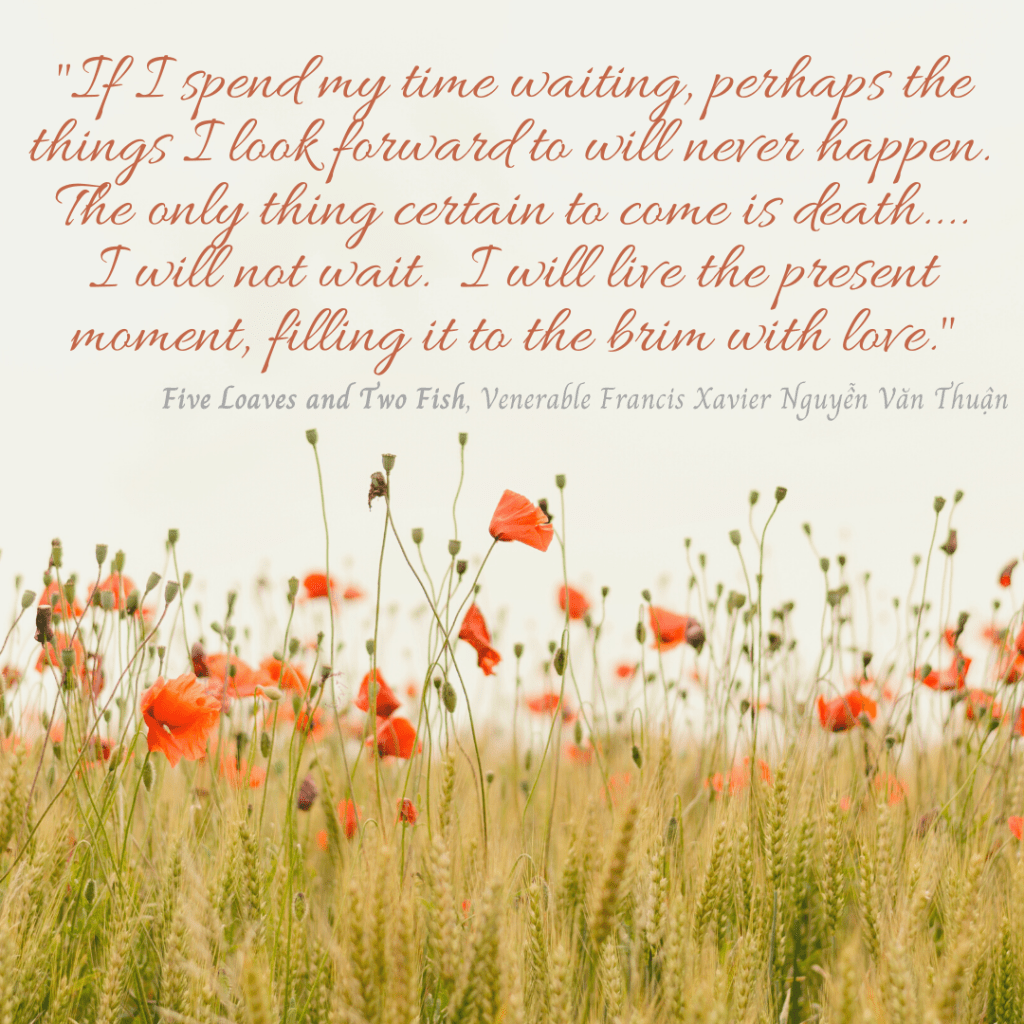
The first truth Francis shares is to live in the present moment. Honestly, if I were confined to a cell for nine years, I might be inclined to live in anywhere but the present moment. The perspective Francis has is, “If I spend my time waiting, perhaps the things I look forward to will never happen. The only thing certain to come is death.” Keeping in mind where he found himself when he considered those words, it was reasonable for Francis to assume he would not survive prison. He chose to embrace the moment and do what he could with what he had.

Through the smuggling efforts of a seven-year-old, Francis sent out messages of hope that he composed during the night. He focused on filling each moment to the brim with love, concentrating on each gesture toward the guards being as loving as possible. The fruit of this was the conversion of many guards. Initially, they rotated the guards often so that he wouldn’t convert them, but then they decided to keep the same ones with him so he would convert as few as possible.

Continue reading “Five Loaves and Two Fish”

Joy in Everyday Things

Joy in Everyday Things

Marie Kondo advocates asking yourself if the things that fill your house spark joy. While I don’t live her method, there is something intriguing about asking that question about the items that fill our visual landscape. Many things in my home don’t do that (I suppose I find it hard for spoons and forks to greatly spark joy in me—yet they are pretty useful for eating), but it is perhaps more interesting to consider the things that do fall into that category.

During the pandemic, I’ve spent a lot of time at home. But given this abundance of time at home, I notice that my affections continue to be drawn to particular things in my home and I find once again compelled to acknowledge that beautiful, practical (and impractical) items are so helpful for ushering joy into our lives.

For example, I have a wooden serving tray and it is perhaps odd the number of times I stop to admire the varying grains that run across and throughout the wood. Either as I’m arranging food on it or washing it off, I generally am thinking, “This is so beautiful.”

Or I have a serving bowl that was handpainted in Italy that I purchased last summer while in Assisi. The bright colors that fill the interior bring me a thrill of joy every time I fill it with salad or an array of fruit. As I use it, I frequently remember the peace of Assisi, the quiet of the streets during our time there, and the beauty of being in a place so old.

Continue reading “Joy in Everyday Things”

A Thousand Deaths

A Thousand Deaths

When Jesus was confronted with untrue accusations, do you remember what He did? As the Sanhedrin gathered false testimony, as Pilate presented questions given by the chief priests, as Jesus struggled beneath the weight of the cross and the jeers of the people, as Jesus was maligned while on the cross, do you remember what He chose?

Silence.

How hard it is to not rush to our own defense! When situations are misrepresented, when intentions are skewed, when honest questions are left unanswered, it is a tremendous act of the will to not attempt to set all things right. Sometimes, it is necessary to provide clarity and correctness and other times it is completely unnecessary. And sometimes it is necessary to try to show the misunderstandings, but to ultimately fail in convincing them of their skewed view.

We always feel the pains of injustice acutely when it offends our own sense of justice. I look at the lives of the saints and martyrs and I tend to think about how glorious and courageous were their deaths. Yet each of those martyrdoms was preceded by many, many small bloodless deaths. St. Paul didn’t only suffer beheading in Rome. Before that, he was imprisoned, he experienced riot after riot when preaching the Gospel, he was looked upon with distrust by the Jews and the Christians after his striking conversion, and he spent much time in chains for the sake of the Gospel. His final suffering, the death of a martyr, was simply the last death he experienced in a long line of dying to self.

Most of our stories won’t be quite that dramatic. We probably won’t sit unjustly condemned in terrible prisons awaiting our cruel deaths. We will, however, suffer in other ways. And it will be in ways that will be easy to want to reject or feel the need to correct. As Jesus heard false testimony, I am certain He had at least part of a desire to simply say, “I didn’t say that. That isn’t right. You weren’t there. You are intentionally misrepresenting me.” Instead, He suffered in silence with the Lord. He knew that the truth would be revealed and He rested with the Lord in the midst of being misunderstood. He invites us to do the same, in the small and the large sufferings of our daily life.

Continue reading “A Thousand Deaths”

From My Heart to Yours: A Lenten Devotional

From My Heart to Yours: A Lenten Devotional

Lent is fast approaching.

Even though I’ve been consistently thinking about Lent over the past few weeks and prepping my students and small group for it, I still haven’t fully decided what I will be giving up/adding to my life for the next 40 days. Many ideas are swirling around, but I haven’t landed on specifics yet. This morning, I was talking with one of the prisoners and after I explained a little about Lent, he asked what I would be doing for it. Great question, friend, I thought, I’m not quite certain yet.

However, there is still time to decide. Time to prayerfully consider how we can draw nearer to the Lord’s heart as we wander into the desert so that He may speak to our hearts more intentionally.

To that end, I created a Lenten devotional for you (and me)! I’m excited about this little project and I hope that it will enable us to have a more fruitful Lent. (Click picture below for the pdf)

Continue reading “From My Heart to Yours: A Lenten Devotional”