He understood it well

He understood it well

But Jesus would not trust himself to them because he knew them all, and did not need anyone to testify about human nature. He himself understood it well.

John 2:24

I keep thinking of those rocks that are rough, with edges that snag on anything softer which passes by it. Any sort of fabric which flutters nearby is caught in the crevices of the rock, pulling and tearing with an immovable stoicism. Like when you sit on a wooden bench and the sneaky slivers of wood grasp the fabric of your skirt or shirt when you stand up, leaving you with clothing pierced through and a snarled bunch of threads.

This type of rock keeps coming to mind, I think, because it seems to be a fitting comparison for my heart and, hopefully not, but perhaps also, yours, too. It seems too easy for my hard little heart to find itself getting snagged on the people and things which pass by. And I’d really like to blame it on the others instead of looking at the roughness which resides within. I want to say, Maybe you shouldn’t have done this thing or You got too close to this hard edge or Why did you mercilessly punch your finger into this wound? If death and taxes are two absolutes, experience dictates that another absolute is our hearts running our own rough edges into the craggy contours of others’ hearts.

When matters appear to be going swimmingly, I find myself discovering another flaw or brokenness or wound through the oblivious words and actions of others. Even in situations where the other person is entirely to blame (which, admittedly, is quite rare), I still must reconcile with what that particular interaction has revealed. The fault may be theirs, but the roughness it has revealed is still certainly mine.

This season of Lent provides the perfect opportunity to look more realistically at these tangled threads, these areas where I find myself torn by the simple experience of living in a community of fallen humans. It creates the opening for mercy and grace, the chance to see how the Lord is inviting me to let my rough edges be smoothed by the crucible of life. I almost never run towards these chances the Lord offers. Instead, I find myself resisting with the vigor of one fighting for her life. I don’t want this roughness to be dragged along the pavement, aching until it succumbs to smooth surrender. I’m more prone to dig in, to harden my heart, to prickle at the first hint of pressure, to worm my way safely into caverns which cannot easily be reached.

Continue reading “He understood it well”

The Teacher’s Own Heart

The Teacher’s Own Heart

I read a few days ago that one of the most prominent failures of teachers is the failure to love and it was a quick jab to the stomach of my pride. Not to mention, it came from St. Augustine and isn’t so easy to dispel with excuses and circumstances.

But the psychological failures that Deogratias must most be on guard against is a failure in love. Deogratias must learn how to step outside of himself. He must learn to teach with joyful self-forgetfulness. The real difficulty lies not in questions of content, nor of technique, but in the teacher’s own heart. For when the teacher takes delight in what he says, that is, when he loves both his subject and his students, then students also will enjoy what he has to say.

St. Augustine” by Ryan Topping, p. 60

So…there’s that.

And I walked back into my classroom with a conscious realization that while I may do many things well, Augustine was right. I fail to love. I love some but not enough. I love in instances but not in entirety. And I couldn’t help but think that this teaching gig is a true preparation for Heaven (or parenthood…whichever comes first).

This teacher’s heart is the reason for this blog. It needed a space to search and question and ache over what happened in the classroom. And while many things in life have changed (and many things haven’t), I still find a need for this continued call for conversion. I need to be reminded that this heart is incredibly important and not just for myself, but for the young souls entrusted to my care.

Continue reading “The Teacher’s Own Heart”

Relentless Pursuit: How Prison Ministry Causes Me to Stand in Awe Before the Mercy of God

Relentless Pursuit: How Prison Ministry Causes Me to Stand in Awe Before the Mercy of God

I don’t believe I ever had as much gratitude for the generous mercy of God as when I started volunteering at the prison.

Over the years, I have perhaps struggled with accepting that I cannot disappoint God or realizing the unplumbable depths of God’s particular love for me. But, in many ways, I never felt that I strayed too far from God. I never stopped going to Mass or turned away from the faith. In college, I was delving into my faith when many of my peers were shaking the Church’s dust from their feet. So I never really had to confront the question of “Can God forgive me for this?” and I say that without any pride knowing that I fail in many, many ways.

Standing before men in prison, though, I am encountering some men who have committed truly heinous crimes. There are men in for drug charges or robbery or embezzlement. And then I’m with men who committed crimes against women and children, in a variety of circumstances and situations. I also find myself with men who have murdered others or conspired to murder people or have attempted to murder others. Regardless their crimes, I am able to confidently extend the mercy of God to them.

There are times when I am in the disciplinary unit, talking with the men cell-front with a couple of other volunteers, and I find myself filled with profound awe over the gift of salvation. I don’t have to ask what sins they have committed to know if the Lord desires to be in relationship with them. If I find myself repelled by their sins or crimes, I know the Lord still yearns for their soul and to pour His love generously upon them. It causes me to experience again the immensity of the Lord’s love. There is no question about if He loves any person I meet in prison. That expansiveness causes me to stand there and just be awed by how the Lord never stops pursuing our hearts.

Continue reading “Relentless Pursuit: How Prison Ministry Causes Me to Stand in Awe Before the Mercy of God”

Ministry: A Gift I Give That Changes Me

Ministry: A Gift I Give That Changes Me

“You’re pretty comfortable here, Trish,” I was told Saturday night when I visited the prison for Mass.

“Yeah,” I said, “It is almost like I live here.”

This comment was coming from a prisoner who had poked fun at me weeks earlier for how shy I seemed while helping with the prison retreat. While I didn’t think I was quite as reserved as he claimed, I would definitely agree that I have grown more and more comfortable in prison as time has passed. In fact, the most nervous I felt all night was when I walked alone in the dark from the prison building to my car. And as it happened, I had to laugh. I had spent a couple hours in prison without a care and my biggest concern was about someone not in prison. It made sense and yet the oddness of the situation was not lost on me.

Recently, I was talking with a friend about prison ministry. I told him that it felt strange to tell people I was involved with it because I don’t really feel like I’m doing that much. I attend a Bible study in the prison one night a week and I try to visit both prisons for Mass on Saturdays. Sometimes good conversations happen and other times I seem to be just one of the crowd. He reminded me that often that is what ministry actually involves: just being present to others. But I realized in that conversation that while I am not convinced that I have impacted anyone in prison, I know that my heart has been moved through this ministry.

What if that is enough?

In ministry that so deeply concerns the conversion of the heart, there is an indifference one must have toward seeing the fruits displayed. Obviously, good ministry will bear fruit, but so often we fill the role of scattering seeds and someone else is the one who helps with the harvest. We want to see people respond and we want to frequently evaluate what we are doing or how we could be more effective. But conversion is quite often the slow work of God in the soul, something formed through various conversations with others or different experiences. I’m convinced that we will only know the impact the Lord has made through us once we are with Him in Heaven. Considering my overabundant human pride, that might not be a bad thing, even if it causes me to wonder if I’m doing anything productive in anyone’s life.

When I was involved in sidewalk counseling outside an abortion clinic during college, I never saw my words or my actions motivate someone to choose life. Instead, I was often fumbling for words as my heart overflowed with feelings but my mind struggled to form ideas to share. Yet being involved in that ministry radically transformed my heart. It gave me the experience of aching with Our Lord, of encountering the complete exercise of free will, of truly being persecuted by others for the first time in my life, and of growing in trust that prayer does something powerful even I don’t see it immediately.

I know without a doubt that hearts were transformed and lives changed through the prayer, suffering, and sacrifices made in that ministry, but I will never know the specifics on this side of eternity. If I had to point to one thing that changed my heart most in college, it would probably be the cold hours I spent begging the Lord for mercy on a street in Pittsburgh. Even if I didn’t see others change, I saw a change occur within myself.

Continue reading “Ministry: A Gift I Give That Changes Me”

Unplanned

Unplanned

My younger sister, parents, and I went and watched the movie Unplanned. It is the true story of Abby Johnson, who went from Planned Parenthood clinic director to pro-life advocate shortly after being called in to assist with an ultrasound guided abortion. I had heard many things about the movie, most of them about how sad it was or how it had the ability to change hearts and minds.

I thought it gave an accurate portrayal of the positives and negatives of both the pro-life and the pro-choice side. (Note: I use the terms pro-life and pro-choice because those are generally what each side wants to be called and if I want to engage in a genuine conversation, I don’t start off by alienating them over a title.) Not all pro-lifers are compassionate figures who reach out in love to assist women. Similarly, not all pro-choicers are concerned only about the money behind abortion. The situation is more complex than a simple good people vs. evil people.

During my time outside an abortion clinic in Pittsburgh, I saw some of each type of person depicted in the movie. I saw people who loved the men and women entering the clinic so much they endured hours of standing in the cold and being cruelly mocked by the pro-choice escorts. Yet I also saw pro-life people yelling at abortionists that they are baby killers who are going to burn in Hell or that the women will for having an abortion. While there, I encountered people who genuinely thought abortion was the best option for some women and thus volunteered their Saturday mornings to assist these women. I also met pro-choicers who were extremely hardened, who intentionally pushed into me when I tried to talk to the women, who stood in circles as they joked about physically harming those of us who were praying.

It is because of my time spent at the abortion clinic in Pittsburgh that I watched Unplanned and didn’t think it was as difficult to take in as some people had said it would be. No, I didn’t enjoy watching it, but I had already watched countless women, escorted by best friends, boyfriends, husbands, and parents, walk passed me and into an abortion clinic. I saw women slowly walk out of the clinic after they had their abortions. The reality is far harder to take in than watching a movie about it, as powerful as the movie may be.

Continue reading “Unplanned”

When the Gift is More for Me Than Others

When the Gift is More for Me Than Others

During two summers in college, I was on a Totus Tuus team that traveled around my home diocese and ran catechesis for elementary through high school students.  When I started, I knew I wanted to share the message of Jesus Christ with the youth of the diocese and I had encountered a zeal in teams from previous years that I desired for myself.  By the end of the summer, I knew I had been thoroughly tricked.  I wanted to share the Gospel and yet I found a deeper need within myself to encounter the Gospel personally.  Returning to college, I told people that Totus Tuus is really about my own personal formation, not primarily about the youth I interacted with at the different parishes.  It was a surprise, but it wouldn’t be the first time the Lord would change me despite my desire to be the one provoking change. Continue reading “When the Gift is More for Me Than Others”

Simple Witnesses: The Newly Canonized Fatima Visionaries

Simple Witnesses: The Newly Canonized Fatima Visionaries

May 13, 1917

Our Lady chooses to reveal herself to three children tending sheep in the Cova da Iria.  Tenderly, she tells them to not be afraid and yet she asks them to sacrifice for the conversion of the world.  They are mere children, the oldest one is ten years old, but they agree to offer up their sufferings and sacrifices for love of Jesus and for the conversion of others.

That may seem abstract to many of us.  However, they are quick to concretize this request.  Whenever poor children ask for food, the three children give them their lunch.  As they tend to the sheep, they see how long they can go without water and offer this thirst to Jesus.  Little Jacinta finds out that she will die alone in a hospital in Lisbon and, although she is scared, she chooses to offer this trial up to Our Lady for the sake of others.

We can take as our examples Saint Francisco and Saint Jacinta, whom the Virgin Mary introduced into the immense ocean of God’s light and taught to adore him.  That was the source of their strength in overcoming opposition and suffering.  God’s presence became constant in their lives, as is evident from their insistent prayers for sinners and their desire to remain ever near “the hidden Jesus” in the tabernacle.

Canonization Mass Homily of Pope Francis, 5/13/2017

These sacrifices, though small in the course of human history, are monumental.  Children are shown to be capable of leading the way to holiness.  Their tangible witness is felt in particular in the place one would expect it: Fatima, Portugal.

IMG_6003.JPG

It has been a tremendous gift of mine that I have been to Fatima three times.  The picture above is from the most recent trip.  The man in the picture happens to be the nephew of St. Francisco and St. Jacinta Marto.  His father was their older brother, John.  Proud of his close relation, he showed us the page in Lucia’s book where she speaks about his father.

Each time I am in Fatima, I experience a great peace that comes from resting in a place that is so dear to my Heavenly Mother.  My birthday aligns with the anniversary of her first appearance in Fatima and so I have a filial devotion to this particular feast.  As I have read more about the children and how they fervently responded to her words, I have grown an even deeper love for Our Lady of Fatima and her little children.

May 13, 2017

In so many ways, their lives were insignificant.  Francisco and Jacinta were two children who fell victim to the influenza epidemic in 1919-1920.  Their lives were spent in poor circumstances in a town in Portugal for which few people cared.  While generally good children, they were not known to be perfect.  Yet on May 13, 2017, they were declared canonized saints in the Catholic Church.

Indeed, God created us to be a source of hope for others, a true and attainable hope, in accordance with each person’s state of life.

Pope Francis 5/13/2017

Continue reading “Simple Witnesses: The Newly Canonized Fatima Visionaries”

A Little More Like Ananias

A Little More Like Ananias

I want to respond to the Lord like Ananias did.

I know I have read this story before, but for some reason when I was reviewing this with my students, my heart got caught on a previously unnoticed section.

Now there was a disciple at Damascus named Ananias. The Lord said to him in a vision, “Ananias.” And he said, “Here I am, Lord.” And the Lord said to him, “Rise and go to the street called Straight, and inquire in the house of Judas for a man of Tarsus named Saul; for behold, he is praying, and he has seen a man named Ananias come in and lay his hands on him so that he might regain his sight.” But Ananias answered, “Lord, I have heard from many about this man, how much evil he has done to thy saints at Jerusalem; and here he has authority from the chief priests to bind all who call upon thy name.” But the Lord said to him, “Go, for he is a chosen instrument of mine to carry my name before the Gentiles and kings and the sons of Israel; for I will show him how much he must suffer for the sake of my name.” So Ananias departed and entered the house. And laying his hands on him he said, “Brother Saul, the Lord Jesus who appeared to you on the road by which you came, has sent me that you may regain your sight and be filled with the Holy Spirit.”

(Acts 9: 10-17)

The Lord calls his name and he responds.

Ananias seems as though he is used to hearing the voice of the Lord.  

I was struck by this response as I spoke to my students about how differently the Lord spoke to Saul and Ananias.  Saul sees a light and falls to the ground, blinded.  A voice from the heavens speaks, telling him to go to Damascus.  Yet when Jesus speaks to Ananias, there seems to be nothing dramatic about it.  Ananias hears his name being called and responds simply, “Here I am, Lord.”  The Lord tells him to go encounter Saul, and Ananias asks a question to be certain this is what the Lord wants.  For the modern Christian, it might seem a bit humorous that Ananias is completely unfazed by the call to go lay his hands on someone so as to bring about their healing.  That is nothing compared to encountering a man who has been persecuting his Christian brethren.  Despite questions and concern, Ananias does as the Lord asks.

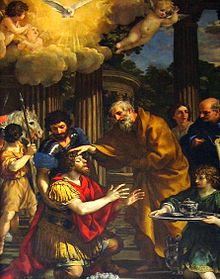
saint_paul_ananias_sight_restored
(Image source)

I want that ability to clearly hear the Lord’s voice and that willingness to do whatever He desires.  

Do you see what the Lord does with this man’s “Yes”?  Ananias is the one who lays his hands on Saul’s head, causing his sight to be restored.  The Holy Spirit comes upon Saul and soon after he is baptized.  In a matter of days, Saul has completely changed his direction and Ananias played a significant role in helping Saul encounter the Lord.

I find it interesting that Jesus does not speak to Saul again and heal him of blindness.  Instead, He works through other people.  People, hopefully, like you and me who are striving to hear His voice.  Paul goes on to become one of the greatest missionaries and evangelizers in the early Church.  Thousands of miles are traveled by foot and boat in order to proclaim the Gospel.  Ananias laid his hands on this man and implored the Holy Spirit to come make His home in him.  That is a significant role for someone who is referenced briefly in Scripture.

Never underestimate how the Lord can use you to bring about healing and conversion in other people.  I challenged my students to encounter the Lord and then to let their lives be a living witness of that encounter.  Because our encounter with the Lord changes other people.  When my older sisters became more interested in their faith, it influenced the entire family.  As I have interacted with people on fire for the Lord, it has caused a deeper desire to burn within me.  The Lord seeks us out and encounters us personally, but He often does much of His work through other people.

And that is what blows my mind. Continue reading “A Little More Like Ananias”

The Best Defense is Encountering Love

The Best Defense is Encountering Love

You can, in the broadest terms, call it “Catholic culture.”  However it’s described, though, it’s not something you simply argue yourself into.  Rather, it’s something you experience aesthetically as well as intellectually, with the emotions as well as the mind, through friendships and worship and experiences-beyond-words as well as through arguments and syllogisms.

“Letters to a Young Catholic” by George Weigel

Something I am intent on drilling into my students this semester is that Christianity is necessarily a life of encounter.  It is the tremendous beauty of being able to experience an authentic and lived relationship with Christ while also delving into the rich intellectual tradition of the Church.  Catholicism is chock-full of the “both/and” that makes life so simple and yet so deep.

I teach high school Theology to sophomores and seniors, making it somewhat safe to assume that I am not an advocate of an anti-intellectual, touchy-feely Christianity.  Specifically, one of my courses is apologetics, which is teaching how to defend the faith against attacks.  And there are many, many attacks launched against the Church in every age, no less in this one.  Defending the faith, though, is not merely done through well-chosen words or precisely articulated statements.  These are helpful, but much of the battle is done through actions.  If my students do not love the Church, they will be far less inclined to defend or understand Her.

I am well aware that the love I have in my heart for the Catholic Church is not the norm.  My students need to encounter more than the beauty of truth to be convinced.  I read the Church’s teachings and my heart stirs with the acknowledgement that these are profound truths.  Often when my students hear the Church’s teachings, they hear how their freedoms are being minimized or that they are being told what not to do.  However, if they love the Church, they will see that She is a mother caring for and protecting Her children, even if they do not always understand.

This is where the necessity of encounter comes in.  Catholicism, in Our Lord’s great wisdom, is a faith filled with the tangible.  We hear the words of absolution at Confession, we feel (and smell) the oils at Baptism and Confirmation that claim us as members of the Church.  The incense, like our prayers, rises up to the Heavens as we adore Our Lord in the Eucharist.  On pilgrimage, we travel to the places where the bones of the Apostles and saints of the Church rest.  Oddly, we touch our rosaries and prayer cards to their tombs, praying that we will follow the Lord’s will as radically as they did.  We light candles before altars, hoping that our intentions will be continually presented to Our Lord’s throne.  As George Weigel says throughout Letters to a Young Catholic, there is a grittiness in Catholicism.  In this book, he also says the following:

Catholicism does not rest on a pious myth, a story that floats away from us the more we try to touch it.  Here, in the scavi [excavations under St. Peter’s], we’re in touch with the apostolic foundations of the Catholic Church.  And those foundations are not in our minds.  They exist, quite literally, in reality.  Real things happened to real people who made real, life-and-death decisions–and staked their lives–not on stories or fables but on what they had come to know as the truth.

To be Catholic, George Weigel argues and I concur, means to live in reality.  And as someone who so often feels that people think my ideals mean that I don’t live in reality, that is uplifting to hear.  Being Catholic means living in the greatest love story while also fighting the greatest battle of all time, primarily because it transcends time.  As a romantic with more than a touch of stubbornness, these intertwining elements make the Church my perfect home.  It is not merely a battle of the wits, arguing and defending a supernatural institution to a world rooted in earthly affairs.  It is also, and primarily, an encounter with Love, being transformed by Love, seeking to enter into Love.  If love is not at the heart, all is meaningless and in vain.   Continue reading “The Best Defense is Encountering Love”

That Heartburn

That Heartburn

Last year, Fr. Mike Schmitz came out with a video.  And this year, I showed it again to all of my classes.  Sometimes I mind watching the same video six times in one day, but this was not one of those times.  Each time I watched it, I was filled with this desire to be holy and to persevere in running the race.

“Therefore, since we are surrounded by so great a cloud of witnesses, let us also lay aside every weight and the sin that clings so closely, and let us run with perseverance the race that is set before us, looking to Jesus the pioneer and perfecter of our faith, who for the sake of the joy that was set before him endured the cross, disregarding its shame, and has taken his seat at the right hand of the throne of God.”  (Hebrews 12:1-2)

Before we watched the video, I put this passage on the board and gave my students time to reflect on it.  Each class period, I found something new to consider in the passage.  I could go through it, line by line, and tell you what stood out to me, but that probably wouldn’t be interesting for you.  Instead, I’ll highlight just a couple.  Of course, the video focused on the “cloud of witnesses” that surrounds us and how the saints are there to push us forward when we want to give up.  Yet I also noticed the “also lay aside every weight” as it shows that we are to, like the saints, strip ourselves of everything that does not help us reach the finish line.  Finally, I was struck by how we are to run the race “set before us” and that it is not necessarily the race that we choose or would want to run.

In listening to Fr. Mike Schmitz and reflecting on that Scripture passage, I am filled again with the desire to be holy.  Though my life is a good one, I do not always feel the adrenaline of being in the midst of a race.  I want it to be exciting always, otherwise I tend to forget that I am in a battle/race. Continue reading “That Heartburn”