It Will Not Delay

It Will Not Delay

The wallpaper of my phone is a picture of a quote which says, “It will surely come, it will not delay.” Next to the plastic, rose-bespeckled skull on my desk at school is another quote which says, “The Lord is not slow about his promise.” I think I feel compelled to post these passages of Scripture around my life because I feel like I’m inclined to not believe them and I know that I must.

I find myself doing similar things in other situations, too. There is a massive paper I need to write (yet which I have done essentially nothing on) and I have a desire to write about the role of hope in suffering as a Christian. This is not because I feel particularly hopeful or because I view myself as a very good suffer-er. And yet there is an attraction to this tension between suffering and hope. Or, as another example, recently, I read the description of a fictional story and it repelled and annoyed me, sounding far too similar in some ways to my own life, and so I bought it.

I’m not sure I love the tension that life offers to me and yet there is something intriguing about it. At times I run from it, not wanting to parse the particular stresses and contradictions in life. Other times, I sprint towards it, wanting one strain of my heart to engage in a head-on collision with another. Or for the misconceptions or untruths I believe to smash brilliantly into the truth or clarity which they don’t want to encounter.

Perhaps it is simply reflected in how I feel about Advent. I love the time of anticipation, the preparations, the slow moving from darkness to light, the delayed gratification. However, I also feel the tension in the season and am quick to see how I also greatly dislike that same tension in my own life, when the end of the journey is not quite so clear-cut and the conclusion unknown. The season of Advent continually calls this tension to mind as we prepare both for Christmas (clearly marked out for December 25th) and the end of our lives (very unclear and uncertain for most of us). It is a delight and a sorrow, a thing of great pleasure and one of profound suffering. Yet it is a tension in which we all must live.

Continue reading “It Will Not Delay”

This is Life

This is Life

Every now and then, I need to remind myself that this is life. As I wrap up a long day teaching and heft a stack of papers into my work bag (where they will likely remain until I return the following day), I acknowledge that this is life. As I take a few quick days to visit a friend from college and enter into the swirl of activity which is life with young kids, I remind myself, “This is life.” And as the days of summer pass by far too quickly, I consider that this is my life.

Perhaps this stating of the all-too-obvious is something you don’t need to do. However, I find myself needing to do this at various times. It seems imperative to call to mind that I am living, that this is my life, and that I only have one chance at this. Sometimes this is a cause for concern, other times one of encouragement, and yet other times it is a good reality check. This is my life regardless of how different it is than what I expected and I need to make the most of this one chance.

If my life was filled with raising young children, I think it would be more obvious how time passes. Not that I would have all of this idealistic time to consider it, but children have the odd habit of growing, changing, and forcing you to acknowledge that they aren’t what they once were. As adults, this seems to be a bit harder to pay particular attention to since the changes are more gradual and can slip by quietly. So sometimes I need to call to mind that time is passing and, what’s more, that this time is precious and won’t come again.

Continue reading “This is Life”

Answering Prayers We Didn’t Pray

Answering Prayers We Didn’t Pray

Jesus, looking at him, loved him and said to him, ‘You are lacking one thing. Go, sell what you have, and give to the poor and you will have treasure in heaven; then come, follow me.’

The rich man in today’s Gospel received a beautiful, difficult blessing. He was able to ask Jesus how he could inherit eternal life and then he was told the answer.

It seems, however, that the rich man was hoping for a different response. Perhaps he wanted Jesus to say, “You don’t need to do anything else–you will inherit eternal life.” Or maybe he wanted Jesus to have some small request or some additional rule to follow. Instead, he is invited to follow Jesus after selling his possessions. This does not seem to be what the man had anticipated or he might not have asked Jesus the question. This good news, this call to discipleship which others received with wild abandon, is met with sadness and a disheartened turning away. The rich man asks a question, receives an answer, and then sulks away. How difficult it is to seek and then find that the cost is higher than you are willing to pay!

This is often true for us, too. We want the Lord to provide an answer to a present difficulty. Hoping for guidance and direction, we implore Jesus to show us the way. Yet when an answer, a path, or a gift is offered, we quickly realize it isn’t what we hoped we would receive. His ways and thoughts are far above our ways, yes, but we keep hoping, over and over again, that they will match up. We find ourselves desiring that just once our meticulously crafted and very comfortable plan will be the one the Lord has also been preparing for us. Many times we, like the rich man, ask questions with specific answers in mind or ask for grace but are focused on very particular graces.

Jesus sees this man wholly. He knows him through and through. The deep desires of his heart and the secret dreams and imaginings are known perfectly to the Lord. It is in light of this knowledge that Jesus offers the answer of sell what you have, give to the poor, and follow Me. Jesus doesn’t need more information to offer a better response. He offers the answer which is perfectly crafted for this man’s heart. Jesus looked at him, loved him, and then placed His finger on the very point which needed His attention right then. The Lord invites him to eliminate what separates them and to become His disciple.

Perhaps before every hard thing that enters our life, the same situation unfolds. Jesus looks at us, loves us, and then points to a lack in our hearts. He does this not to hurt us or to unnecessarily grieve us or to cause us to turn away from Him. Instead, it is this abundant love and great knowledge of our innermost being which causes Him to offer us a grace we didn’t ask for and mercies we didn’t expect. They often come wrapped in problems, accompanied by heartache, and bathed in tears. We don’t want them. We generally desire to resist them. And yet they come, through various means and different channels, from the hand of the Lord.

Continue reading “Answering Prayers We Didn’t Pray”

Prevailing Hiddenness

Prevailing Hiddenness

I like surprises, but I also enjoy the game of trying to figure out in advance what the surprise will be. It is a double-edged sword. If I do manage to untangle the mystery ahead of time, it detracts from the overall surprise. If I don’t, then I miss the thrill of discovery. When I was quite young, I realized the bittersweet victory of unearthing a surprise when I broke my sister by persistently asking what my present was for Christmas before she finally caved. It was both what I wanted and yet thoroughly not what I wanted.

With the Lord, however, He definitely has the competitive edge when it comes to keeping a surprise entirely hidden from my view. There is an obvious frustration this can provide considering that the cleverly hidden surprise is my life and that I really believe I would like to know what lies in wait for me.

But do I really?

If the Lord revealed to me the future happenings of my life, would this satisfy me? In all likelihood, no. I’m quite certain this would only raise more questions, more concerns, and more fears about what will be. So, perhaps, there is a blessedness to the prevailing darkness and unknowing which surrounds me.

Now that I look back, it seems to me that in all that deep darkness a miracle was preparing. So I am right to remember it as a blessed time, and myself as waiting in confidence, even if I had no idea what I was waiting for.

“Gilead” by Marilynne Robinson (p. 55)

I’m reading Gilead and while I cannot tell exactly where the novel is headed, I am enjoying the process of watching it unfold. Some people read the end of a book before beginning which properly horrifies me, but I guess I am a less patient participant when the story is my life and not something with a clear and definite ending. In a book, I know there will be some sort of conclusion or resolution (or complete cliff-hanger) within the remaining pages. My life provides less clarity and, for all of the uncertainty, more excitement, since I do not know when the ending will be and cannot speed-read through slower parts in order to arrive at the action.

Continue reading “Prevailing Hiddenness”

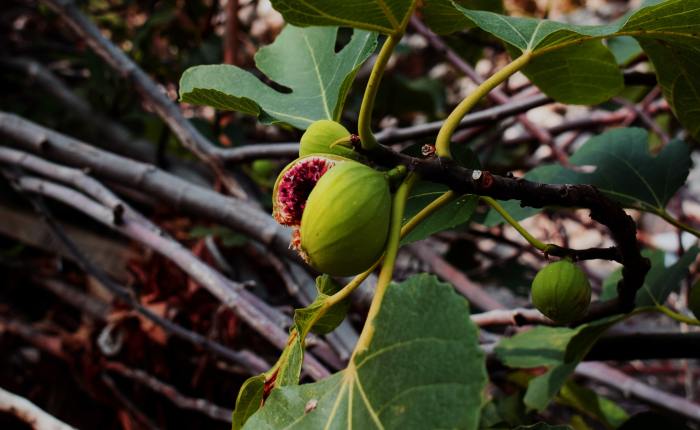
Though The Fig Tree Does Not Blossom

Though The Fig Tree Does Not Blossom

On one hand, I like to think of myself as rather mellow, a calm person who is generally unruffled. This seems true when I get to the end of the day and have no dramatic stories to tell. Instead of exhilarating experiences or woeful sorrows, I tend to have rather little to say about the day. In fact, sometimes it seems preferred when I arrive at the end of the day and there is no drama, good or bad, to recount. In these moments, I think I am a balanced, staid teacher who has completed her duties for the day.

Yet, on the other hand, I see that I can go through the gamut of emotions in a single week. I can feel frustration and rage at a student’s insolent response. I perhaps experienced sadness over a student’s hatred of the Church or a traumatic experience they have shared. Or maybe I have felt despair, a desire to give up and seek any other profession than the one I am currently in. In the course of a single week, I can plan for next year to be better and I can find myself searching random missionary positions or job postings anywhere else. I can be both sad to see my seniors graduate and uncertain if we will all make it to the end of the semester with our sanity and goodwill intact. It is in these moments, when I survey the emotional landscape of a preceding week, that I believe the calm affect is a total lie, one I tell myself in order to not pay too much attention to the ferocious swinging of the pendulum.

These experiences, of great, immoveable calm and tremendous swirling of feelings, cause me to wonder which is more me. Which one am I more truly? Or am I both? Are all humans simply both, some perhaps more one than the other? I think I’m steady, but maybe it is a steadiness born of fear to move. In a recent conversation with a friend, I was led to wonder what would make me leap into something new. If I refuse to move unless I know all of the answers, then I may always find it easier to be rooted.

My seniors have a sort of privileged position, even if wrought with uncertainty and stress. They must leap. Perhaps they won’t leap as far as they could, but they cannot remain where they are. We won’t take them back the following year and they cannot simply add another major as one could do in college. Next month, we will wrap up, wish them well, and then firmly close the door behind them, never to be opened in the same way ever again. Rarely does such a situation happen in life again and even more rarely would this situation be considered good.

They must leave.

And I?

Continue reading “Though The Fig Tree Does Not Blossom”

A Wintry Grace

A Wintry Grace

Snow has a way of making people live out the Golden Rule a bit better.

Perhaps this doesn’t happen for all five months of winter, but the first few snowfalls find my vehicular encounters with people more pleasant as a whole. People are more inclined to give extra space, wait for someone to pull ahead of them, use blinkers, and not honk when a car is sliding through the intersection with a clearly red light.

In short, we seem to naturally offer more grace to one another.

As I navigated the snowy roads a few nights ago, I was wondering why we find it more natural to be gracious in such situations, when normal driving conditions often bring out the frustrated side of humanity. Maybe it is because it is in our best interest to be gracious. Although the light may be green, it is clearly better for us to wait until the skidding car careens out of the intersection, rather than race toward it because the light indicates we can. Or maybe we don’t desire an accident and the headache that insurance claims naturally bring about.

But maybe, just maybe, it is because we are able to recognize a connection that goes beyond our personal best interest and draws us together as humans. The journey home in inclement weather gives me this feeling of unity that is similar to what I feel when an ambulance or fire truck or funeral procession passes by. For a moment, we are united by something that surpasses our personal desires and we acknowledge that someone else takes precedence.

Grace is often spoken of in relation to God’s free and unmerited favor toward us. While that is true and necessary, grace is also something we offer one another. The unmerited part is particularly difficult for us, though. Oftentimes, there is a natural sense of justice we have about what another deserves, but grace is giving people what they don’t deserve. We acknowledge what could be a fair response toward them and then we choose to be more generous than needed. And because it is freely given, that means it is a gift. In a moment of difficulty, we choose to bestow upon the other a gift they don’t deserve, but one which might cause them to change in some way.

Continue reading “A Wintry Grace”

A Life-Giving Intentionality

A Life-Giving Intentionality

In the first few weeks of school, I find myself swinging between this isn’t that bad and then suddenly falling into I’m not sure I can do this for an entire semester or an entire year. What I keep returning to is the knowledge that this year, perhaps more than ever, needs to be filled with intentional work-life balance and an abundance of good, life-giving things for me. It is always the desire and goal each year for those things to have a critical place and yet this year I think they need to be a desire turned into reality.

With everyone masked, I find myself trying to guess more and more what my students are thinking or how they are receiving the information presented. Not every student gives away their inner thoughts on their faces, but it certainly helps me know more about what is happening internally when I have an entire face to view and not simply a set of eyes.

I realize the same is true for them, too, when I re-watch videos of me teaching and I see how crucial the facial expressions were for the lesson. I don’t claim to have the most interesting face, friends, but the whole face is incredibly helpful when lecturing. Even though I was raised by a man who disciplined with his eyebrows, I cannot convey every emotion purely through raising or lowering my eyebrows. I attribute at least part of my excessive tiredness to this COVID-induced reality.

Continue reading “A Life-Giving Intentionality”

Birth and Death and Rebirth

Birth and Death and Rebirth

In March, before COVID became a full-blown pandemic, I ordered four icons from an Orthodox icon shop I’ve used in the past. They were able to ship two of the icons before needing to close their shop due to state restrictions and for the health of their employees. The other two would be shipped at a later date, as they were able to re-open and continue production of the icons.

When I got an email a few weeks ago, it said the icons were shipping and would arrive the middle of the next week. The situation was humorous since I had been home for weeks on end and during the one week of the summer I was away, the long-awaited icons were delivered to my doorstep, where they waited for my arrival a few days later. Of course, I exclaimed, to anyone who would listen to me, of course the icons arrive when I cannot be there to get the package.

A couple of days later, I learned of the death of a dear friend of the family. There are dozens of memories of my childhood and young adult life that I can return to and find this man filling the scene with his lively personality. He and his wife were friends of my parents. They were present for important sacraments and were the babysitters for my younger sister and me on occasion. Later, they were my bosses as I worked for them during the late-summer and fall. So many reflections on their frequent presence in my life and the unique role they had in relation to my family. Over the next few days, my family and I reminisced over the eccentricities and humor of our beloved friend.

When I returned home a few days later, I retrieved the package on my doorstep, grateful that it wasn’t damaged by rain or heat. I opened up my package and saw the two delayed icons.


The Raising of Lazarus from the dead


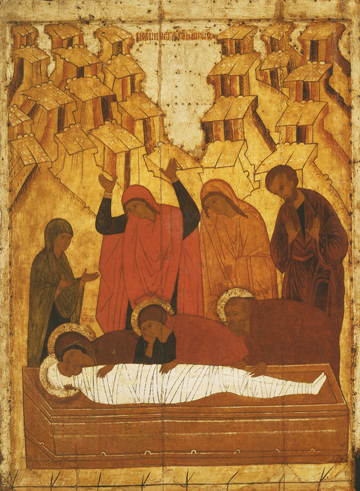
“Epitaphios”–an image of the body of Christ used in Orthodox and Byzantine liturgies at the end of Holy Week

Continue reading “Birth and Death and Rebirth”

Joy in Everyday Things

Joy in Everyday Things

Marie Kondo advocates asking yourself if the things that fill your house spark joy. While I don’t live her method, there is something intriguing about asking that question about the items that fill our visual landscape. Many things in my home don’t do that (I suppose I find it hard for spoons and forks to greatly spark joy in me—yet they are pretty useful for eating), but it is perhaps more interesting to consider the things that do fall into that category.

During the pandemic, I’ve spent a lot of time at home. But given this abundance of time at home, I notice that my affections continue to be drawn to particular things in my home and I find once again compelled to acknowledge that beautiful, practical (and impractical) items are so helpful for ushering joy into our lives.

For example, I have a wooden serving tray and it is perhaps odd the number of times I stop to admire the varying grains that run across and throughout the wood. Either as I’m arranging food on it or washing it off, I generally am thinking, “This is so beautiful.”

Or I have a serving bowl that was handpainted in Italy that I purchased last summer while in Assisi. The bright colors that fill the interior bring me a thrill of joy every time I fill it with salad or an array of fruit. As I use it, I frequently remember the peace of Assisi, the quiet of the streets during our time there, and the beauty of being in a place so old.

Continue reading “Joy in Everyday Things”

Only to bring him to life

Only to bring him to life

I am going to hold a pistol to the head of the Modern Man. But I shall not use it to kill him–only to bring him to life.

Innocent Smith in Manalive, GK Chesterton

The priest at Mass the other day posed the question: if it was possible to know, would you want to know when you would die?

As a melancholic, death is never too far from my mind and that isn’t necessarily a bad thing. While I don’t have strong feelings about the question one way or the other, I was thinking of some of the benefits of knowing when I would die, even if there is wisdom in not knowing. Sometimes, when death is clearly imminent, it compels us to truly embrace living. When our time is definitively short, we can move from passive existence to passionately experiencing life.

Is that type of wholehearted living reserved only for those who know death is at their door? Could I do that now? If people are able to live more when death comes close, could we just do now what we would do if we knew?

It made me consider how I would change my life if I knew the times of other events. Besides death, there are many other things that seem to be unknown yet shape how I live. For example, if I knew within the next year I would meet someone I would marry, would it change how I live? I believed that I would. What if it was five years, would that change how I live now? Yes, it would. What if I knew I would never get married? Again, yes.

And then I asked myself an important question: why?

Continue reading “Only to bring him to life”