Surprised by Grief

Surprised by Grief

Grief is a tricky thing.

I keep thinking this as the days and weeks have gently rolled by and yet I keep being surprised by it.

Several weeks ago, a man I knew from prison died.

Were we friends? Yes, in a way that I feel inclined to categorize in my head as “prison friends.”

There is almost no chance we would have known each other except for meeting in prison, life and circumstances being so entirely different for each of us. I never quite knew how many of his stories to believe or how to wrap my brain around his understanding of Scripture. I was often unsure what transpired inside his mind, as he would silently survey all and thoughtfully form an opinion which, if asked, would take several minutes to unfurl. How did all of his stories mesh together? What happened in the years he was silent about? How exactly did he end up where he did?

A mystery.

He was very much a mystery to me.

It was in prison that he chose to enter the Catholic Church. At a Saturday evening Mass, he was baptized and confirmed. In a place where touching between inmate and visitor is frowned upon, it was memorable to step up behind him and place my hand on his shoulder as he was confirmed. I prayed for the Holy Spirit to descend powerfully upon him and remain with him even while I also wondered why he picked me as his sponsor.

Over the years, we spent hours talking. He spoke more than I did, but he would remember to follow up about different things in my life about which I had shared. What I was teaching, what I was learning, the paper I was supposed to be writing. He’d share fantastic stories about his youth, about his thoughts on a passage of Scripture, about advice other guys would ask for, about observations about staff and inmates. There was always something formulating, fermenting, bubbling up inside of him.

So it is a bit striking for all of it to stop.

Suddenly.

A surprise death. One which lingered suspensefully for a few days as we sat in the “is he dead or isn’t he?” And even when it was revealed that, yes, he was dead, it was still unbelievable. A memorial Mass was offered and a visit to the gravesite occurred and yet it still seems unresolved. There was a statement from the DOC, a smattering of news reports, and an oversized pile of dirt in a small rural cemetery. But there was no body that I saw, no funeral pictures, no casket, no obituary, no headstone. Just enough to show that he was gone and little enough to force my brain to recognize how absolute it is.

Continue reading “Surprised by Grief”

The Father’s Beloved Son

The Father’s Beloved Son

This is my beloved Son, with whom I am well pleased; listen to him.

Matthew 17: 5b

As Jesus revealed His divinity at the Transfiguration, the three disciples with Him heard the Father speak these words. In much the same way as He operates in our lives, the Lord didn’t give them perfect understanding of why they were chosen, what this revelation might mean, or how this was intended to sustain them through the suffering to come. Yet this mountaintop experience must have been held closely to the hearts of Peter, James, and John as they followed Jesus down the mountain and heard Him command them to tell no one at that time. This experience of Moses and Elijah alongside a bright cloud, the Father’s voice, and the veil of ordinariness being lifted from the person of Christ must have been quietly mused over by the disciples.

Did they look at Jesus a little differently? Did they wonder if He might again lower the veil and reveal His divinity to more people? Whatever specific questions they pondered, I am certain this experience was often in their thoughts as they followed Jesus.

“This is my beloved Son, with whom I am well pleased; listen to him.”

In the moment, these words were likely easy to believe. They are on a mountain removed and the experience is all-encompassing, a dramatic sensation for all of the senses. This man who performed numerous miracles, spoke with wisdom and authority, and appeared driven and purposeful would be easy to see as one loved by God. Of course, they would listen to Him.

“This is my beloved Son, with whom I am well pleased; listen to him.”

Yet from this moment forward, Jesus walks toward the cross, enduring disdain and betrayal. In the agony in the garden, when Jesus asks for what is God’s will to be different than what is laid before Him, the disciples perhaps struggle to see Jesus as beloved or to recognize in this moment the Father’s pleasure. Jesus being arrested, handed over to the authorities, scourged, crowned with thorns: this is the love of the Father? The heavy cross laid upon His shoulders, the mocking and ridicule, the nails driven through His hands and feet: this is the Father’s pleasure?

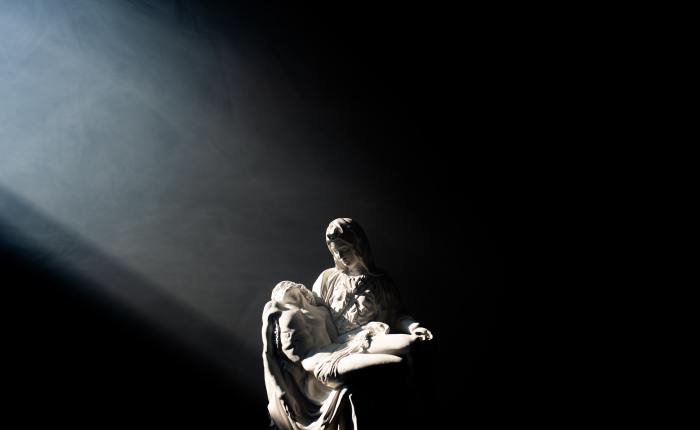
As Jesus is hurriedly laid in the tomb after resting in His mother’s arms, it is a bleak and despairing moment for the disciples. Do Peter, James, or John even remember the Transfiguration in this moment? Do they hear the Father’s words, “This is my beloved Son, with whom I am well pleased; listen to him“? Do they wonder now how they can listen to the Father or the Son? Do they wonder if they even want to listen if this is what happens to God’s beloved?

“This is my beloved Son, with whom I am well pleased; listen to him.”

Continue reading “The Father’s Beloved Son”

The One Longed For And Yet Present

The One Longed For And Yet Present

The longing of God’s chosen people fills the Old Testament.

For generations they are waiting for God to redeem them, to restore their nation, and to enter into a new and lasting covenant with them. They tell their children and their children’s children about His mighty works and the promises God has made to them. While they don’t know how these promises will be fulfilled, they trust that they will be.

I will call to mind the deeds of the Lord; yes, I will remember your wonders of old. I will meditate on all your work and muse on all your mighty deeds….You are the God who works wonders, who have manifested your might among the peoples. With your arm you redeemed your people, the sons of Jacob and Joseph.

Psalm 77:11-12, 14-15

For years I’ve viewed the birth of Christ as the end to their waiting and a fulfillment of their longing. All that they were waiting for was there, wrapped in flesh, lying in a manger. The King they were waiting for had come. We celebrate Christmas with that in mind: the Hope of the Nations is born and so we rejoice.

Yet this year I was filled with a recognition that one of the most important moments in human history happened and yet virtually nobody knew about it at the time. Similar to the quiet yet monumental yes at Mary’s Annunciation, the birth of Jesus took place in a relatively hidden way. Angels told some shepherds and wise men arrived from the east, yet as a whole, Israel was unaware of what was happening in their midst.

On the day after Christ’s nativity, they awoke….and didn’t know that anything was different than the week before. They still longed for a king and awaited the redemption of Israel. Yet He was there, the little King, already laboring to save them. When they gathered in the synagogue to pray, recalling the promises and the works of God, they did not know that the incarnate God was with them. As they provided work for St. Joseph, they did not know that it was the God-man who crafted and created alongside him.

Christ was living and working in the world and yet the world did not know it.

For thirty years, Christ was hidden. He lived the ordinary life of a son, a neighbor, a faithful Jew, and a carpenter. People laughed, worked, ate, prayed, talked, and experienced life with the God-man and did not know it. The One an entire nation longed for washed His feet to remove the dust, ate His mother’s food, and slept deeply after a day of laboring.

He was there, known and yet unknown.

Continue reading “The One Longed For And Yet Present”

Birth and Death and Rebirth

Birth and Death and Rebirth

In March, before COVID became a full-blown pandemic, I ordered four icons from an Orthodox icon shop I’ve used in the past. They were able to ship two of the icons before needing to close their shop due to state restrictions and for the health of their employees. The other two would be shipped at a later date, as they were able to re-open and continue production of the icons.

When I got an email a few weeks ago, it said the icons were shipping and would arrive the middle of the next week. The situation was humorous since I had been home for weeks on end and during the one week of the summer I was away, the long-awaited icons were delivered to my doorstep, where they waited for my arrival a few days later. Of course, I exclaimed, to anyone who would listen to me, of course the icons arrive when I cannot be there to get the package.

A couple of days later, I learned of the death of a dear friend of the family. There are dozens of memories of my childhood and young adult life that I can return to and find this man filling the scene with his lively personality. He and his wife were friends of my parents. They were present for important sacraments and were the babysitters for my younger sister and me on occasion. Later, they were my bosses as I worked for them during the late-summer and fall. So many reflections on their frequent presence in my life and the unique role they had in relation to my family. Over the next few days, my family and I reminisced over the eccentricities and humor of our beloved friend.

When I returned home a few days later, I retrieved the package on my doorstep, grateful that it wasn’t damaged by rain or heat. I opened up my package and saw the two delayed icons.


The Raising of Lazarus from the dead


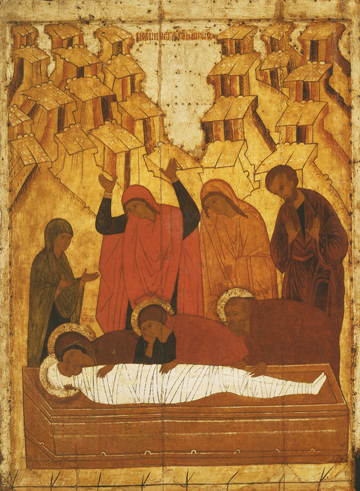
“Epitaphios”–an image of the body of Christ used in Orthodox and Byzantine liturgies at the end of Holy Week

Continue reading “Birth and Death and Rebirth”

Is the Good News Good?

Is the Good News Good?

St. Peter says to “be ready to give a reason for the hope that is in you” (1 Peter 3:15) but sometimes it seems the hope can get lost in a parade of rules. I asked my students what is the cause of our hope and after throwing out several answers, someone finally said the life, death, and resurrection of Jesus was the source of our hope.

“Do you feel like the Good News is good?”

They paused for a moment, almost seeming to sense there was a trick question they needed to skirt.

“Yes,” one student said.

“Why?”

This simple question seemed difficult for them. Someone replied, “Because it seemed like the right answer.” In fact, when I asked a later question (“Why does the Good News not seem good?”) they were able to respond with more answers.

When I go into the prison, so many of the men that come to the Catholic bible study or Mass are able to clearly point to their lives and say, “When I do my own will, I am not free.” It is a profound gift that the men in prison have that I think so many outside prison lack. The doctor, the teacher, the student, the politician, the bus driver, the plumber, the painter, the whatever can look like they have it together because they have some worldly success and their struggles might not be so apparent. The reality, however, is that we are all in great need of being saved. This crashes into the truth that the Good News is profoundly good, but it does require an acknowledgement that I cannot do it on my own.

Continue reading “Is the Good News Good?”

I Find God Here

I Find God Here

“Why do you come in here to be with us and teach us about Jesus when you could do that outside?” one prisoner asked during a meal on the prison retreat.

“I do teach about Jesus to people out there.”

“Why do you come in here?”

A few months ago, I would have said it was because my sister started getting involved in prison ministry. Or that I became interested when a priest I had known for a long time became the prison chaplain. Yet neither of those things really answers the question of why I keep coming back.

“Because I find God in here,” I said. “I guess it is actually a selfish reason.”

He looked at me, a bit taken aback. “You find God in prison?”

Continue reading “I Find God Here”

A Strength To Find Rest In

A Strength To Find Rest In

It was a late meal and before too long, my niece was soon battling sleep. Eventually, it overtook her and she laid with her head on the restaurant table while everyone else chatted and finished their meal. Then, my brother picked her up and carried her to the vehicle to go home. I don’t know if she slept through the entire trip home or if she simply acted like it, exhaustion keeping her calm and still.

Oddly enough, it wasn’t until the next day that I found myself pondering that scene. The similarities made me think of how my parents would often carry me from the car into the house after a drive home from somewhere. At times, I was really in a deep sleep and other times I just wanted to act like it. I would be partially awake as I heard the vehicle turn off, but I wanted to be effortlessly transported into the house. Once I reached a certain age, my parents would wake me up and I would need to enter the house on my own two feet.

What was so nice about being carried? Perhaps it was the sense of being cradled tenderly or the chance to be lovingly provided for even as reaching ages of independence. I’m sure sometimes it was just laziness, but it was probably most often the joy of resting in the strength of another. At six or seven, I wouldn’t have phrased it that way, of course. Yet if I look at the desires of the human heart, I am certain that was a central focus.

As an adult, we have to re-learn the art of resting in the strength of another. We often don’t want to be carried, physically or emotionally. The ease that comes with being carried in childhood often vanishes as we become adults. The sense of being carried starts to feel awkward and uncomfortable, like how it would feel if someone picked us up and carried us over their shoulder like happened when we were kids. We need to find anew the gift of resting in the Lord’s strength.

Continue reading “A Strength To Find Rest In”

What They Remember

What They Remember

My sister asked her if she ever had me as a teacher.  She couldn’t remember what class I even taught her, but she knew that she had.  My pride was wounded a bit at the idea that the hours upon hours I spent teaching weren’t memorable.  The question wasn’t what was the favorite thing I taught her, simply what class did I teach.

What she did remember was that at the end of the semester, I wrote every senior a card.  It was the only year I ever did that.  Apparently, that spoke louder than the arguments for God’s existence, Church teachings, and problem of evil discussions.   Continue reading “What They Remember”