In the Body of Christ, Your Healing Heals Others

Her response was something along the lines of, “It’s Jesus.  Of course He was doing something for both of us.”  Her certainty and lack of surprise seemed the opposite of my wide-eyed, wide-hearted realization of God’s perfect planning.

On a silent retreat, I found myself working through a painful memory I had with my sister.  I had tried a couple times during prayer to get to the root of it, but I seemed to get off course.  Finally, I was in the memory and I pictured Jesus there, too.  The pain of the moment eased and I saw things from a better perspective, one closer to what Jesus must have experienced.

Instead of recalling only my emotions, I began to see the situation as she may have experienced it.  “You are the Beloved of the Father,” I found myself telling her.

Then she said those same words back to me and a deep healing occurred in that moment.  Something wounded in me was restored by God, not through a conversation with my sister.

After the retreat, I decided to write her and tell her about that experience.  I didn’t go into detail and I didn’t explain how I had felt hurt.  I simply told her what transpired in prayer.  The next time I saw her, she brought up the letter.  She said my letter was the Lord’s response to her about something she was struggling with.  As she told me that the letter was good for her own heart, I was amazed.  Our Lord took that inclination I had to write my sister and He used it to speak to her heart in a way I didn’t know she needed.

My response was, “Woah.”  Hers was one of confident certainty that the Lord works in exactly that sort of way.

Sometimes the Lord takes the movements of our hearts and our own healing so He can use them to speak to others in a profound way that we never intended.

Sometimes my own healing allows others to experience the grace of God.

As fallen humans, we are always seeking to repair our fragile, little hearts.  But what a different perspective I have when I think of my healing being an avenue that God uses to love others.  Beyond the fact that God desires my own personal wholeness, He has a mission for me, one that requires me to seek healing for the sake of others, not just for myself.

In a way, the Church needs you to be healed.  Our personal healing is a service to the Church.

Souls need you to pursue holiness and wholeness because, though perhaps unbeknownst to you, God will use that renewal to encounter them.

The Mystical Body of Christ is a mysterious being.  God heals us for our own good and then seeks to use that healing to bring about restoration in others.  One that may rely in part on your “Yes” to Jesus entering into those wounded parts of your own heart, areas you don’t want Him to go, but which will truly revive your soul if you let Him.

Your own healing might be that catalyst for others to be healed or encounter God in a necessary way.  

And so He gently asks, “What do you want me to do for you?”  (Mark 10:51)

Your response?  Unlock that little room within your heart that you’ve walled away and invite Jesus into that place.  His healing, transformative presence will change you and that will change others.
Follow my blog with Bloglovin

The Grace of the Present

I’m not opposed to making memories.  As an introvert, I spend a decent amount of time inside my own head, thinking over what has or will transpire.  However, the other day I was scrolling through Facebook and I was seeing pictures and albums that were presented as “making memories.”  Do we prefer to make memories rather than live in the present moment?

Is something off if we spend a large amount of our time documenting for the future moments of the past?  Could it be that the present is not actually as great as we will remember it to be once it is firmly grounded in the past?

I’m sporadically reading One Thousand Gifts and the other day I read about how Ann Voskamp, the author, was struggling to encounter God’s face in the moments where she is stressed and angry.  Seeing God’s face in the brilliance of the morning sunrise or the contented cooing of a newborn is easy.  Yet it stretches us to see God’s face in a belligerent student or a quarrel with a friend.  As I read, I thought of how just that day I had been annoyed with my students not listening to my directions.  It never even crossed my mind to stop and consider, “How are they revealing God’s face to me right now?”

The present moment is the place where we encounter God.

We are making strides when we are able to go back to a difficult situation and see how God was present in that moment.  Yet it is supremely better to be able to, in that very moment, see the face of God present.  If only I could look at my students, complaining and upset about their work, and see Christ in them.  It would take re-training my mind and my heart.

In One Thousand Gifts, Ann Voskamp reveals an experience she had with her son that changed them both.  At one point in the conversation, she tells her son that the only way to combat feelings is to have other feelings.  The central feeling we can use to combat unwelcome feelings, she presents, is gratitude.  In the midst of frustration, fatigue, anger, sadness, or annoyance, what a difference it would make if we would begin to be thankful.  Not gratitude for something of the past or the future, but gratitude for that present moment.  What would it be like if in our most trying moments we saw the face of God in His perennial presence?  Surely it would change things.

If we spend our lives trying to simply “make memories,” I fear that the best moments of life will not be what we actually experience, but always events of the past.  I run the risk of sabotaging my present for the glorification of a past that never really existed.

When I look at my semester that I spent studying abroad, I don’t initially recall the tiredness, the inevitable frustrations of group planning, or the desire for American comforts.  Yet those were very real aspects of my semester.  I cannot expect my present moment to measure up to my idealized past experiences.

God is present in the here and now.  In this moment, despite the commonness.  In my quiet study hall on a random Wednesday.  In the lukewarm coffee I’m still enjoying from this morning.  In the satisfaction of checking another item off my to-do list.

This present moment is a moment of grace.  Because grace is only offered in the present.

I desire to teach myself to accept each moment as the grace-filled, soul-transforming, heart-deepening, wound-healing, saint-making, God-given moment that it is.  This present moment is where we encounter God.  Let us not overlook His presence in the now in an effort to live in the past.

Follow my blog with Bloglovin

A Heart Like His

When I was in high school, a Totus Tuus team would come to my parish each summer.  One year, on the night we were having Adoration, I thought about how the team would do the same program each week.  Each week they would have Adoration and I found myself thinking that it must not be that novel of an experience anymore.  If they did it week after week, they must get used to it and not be as excited as I was, since I rarely had the opportunity to go to Adoration.

Fast forward a few years and I was a member on a Totus Tuus team.  I realized how wrong my earlier assumption had been.  It was because I was closer to Christ that the night for Adoration seemed so much dearer to me than it had before.  No, it wasn’t a particularly new experience, but I yearned for that hour each week when I could just sit before Our Lord.

This memory came to mind because today in my sophomore class I showed a couple clips from “The Passion of the Christ.”  As Jesus carries the cross, there is a part where Mary is racing to reach Him as she recalls a similar incident that took place when He was a child.  My heart was aching with this dear mother and I found myself near tears.  Part of me thinks I shouldn’t have this response anymore since I’ve seen the movie several times.  Yet I think it is almost a requirement that as we draw nearer to the Lord, we develop more of His Heart.  He has a tender heart.  Sin makes us harden our hearts, but Jesus gives us new hearts, hearts of flesh.

 “A new heart I will give you, and a new spirit I will put within you; and I will take out of your flesh the heart of stone and give you a heart of flesh.”  (Ezekiel 36:26)

Hearts of flesh feel experiences more intensely.  I find myself wanting the heart Jesus has and yet being fearful of what that will entail.  My heart is already very sensitive at times, how would it respond to being more aware of the impact of sin in the world?  Could I handle a heart like His that would be vulnerable and open to all?  Wouldn’t I get wounded?

We fear being wounded.  Rightfully so, because it hurts.  Yet if we want to follow Jesus, we must carry our cross and live as He did.

And Jesus was wounded.  

His heart could truly love because it was truly open.  In my mind, I seem to imagine that Jesus had this loving heart that was also fiercely guarded, like the armor of a knight.  That is incorrect.  Jesus is the Divine Healer who allows Himself to be wounded for our sake.

The closer we come to the heart of Jesus, the more we will experience in union with Him.  Hearts of steel and stone cannot deeply love.  Jesus desires us to have hearts of flesh.  Hearts that can be wounded, but more importantly, hearts that can love and be loved.

Heart of Jesus, sanctify my heart.

Follow my blog with Bloglovin

Living Authentic Desires

What if I lived how I truly wanted to live rather than how I wanted to live right now?

Maybe there doesn’t seem to be a difference in those two versions, but in my life, sadly, there is.  I’m a bit dense.  It takes a while for things to sink into this head of mine.  While I often know what would be best for me, I take the easier path and attempt to satisfy deeper desires with more superficial things.

St. Paul understands this little heart of mine.  Perhaps it is simply a condition of humanity.  “I do not understand my own actions.  For I do not do what I want, but I do the very thing I hate.”  (Romans 7:15)  Even if what I’m doing isn’t sinful, it isn’t living up to the calling God has for my life.  I settle for mediocrity when I am called to be extraordinary.

Examples needed?  My life yields plenty of material.

I truly want to go pray.  I’ve thought about it several times in a given day and I know it would bring peace.  But I’m tired.  So I scroll through Facebook.

I want to go for a run.  But I’m tired.  So I take a nap instead, planning to go for a run the next day.

I want to spend some time reading a book.  But I’m tired.  So I watch a movie instead.

There are a couple trends that should be noted.
1. I’m tired so often.
2. While I know what I should do (and what would actually satisfy the desires of my heart more), I tend to opt for the path that requires far less of me.

Yet when I actually put aside my momentary desires and do what requires a little more effort or discipline, I am always amazed at the internal peace that occurs.

Instead of mindlessly scrolling through the internet, I go to adoration.  I’m far more pleased with myself (because even as I’m wasting time on my computer, there is a nagging feeling that I am not doing what I ought) and I feel a deeper peace because I did what my soul needed, I did what I actually wanted to do.

Sometimes what I want to do, isn’t what I actually want to do.  And sometimes what I don’t want to do, is actually what I really want to do.

It makes me wonder why following my own heart’s desires is so difficult.  Sadly, it is far too easy for the true desires to get overlooked by far more superficial, temporary wants.  On the drive home from the church, I was thinking, “What if I always lived so that I was actually doing what I wanted to do and what was best for me?”  My internal response?  “Huh.”  As though following my authentic desires was a novel concept.

Yet this is what the saints did.  They lived!  As saints they fulfilled the deepest, authentic desires of their hearts and did not succumb to the lazy wants that surfaced.

I could be such a better person if I followed my true desires (at times, genuine promptings of the Holy Spirit) instead of what I felt like doing in the moment.  I could be a saint if I did now what I knew I should do, instead of waiting for a later, more convenient time.

The path to sanctity is now.  And it is truly what I want.  So why not start?

“Do now- Do Now- what you’ll wish you had done when your moment comes to die.”   -St. Angela Merici

Follow my blog with Bloglovin

Their Eyes

I live for the moments when their eyes look like they did yesterday.  When I’m opening my heart because for a few moments it feels safe with a class, and their eyes are fastened on me.  I want to read the stories that are written there.  I want to profess my love for them even though it is all heightened and strengthened by the moment.  A few seem on the verge of tears, but all appear to grasp my sincerity and my desire to impart this knowledge to them.

I’m discerning on my feet if I should tell them about that powerful prayer experience I had a couple weeks ago.  And I do.  I talk about spiritual direction and share what I learned from it just the day before.

Maybe some are annoyed with my long preaching session, wondering if it is going to be required knowledge for the test.  But I cannot tell that those thoughts are running through their minds.  I can only see their eyes.  They are pools of experiences–hurt and joy.  And I desire to sit down with them and hear all the stories.  I don’t always feel that keen desire, sometimes I forget that their experiences are just as real as my own.

I’m trying to speak truth into situations that I do not know or understand, but I know they are in them.  Because I’m in similar situations.  It is part of the human condition.

The simple truth I desired to impart was this: Jesus knows.  He knows what it feels like to be in their shoes and to experience the pain they feel.  I spoke about how all of Jesus’ friends abandoned Him at the moment He most needed them.  He knows what it is like to feel betrayed and left alone.  He suffered for the sins and sufferings of the entire world, throughout all of history.  And He did this so that when we come to something that seems too much, He can tell us that He already passed through this, too.

And I asked them to find Jesus in the midst of it all.  How is Jesus loving you in this situation?  He is present in death, in their parents’ divorce, and in the betrayal of a friend.  He is loving us through every situation.

A priest pointed this out to me the other day–I told him I was seeking to see each experience as God trying to convert my heart and he included that each experience was God loving me.  How quick I am to shift the focus just enough that it distorts the image.  It is different to experience all as a means for my own conversion and quite another to see it as an avenue of His love.

“I don’t understand,” one student says.  “How can you find Jesus loving you in your parents’ divorce?”

And I don’t have a clear answer.  I can’t give them a Scripture passage or a Catechism reference to answer it nicely.  Instead, I must tell them that I don’t know how Jesus is seeking to love them in their difficulties, but I know that He is doing it.  That we need to open our hearts, to not pull back when we are wounded and to open them to the Healer.  I am speaking to myself as much as I am speaking to them.

Reminding them that Jesus is present in all, reinforces that belief in me.  All I’ve experienced He has already experienced and has thus sanctified the experience.  And each experience is a new way to receive His love.

All can be seen through the eyes of Love.

Follow my blog with Bloglovin

The Good Thief

Jesus said to his disciples: “Be sure of this: if the master of the house had known the hour when the thief was coming, he would not have let his house be broken into.  You also must be prepared, for at an hour you do not expect, the Son of Man will come.”  (Luke 12: 39-40)

Jesus compares His Second Coming to a thief coming at night.  As the Gospel was being proclaimed at Mass, I was struck by the phrase “he would not have let his house be broken into.”  Of the many ways Jesus could describe His Second Coming, He chooses at this time to say that He is like a thief who breaks into a home.  Obviously, the master of the house would want to protect himself against any thief forcing entrance into the house.  The immediate connotation is a negative one: be prepared so Jesus doesn’t break in.  What is the other option?

In John’s Gospel, Jesus is the Good Shepherd and also He is the door.  Entrance through His door means salvation.  But He mentions a thief and says that a thief doesn’t enter through the door but comes only to steal, kill, and destroy.  So is Jesus like a thief or is He a door?

What about if He is actually both?  Jesus stands at our hearts, knocking, gently persistent, asking for entrance into the deepest recesses of our being.  We choose if we open the door to Him or not.  He waits, patiently.  Yet there will come a day when waiting is no longer an option, when our refusal to acknowledge Him will come face-to-face with the reality of Who He is.

Will you open the door for Him?  If not, He will not be kept out and He will find a way in, like a thief, stealing through the chinks in our armor, stealthily slipping into the cracks in our fortress.  Yet if Jesus came to give us life, how could He also come to “steal, kill, and destroy” like a thief?  To us in the midst of our sinfulness, the act of taking away our addictions, habits, and struggles will seem like thievery.  It may seem like it is killing and destroying us to be stripped of that which we have made to be our personal god.  An experience of authentic self-denial can help us see the death that must occur when we have not opened wide our hearts to Christ.

He will break into our house.

That experience of a break-in will be unique, but He daily breaks into our world.  He isn’t hiding, but He isn’t forcing us to acknowledge Him today.  He is breaking into my world through the sky filling with a sunrise palette.  He is breaking into my world through the student who insists on keeping a ten-minute running commentary during a surprise fire drill.  He is breaking into my world by placing me in difficult situations I never thought I would have to encounter.

I can recognize His breaking in, or I can pretend like it never happened.  He can be a door or a thief.  Either way, He will enter into my life, it is simply a matter of method and perspective.

And so we strive to let the Good Thief in through the Door.

The One who persistently calls your name, knocks on the door of your heart, and ushers you into an abundant life.

He will come again whether it be His Second Coming on earth or at our death.  We will encounter Him in His glory and realize, with total certainty, who He is.

Do you want the Thief or the Door?

Follow my blog with Bloglovin

Free Will

Why free will?

I have a decent grasp theologically on the role of free will.  It is a necessary aspect of our humanity and God desired us to choose Him rather than to be forced into being with Him.

I wouldn’t have done it this way.

Which is yet another reason (if you needed one) that you can thank God that I am not God.

I am not that generous or that loving to create all of everything and then simply let them choose me or not choose me.  With all power and perfect knowledge, I think I would be a bit more forceful than God.

Currently, the Lord is allowing me to see how little power I actually have.  It should be simple for me to grasp it, but it is taking a while for it to sink into my dense brain.  I cannot make anyone do anything.  Even with the best reasoning, the most loving disposition, and gentle truth, I cannot push someone to do something they don’t want to do.  Or, at least, I cannot make them desire it.  The choice may be clear for me, but if it is not for them, then nothing I do or say can change them.

A brief survey of the culture and the world and I am mentally snatching free will from others, those who don’t use it correctly.  (Of course, I would be one of the first to admit that I would also need my free will revoked on many, many occasions.)  I think I am solving all the problems by removing the ability to choose the wrong.  The multiple choice questions seem to be tripping humanity up, and so I cleverly devise a test they cannot fail: choose A.  No questions, no other options.  Wouldn’t that be perfect?

Obviously, God had something else in mind.  What if it was better to give humanity choices, so that rather than all choosing A (purely for lack of another option), some would choose A because they desired it?  That must yield greater glory to God.  Not a mindless group of robots, but living, breathing, willing beings who follow God because they choose it.

Regardless, my heart still revolts against the reality that I can do nothing to make someone want something.  Perhaps this cardiac revolution is a good thing.  It can teach me that I am little and must always remember that.  It can teach me that my will is the only thing I can actually control and to seek to make it in complete accord with God’s will.  It can teach me that rather than constructing perfect arguments or dwelling in frustration, I can turn to prayer, something that slips beyond the bonds of time and is mysteriously used to further God’s plan.

The gift of free will is a mystery.  As a mere human, I cannot fully grasp why God saw it best to give these finite beings such a gift.

“Here the will of God is done, as God wills, and for as long as God wills.”  –St. Gerard Majella

His Human Heart

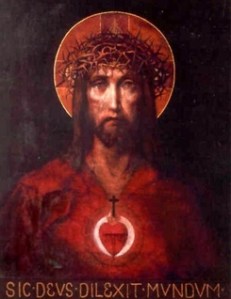
Jesus loves us with a human heart.

Human hearts are unruly things.  They don’t fit neatly into boxes.  They don’t follow the head as often as we may wish.  They can experience the entire gamut of emotions…in an hour.  They get conflicted, torn, bruised, inflamed, and expanded.

Human hearts can be fickle, quickly following the ebb and flow of the emotions one is surrounded by.  Yet they can be enduring in their sentiments, sometimes for far longer than we would wish them to be.

The hearts nestled within us are the great gifts that may appear to cause us the greatest of trials.  They feel heavy when we suffer or suffer with/for someone else.  At times, we may get frustrated with our responses, the spasm in our heart when nobody else seems to be impacted.

Jesus has one of these.  A human heart pumped Precious Blood through His veins and with that heart He loved.  He experienced anger when the temple was misused.  Jesus felt sorrow when He wept at the tomb of Lazarus.  He was compassionate and merciful to the sinful and the ill as they approached Him.

“He has loved us all with a human heart.  For this reason, the Sacred Heart of Jesus, pierced by our sins and for our salvation, ‘is quite rightly considered the chief sign and symbol for that…love with which the divine Redeemer continually loves the eternal Father and all human beings’ without exception.”   (CCC 478)

The Incarnation is the central point of Christianity.  We believe in a God who desired so much to encounter us, that He became one of us.  He didn’t send a mere messenger, He sent His Beloved Son, He came Himself.

We romanticize the earthly life of Jesus.  Of course life would be easy if we were God, we think.  And then we say that God couldn’t actually understand our pain or suffering, because He never experienced something like this.

He experienced it all.

No, maybe your particular situation is not one that Jesus found Himself in.  Yet on the cross He experienced the suffering of all humanity, in all its forms and intensity.  The “But You’re God” excuse only lasts for so long.  Yes, you have grasped His divinity.  Congratulations.  Now grasp His humanity.  It wasn’t a mask or a mere appearance, it is a reality.

His human heart beats.
I love you.

It aches for humanity.
Yes, I suffer also.

It remains present to us so that we might embrace Him in a deeper way.
“The Body of Christ.”

Your weary little heart needs to know that Christ has a heart like yours.

His heart is tender, vulnerable, open to love all.

This heart desires to dwell within you.

"After this He asked me for my heart, which I begged Him to take. He did so and placed it in His own Adorable Heart where He showed it to me as a little atom which was being consumed in this great furnace, and withdrawing it thence as a burning flame in the form of a heart, He restored it to the place whence He had taken it..."  -St. Margaret Mary Alacoque

Sacred Heart of Jesus, sanctify my heart.

Growing a "Yes" Within

Confession: I don’t always enjoy praying the Rosary.

In fact, I often avoid it because it takes me so long to pray it by myself and I want to spend my prayer time doing other things.  That might be borderline blasphemous to some Catholics, but that is honestly how I feel sometimes.

Last night, however, I decided to pray the Rosary.  I told myself that I could stop and pray with a given mystery if I felt drawn to it.  It was a minimal-commitment Rosary, if you will.

The joyful mysteries were the mysteries for the day.  I tried to mentally enter into the mysteries: what if I was Mary and experienced the Annunciation or needed to travel to Bethlehem for a census?  The interesting thing was that instead of Jesus being who was developing within me, it was a “Yes.”

Before prayer I had gone for a run and part of the time I was thinking, “Lord, help Your will to be my will.”  So as I reflected on these mysteries, I thought of this desire to follow God’s will as a “Yes” that is grown within oneself.  This “Yes” was what Mary spoke at the Annunciation–a “Yes” that took on flesh and entered into humanity, but a “Yes” nonetheless, one that she said with her whole self, every day.

The “Yes” does not lead to immediate results, however,  Mary’s “Yes” took nine months of quiet growth before it was born into the world.  Similarly, our “Yes” may not be evident after the first day.  It might take months to begin to show.  But when it does, it will noticeably transform us, even though it might remain hidden.  We might labor to give birth to this “Yes” with our whole selves.  But what struck me was the presentation in the temple.  Even after we have grown this “Yes” within us and labored for it to bear fruit, the results are still not our own.  We present the fruit of our “Yes” to the Lord to do with as He wills.  Nothing remains our own.

After giving ourselves to this “Yes” and presenting it back to the Lord, we might still struggle to understand and find this “Yes” in the confusion of our lives.  Mary had to seek after the “Yes” in accepting to become Theotokos–the God-bearer, she looked for Jesus in the temple, and she stood sorrowfully taking in this “Yes” hanging on the cross.  It was a “Yes” that filled her entire life, one of complete obedience to the will of God.

My reflection on the joyful mysteries of the Rosary filled me with a renewed desire to nurture this “Yes” within myself.  Not in one area of my life, but in all areas.  Without even thinking about it too much, when I imagined this “Yes” filling my life, I knew it would be accompanied by an undeniable and nearly uncontainable joy.

A “Yes” to the Lord involves sacrifice, that is true, but it leads us to a deeper peace and joy than only saying yes to our own will.  It fills us and gives true life.

But he said, “Blessed rather are those who hear the word of God and obey it!”  (Luke 11:28)

Running for Them

This might be premature, but I find it interesting that what has motivated me to take up running is teaching.  More specifically, my students.  “Take up running” means I’ve gone for four runs in the past week.  It could all fall apart very soon (definitely has happened before), but I think this might be here to stay for the time being.

A couple weeks ago I came to a realization: I don’t sacrifice for my students.  They come up in my prayers and I hope the best for them.  However, I don’t often find myself tangibly offering things up for them, other than allowing them to keep living after a particularly trying class period.

I’ve realized this lack of sacrifice before.  This time I was compelled to do something about it.  Running is something good for me and good for them.  I find myself thinking about them as I run and offering up my labored breaths for them.

Yet the more I run (think: slow jog), the more reasons I find to keep doing it.  I’ve run twice through my neighborhood and while I don’t like it as much, I think I might keep it up because it gives a new perspective and new prayer intentions.  I run past a home and I hear the muffled sound of a man and woman arguing.  Or I run around a bend and see two kids in front of a house, a larger pre-teen girl slapping the head of a smaller pre-teen boy.  The girl looks belligerent and the boy has his defenses up but is angry.  She glances at me and there are no more blows while I run by the house.

I find myself praying for peace as I meander the streets of my neighborhood.  This little heart inexplicably finds itself aching for situations I will never know about, fights I will never see, hurtful words I will never hear, but that are happening in these places so near to me.  I prayed for peace to flow through these houses.  For homes to be places of peace, not places where we take up arms against our flesh and blood.  For parents to show their children how to love.  For people to experience the love and peace of Christ that I have experienced.

It is not that much, and I should in all rights probably be doing far more.  But for now, I am running for my students.  For their addictions, depression, relationships, struggles, and hearts.  When I nearly convince myself to not go for a planned run, I remember them and realize I’m not doing it for me, but for them.  And it makes me run.