It doesn’t have to be perfect

It doesn’t have to be perfect

It doesn’t have to be perfect.

I’m sitting in my college Honors class.  The two hour class occurs twice each week and is entirely discussion based.  We are reading the classics and then we discuss them, seated in a circled with annotated copies of Western Civilization’s greatest works at hand.  I cannot bring myself to talk and I feel helpless as class after class passes and I say nothing.  The longer my silence goes, the more convinced I am that the first time I say something, it must be brilliant.  It must be perfect.  It must redeem the previous hours of silence.  But with such pressure, how can I ever speak?  After a class mid-way through the semester, one of my peers tells me that I have things to say, I just need to say them.  The perfectly sculpted answer never comes into my head, though.

It doesn’t have to be perfect.

It is my senior year of college and I am sitting in my boyfriend’s car.  It doesn’t matter what the question was that he had just asked me.  It wasn’t a one time occurrence.  He asks me a question and the little introvert retreats into her mind.  Maybe the question really required some deep thought, but sometimes it was just trying to come up with the perfect way to phrase my response.  Sometimes we sat there for fifteen minutes, the silence heavy and my brain actively trying to arrive at perfection.  I was asked to just say something and I found it difficult.  It needed to be just right.  It should be a perfect answer after twenty minutes of deep thought.  

It doesn’t have to be perfect.

But I want it to be perfect.

Twice over the past week it has been presented to me that it is alright that something is not perfect.  I am an idealist through and through.  While I live in this reality, my mind is often caught up in a world of what should be.  After a talk I recently attended, there was a bit of discussion.  One of the women who attended shared a bit of her heart with the group and one of the guys there responded to her.  There was an exchange of dialogue and then a couple beats of awkward silence, the group trying to transition to the next subject.   I found that the awkward transition bothered me.  My idealistic self wanted the conversation to flow naturally, for people to share their hearts and for everyone to respond in the perfect way.

It doesn’t have to be perfect, Trish.  

Humanity is a sea of imperfection.  I should be used to it: I’m a little pool of imperfection.  And yet I find myself wanting for things to play out as they do in the movies or in book: perfectly scripted where everybody knows their cues.  But it is fine for things to not be perfect.

Then I went to a retreat and there were a few times when people were able to share a little witness of what they had received in prayer.  When people got up to speak, I felt sorry for them if they seemed a bit nervous.  Yet I found myself internally willing them to not be nervous and hoping they would say everything perfectly.

It made me pause: what is my hopeless addiction to things being perfect?  I’ve scripted and re-scripted how I meet the man I will marry.  I look through food blogs and I pin recipe after recipe of perfectly photographed culinary delights.  I imagine running race after race to become perfectly in shape.

It doesn’t have to be perfect.  In the midst of someone’s suffering, some words spoken in comfort are far better than the nothingness while you seek for perfection.  When hungry, something adequate is far better than the perfectly pulled together meal that never happens.  When training for a race, the ugly flailing of limbs is better than waiting for perfection to spontaneously take root in you.

I am now beginning to understand the phrase that a dear priest would say repeatedly: if something is worth doing, it is worth doing badly.  So he was quoting dear G.K. Chesterton, but I will always think of him with that phrase.  And now I am getting it.  At the time I probably thought: wouldn’t it be best to do it well?  Of course, if one can do it well, they should do it well.  But some things, one must simply do, whether or not they do it well.  If the race is worth running at all, then I should do it, even if I do poorly.  If the class is worth teaching, then I should teach it, even if I don’t do it perfectly.  If the words are worth speaking, I should speak them, even if I fumble and don’t find the exact phrasing I want.

Chesterton and that dear priest were advocating trying, even if you failed.  That has not been my life motto.  Mine would be pretty close the opposite.  “If something is worth doing, think about it for a long time until you think you can do it perfectly, otherwise don’t do it at all because it might not be quite right.”  A bit of a different worldview, I would say.

I cannot advocate the absolute crushing of the ideals I have, but I can propose that the ideals should be remembered as something to strive for, not the intended starting point.  The goal isn’t to be imperfect, but it is impossible to plan to arrive at perfection immediately.  Instead, the reality of humanity must be taken into full account.  It is acceptable to stumble and fall along the way, as long as we keep getting back up and moving forward.  If I come to terms with the imperfection that is naturally within others, perhaps I can give myself greater permission to come to terms with the imperfection that is overflowing within me.  Instead of masking it, I could acknowledge it and then set about pursuing something more, something better.   

Reality isn’t perfect.  It is flawed, messy, and doesn’t follow a neat set of rules.  But it is what I have.

If life is worth living at all, then it is worth living badly while in the pursuit of something great.  And this little heart of my deeply needs to just live without the strain of perfection.  Jesus said His yoke is easy and the burden is light.  Being perfect is not a part of that easy and light.

I’m not perfect and I don’t need to be…yet.

Encounter

Encounter

“You’ll enjoy it.  You’ve been excited for this talk since you heard about it.  You don’t go out much…you really should go out tonight.”

This wasn’t me trying to convince a friend to go out.  This was me trying to convince myself to go out last night for a theology talk at a bar.  Shouldn’t be that hard of a sell except I have one little quirk: sometimes my introvert takes over.  Going to bed early or spending the night at home reading or doing some needed homework sounded like lovely alternatives to going out to talk to people.

Introverts like social interactions (humans are social beings…and introverts are humans), but it doesn’t take much for me to prefer a quiet evening.  Or at least just a few friends and not a potentially crowded room where I would engage in the ever-hated small talk.  But I did it.  I went.  Initially, I was annoyed that I was an introvert and it took so much convince myself to go out.  But, gradually, I forgot about it and enjoyed the evening.

When I got home, I listened to a voicemail from a friend and I had to laugh.  She was telling me about how that evening she went out to a party with co-workers.  For a couple days she had not been herself, but after an hour of talking to co-workers at a crowded bar, she left happier.  We’re both introverts and so we get the lack of desire to do social things sometimes.  But a question she posed in the voicemail resonated with me.  She said, “Why, Trish, why would going and talking to my co-workers at a crowded bar change things/make me happier?”  (I paraphrased it a bit, but that is the gist.)

My first thought was because we need community.  On our own, we can become isolated and it can be a bit miserable to be lost inside your own head.  But community brings us outside of ourselves.  I was grinning as I listened to my friend ask this question because I had just experienced the fruit of being with people.  It wasn’t that I was with my best friends or that it was the most fun I ever had.  Rather, it was the experience of the encounter.

What is amusing to me is that the talk I attended focused around the fact that Christianity is not a set of rules but is an event, an encounter with a person.  We are Christians not because we follow the Christian code of conduct (although Christ definitely asked us to live in a certain way and how we live does matter) but because we have encountered the person of Jesus Christ and have been changed because of it.  This encounter with Jesus can happen through our encounter with other people.  We experience the presence of God in a situation and it can seem magnificent, but it is acknowledging a truth that is constant: God is here with us.  He is dwelling among us.  We can find Him in one another, experiencing the same person of Jesus Christ even though He has the face of a stranger.

One of my Lenten goals/penances is to personally encounter my students more.  It is so easy to have them come in, sit down, ask the class a general question about their weekend, and then launch into the subject at hand.  And it is important to actually teach them something substantial.  However, I have a desire to know my students.  Small talk doesn’t come naturally to me, so I am making an effort to have a little conversation with different students.  Today, I talked to one of my quieter students who seems to just be slipping by in the class.  It isn’t that the grade is low, but the student seems to not have close friends or reach out to many people.  So we talked briefly.  She was one of the first ones in my classroom and we talked about her job that she was working at this weekend.  In the midst of this conversation (neither very monumental nor very deep), I was struck by the encounter.  It was something small, but it was something.  She didn’t bare her soul to me, but she shared something about herself that I didn’t know before.  We found something we had in common and we shared it with each other.

We are communal beings and in encountering each other, we can encounter Christ.  That is why a trip to a noisy bar with co-workers can transform us from glum to joyful.  It wasn’t where we went or even what we talked about or what we imbibed.

It was the encounter.

Tangible

Tangible

The Lord understands the need we have for the tangible.

We have a soul gifted with intellect and free will.  In this way, we share in the likeness of God.  Yet we also have bodies and this is no small part of who we are.  We are not to have a Puritanical mindset that declares the body is bad.  Our bodies matter.  This physical world matters.  And God reaches out to us in the midst of what we know and understand.

Over the past few days, I have soaked in the beauty of the tangible in the Catholic faith.  On Ash Wednesday, we have a cross of ashes inscribed on our foreheads.  We hear, “You are dust and to dust you shall return.”  Remember, remember the brevity of life.  It is hard to miss the symbolism–our bodies will return to dust, like the dust from which Adam was formed.  Our life is fleeting and we do not hold within ourselves the meaning for our own existence.  Civilizations and generations will return to nothing.  We are called to remember that our treasure should rest in something other than these earthen vessels, something that will survive time.

Even as we are told to look beyond the physical, the very means of this heavenly gaze is found in the physically tangible.  The black ashes that seal your forehead.  The words we hear that speak of the end for our physical bodies.  Physical signs point to spiritual realities and truths.

That evening I went to a funeral home for my uncle’s wake.  My four year old nephew wanted to touch my ashes and so I tried to keep him at an arm’s length.  When he saw me the next day at the funeral, he noted that the thing on my forehead was gone.  Sometimes kids have the appropriate response.  Familiarity leads adults to see the ashes as commonplace, but my nephew was intrigued by the smudge on my face.  In a way, he saw that the ashes said something significant.

At the funeral there were numerous tangible elements.  The body is reverenced in a way that might surprise us if we pause to think about it.  No longer is this the person we knew, but yet we bring the body into the church.  The casket enclosing the body is nearest the altar, as we hope that this person is nearest the throne of God, participating in the eternal Wedding Banquet of the Lamb.  We cover the casket with a white cloth, remembering their baptism into the death of Christ and into His everlasting life.  The pallbearers, an honor given to a few friends or relatives of the deceased, carry or follow the body from the church to the hearse and from the hearse to the grave site.  This isn’t a task relegated to people paid to help with the funeral, but rather is seen as an honor.  The importance of the body causes us to have a committal ceremony where we place the body into the ground.  We mark it and return to visit this place even though the body will return to dust and the person as we knew them does not remain.

Our physical body matters.  The physical world matters.  The Catholic Church has a beautiful tradition of keeping this in mind.  Whether it is investing in beautiful basilicas or commissioning great works of art, the Church sees the beauty in calling to mind the spiritual through the physical.  Other churches see it, too, but I would say the Church has a deeper understanding.  Weekly, we come together to be nourish by the Bread of Life, by the Body of Christ.  We enter a room or a box and we hear the words that declare that our sins are forgiven.  In entering the the mystical Body of Christ, we are plunged into water as a sign of the cleansing of our soul.

The Catholic Church is all about the incarnational.  Jesus Christ entered into the physical and the tangible.  Of course, we can say that God would completely understand human nature even if He never took it on because He is all-knowing.  But it adds a depth when we acknowledge that He chose to take on human nature so that His knowledge would be experiential and His experience salvific.  

By doing this, He shows us that holiness is pursued through the physical and the spiritual realms.  It isn’t only about the soul and deep meditative prayer.  It isn’t necessary to retire to a desert cave to live on little food and spend days in ecstasy, although He does call some to that life.  The Church has the spiritual and the corporal works of mercy.  It is not enough to admonish the sinner, we must also give drink to the thirsty.  It is insufficient to teach/instruct the ignorant (although important and, technically, my job) but we must also bury the dead.  In the Catholic tradition, we have the great both/and.  We are called to pursue the delicate balance of body and soul, both seen as important aspects of who we are as human beings.

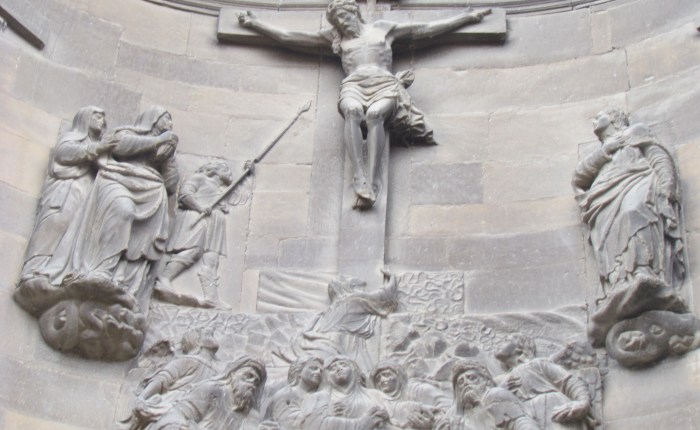
At times, we want to accuse God of being silent or distant.  We ask Him why He does not reveal more of Himself to us or why He requires such faith to believe in Him.  Yet He gives us many signs of His presence with us.  The sanctuary candle that burns in every Catholic church, indicating that the King of Kings is present.  A hand raised in absolution also involves a voice audibly telling you that all is forgiven.  The nearly scandalous declaration of love and sacrifice found in each depiction of the crucifixion.  We belong to a church that firmly declares that Christ walked with us yesterday and still walks with us today in a very concrete way.

God knows what we need.  We have one foot on earth and one in heaven.  And He meets us in both ways.  He is a God who is tangibly with us.  Emmanuel.  God with us.  Our foreheads have been sealed with ashes where we declare that we have sinned and that we are destined to return to dust.  He encounters us, mercifully, in that declaration.  We seek Christ in this desert walk, in these forty days of sacrifice.  How will we tangibly encounter Him?  How will our body and soul be in the union they were created to live in?  

Maybe Mercy

Maybe Mercy

What I really wanted to do was call the teenage girl out on her attitude.  Yes, I should have prepared better for class by having the questions printed out for them instead of having them write them out.  At this point, however, it was the end of the day and I didn’t feel like trying to convince my students why school required them to do schoolwork.

Instead of writing down the questions, this young lady was resistant.  Her face was one of annoyance that she would have to write down questions.

“Do we have to write these all down?”
“Well, I think you would want to.  You need to answer these questions over the movie we are going to watch and you won’t be able to see the questions when I pull the projector down.”
“So we don’t have to?”
“I guess not if you think you can remember all the questions and answers.”
“Cool.  I’m not doing it then.”

I was frustrated that something so little was seen as such a heavy burden.  She wasn’t the only one who was put out by this task.  As the students wrote down the questions, they would take time to heave a sigh or breathe deeply.

“I hear your sighs.”  I told them as I waited for them to finish copying the questions.

So while others were not enjoying the task at hand, this girl was the most vocal about it.  She has her days.  Some days she is bubbly and excited, calling me “girl” and sharing different stories.  Other days she has a bit of an attitude and looks unimpressed by nearly everything.  I was trying to decide how to handle her responses to me in the classroom.  Should I take her aside?  Should I give her a look?  How should I respond?

In the midst of my frustration, I remembered a personal detail she had written on an assignment at the beginning of the semester.  She wrote briefly of a family life difficulty and in that moment of her less-than-desired responses, I thought of it.  And I prayed for her.  I ask Our Lady to give me the patience to deal with this young girl who was struggling with things that I didn’t know or understand.  In a moment of clarity, I recognized her responses as being, at least in part, the fruit of inner turmoil and pain.  She was hurting and something she felt she had control over was complaining about a simple task in class.

I wish I could say that I have applied this merciful attitude toward all of my students all of the time.  I haven’t.  But it did make me stop and consider: why don’t I extend to those I meet the same mercy I would desire others to extend to me?  Of course, we all need to grow in not letting our emotions overrun us.  We strive to not take frustrations out on people who are completely removed from the situation.  But I know I have been unkind many times and what has brought me out of that rut before has been people looking beyond my ugly words or actions and treating me with kindness.

This brief interaction made me want to extend mercy, without being a doormat for my students.  Not everything in their responses is about my teaching or what they think of me.  Perhaps they just had a difficult test or a fight the night before with their parents.  It doesn’t make what they have said or done acceptable, but it can make them more real to me, people with hearts and problems, struggling to navigate the difficulties of life.

It was once again impressed upon me the need to pray.  I do not enter the classroom alone to fight in a fierce battle against teenagers.  Those would be rather bleak prospects.  Rather I go to them (hopefully) as a missionary and I go armed with the best of warriors–the universal Church.  Particularly during this year of mercy, wouldn’t it be wonderful if I could encounter my students and everyone I meet as a missionary of mercy?  How beautiful would it be if through an encounter with us, people could know that attribute of God in a deeper, fuller way?

Whoever Has Ears Ought To Hear

Whoever Has Ears Ought To Hear

What if St. Paul didn’t respond to God’s call in his life?

Too often, I assume that the saints would, naturally, follow God’s will in their lives.  I mistakenly believe that it was easy for them–of course they responded correctly, they are saints.

Now we hold them to be saints, but they were not always so.  They had free will and probably had many compelling reasons for not following God.  It probably seemed just as inconvenient to them as it does for us at times.

St. Paul is bound for Damascus and Jesus intervenes into his life in a very dramatic way.  The bright light, the physical blinding, and the clear voice all point to a powerful divine intervention.  “Saul, Saul, why are you persecuting me?”  What if, after this encounter, Saul instead returned to his original mission of hunting down the Christians?  In many ways, it might have appeared to be a better life decision.  Or he stops pursuing the Christians, but he doesn’t start to follow Christ.

Following his conversion, Paul goes off to immerse himself in the study of the Gospel.  Then, he presented himself to the Apostles and they were hesitant to accept him.  For a while, he is then considered a traitor by the Jews and someone not to be trusted by the Christians.  When he goes on his journeys to preach the Gospel, riots will frequently spring up as he evangelizes.  At one point, they pick up stones and hurl them at Paul, intent upon killing him.  Dragging him outside the city, they leave him for dead.  When his disciples surround him, he gets to his feet and continues preaching the next day.  In the end, he will be beheaded in Rome, a death he underwent since he was a Roman citizen.

The Lord gave St. Paul the grace of an indomitable spirit, but that doesn’t mean that each movement was filled with absolute certainty.  Perhaps some mornings, Paul woke up and was tired, not wanting to preach and be ridiculed yet again.  Maybe as his feet pounded over miles and miles of Roman roads, his heart was constantly uttering, “Lord, come again.  Lord, end this suffering.  Lord, take me home.”  In the spirit of St. Teresa of Avila, maybe St. Paul experienced the pain of being pummeled with rocks and as he pulled himself to his feet said, “Is this how you treat your friends, Lord?  It is no wonder you have so few.”  St. Paul was a dedicated and faithful evangelist, but that doesn’t mean the Lord surrounded him in constant reassurance or prevented any doubts from entering his mind.  The beauty is that Paul chose Christ daily, even when it seemed foolish in the eyes of his friends and family.

These thoughts about Paul came to mind when I started to watch a video about him in preparation for one of my classes.  The movie opened proclaiming what a great evangelist he was after encountering Jesus and the thought came to mind, “What if he didn’t answer that call?”  The realization was similar to when I realized that perhaps in Old Testament times, God called other people, but it isn’t recorded because they didn’t say “Yes.”  St. Paul had a free choice.  Although God revealed Himself in an undeniable way, it didn’t require St. Paul to choose to follow Him.

My students received the assignment to write an imaginative story about either being a traveling companion of Paul or being a villager in one of the places Paul preached the Gospel.  The goal of the writing was to consider how they would respond to his preaching and to think about what it would be like to experience those events first hand.  Scripture isn’t a nice storybook about events from hundreds of years ago, but rather it is alive and applies to us right now.  So the underlying question to consider is: how am I now responding to the compelling, radical message of the Gospel?

Familiarity with the message of Christianity makes it appear dull and commonplace.  Yet it is anything but that.  We preach of a God who loved so much that He entered into humanity so that He might pay the price to reconcile all of humanity with Himself.  All of salvation history is God reaching out to humanity and working with our “Yes” to bring about transformation.  God knows how we will respond but He never takes away our free will in order to get a “Yes.”  And even if He knows we will refuse, He still asks and offers us a chance to follow Him.

The beauty of the life of St. Paul is not so much that God called him.  God calls each of us to a unique mission that leads us closer to His heart.  The beauty of St. Paul’s life is that he heard the voice of God and he responded with zeal.  His fervent “Yes” opened the pathway for others to hear the Gospel and commit their lives to Jesus.  May we, in this world that is thirsting for the Gospel in all of its truth and radicality, present the beauty, truth, and goodness found in the message of Jesus Christ.  One that is compelling enough to sacrifice home, family, social status, and all worldly goods to pursue.

St. Paul responded wholeheartedly to God’s call in his life.  What if we didn’t?       

A Lesson in Snow

A Lesson in Snow

The evening air is cool, but it feels nice as I lean on my shovel and survey the path ahead.  I’ve been outside for nearly forty minutes and the end is in sight, but not as close as I would have liked.  At my house, we take turns shoveling the lovely snow and I thought it was unofficially my turn to do the honors.  A corner lot with long, long sidewalks make for an impromptu workout and time to reflect.  The front sidewalk is easy and I simply slide the shovel along, emptying it every few feet.  I turn the corner and it gets progressively more difficult.  Finally, I’m looking up the path, realizing that the sidewalk is inches below, under freshly laid snow as well as snow that has been crunched underfoot for days.  So I forge a path of my own, seeking to find the trace of civilization beneath nature’s blanket.

I pause again and it pops into my head.

Shoveling snow is like sin/bad habits–it is easiest to get rid of it right away, rather than wait and do it later.

I smile, wondering if any of the other evening-snow-shoveling-folks are theologizing as they scoop.

Admittedly, I like the reflection, though.  The front sidewalk was easy because it had been maintained and all I needed to do was take care of the most recent snowfall.  But the back sidewalk had been a bit neglected and getting it to the same state as the other required far more work.  Ice needed to be chipped and compacted snow had to be disposed of.  It was work that wouldn’t have been needed if it had been taken care of the first snow.

The same thought can be applied to the spiritual life, particularly in regards to cultivating good habits.  What if when I noticed myself doing something I didn’t like or was bad or was not going to help me grow in my life, I would immediately correct it?  Instead, it is easy to say it isn’t that big of a deal and continue until it becomes a habit.  Then we realize we need to take action, but it is no longer just a tendency or inclination but an ingrained habit.  So we go to work: we chip away at it and look longingly down the path to the time when this flaw can be behind us.

What if we got to work on those little things right now so that later on we wouldn’t have to pour more energy into them?  What if we worked so that little things could simply stay little?  Makes a bit too much sense, probably.

It would mean combating laziness with productive work and using my time well.  Not planning to work on laziness later.  Instead of thinking, “Yeah, I probably should do something else rather than peruse Facebook (again) or watch another movie” and then justifying said behavior anyway, I would get up and go: pray, take a walk, go for a run, read a book, clean my room, lesson plan, grade papers, etc.  This goes back to the whole mentality of sacrificing the easy thing in the present to do what I actually want to do, things that bring me life and fulfillment.

Yet another goal and way to grow in my daily life discovered.  Instead of waiting to tackle little problems or flaws, I should enter into the skirmish now so there doesn’t need to be a full-out war later.

From one person on the frontlines to another: let’s get to work.

Not Too Holy

Not Too Holy

“I want to be good!  I want to be good!” my nephew exclaimed a couple years ago, near tears.  He had been caught, doing again, what we had recently instructed him not to do.

“Then be good!” I replied.

It seemed simple.  We were very specifically asking him to not do something and he would go and do it again.  It was amusing, though, to hear those words come from him–a proclaimed desire to be good while yet desiring to do the same things again and again.

Don’t we wish we could say that was a problem simply for the young?  Too often I am encountering the Lord saying, “I want to be good!” yet lacking the desire to do what is necessary to be good.

“If you will look into your own heart in complete honesty, you must admit that there is one and only one reason why you are not a saint: you do not wholly want to be one.” William Law

The first time I read this quote, I was a bit surprised.  I found myself wanting to argue but all arguments dying within myself.  It is true.  If I truly wanted to be a saint, I would be one, or at least I would be far closer to one than I am right now.  God’s grace is sufficient: what is lacking must be found in my own desire and willingness to receive His grace.

There is a healthy sadness within myself when I admit that the plan God has for my  life does not match up with my own desires.  I say I want to be a saint, but my actions have a voice that speaks to the contrary.  Because being a saint does not mean to strive to be better then most.  It doesn’t mean to work so that others think you are saintly.  The quest to become a saint is one of the few things in life that cannot be determined by your placement to others.  Even the witness of other saints, while inspiring, cannot tell you if you are the saint you are called to be.  If Bl. Teresa of Calcutta spent her whole life comparing her mission to that of St. Therese of Lisieux, she would have missed the mission to which God was uniquely calling her.  We, too, will get confused if we routinely use others as a measuring stick for our own holiness.

Unlike a credit score or an ACT score, being a saint isn’t boiled down to being in the top 10%.  In high school, it felt like I was one of the only ones who cared about my faith.  I would look at the choices my classmates were making and I would see the choices I was making.  I knew I wasn’t perfect, but I felt pretty good in terms of faith.  And people seemed to recognize that I valued my faith and thought of me accordingly.  When I got to college, I was surrounded by people who were deeply invested in their faith.  I had good formation from my parents, but I remember freshman year looking around and thinking, “Oh, no!  I’m way behind!”  While I was coasting in high school (feeling like I was the only one who cared), these people were going deeper in their faith.  It was a good wake up call, but I was still dealing with it in terms of where I ranked in comparison to others.

In many ways, I am still fighting that battle.  Sometimes I find myself wanting to not get too holy.  It honestly shouldn’t be a concern of mine, because that is a distant dream, but I understand why I think that way.  The closer one gets to Christ, the more one realizes the failings of this world.  The more we act like Christ, the more we run the risk of making others uncomfortable.  What if I get too holy and just being myself makes other people uncomfortable?  I bet some people left dinners early when Jesus would show up.  “Ah, there’s that guy.  Something about him makes me feel uncomfortable.”

Instead, I find myself wanting to be “just holy enough.”  Holy enough that I’m following God, but not so holy that others really notice.  Not so holy that I actually suffer for it.  I want to be called and chosen to live a life of sanctity, but one that makes me well-liked and a perfectly balanced introvert-extrovert.  Oftentimes I romanticize sanctity and assume it means that there will be no problems other than surrendering to God’s will.  People will be wonderful, beautiful beings and my encounters with them will be filled with a gushing of God’s love.  Isn’t that silly, though?  I seem to think holiness will make life easy.  Jesus, however, speaks of picking up a cross and following after Him.

I have several reasons that I am not yet a saint.  One of which is because I fear the persecution and loneliness that will come from selling all my pearls to buy the one of great price.  I worry that putting God in an undeniably central place in my life will make other people step away.  And if you ask me if I think Christ is sufficient, I will say, “Yes, Jesus will fulfill all my wants and desires.”  Yet if you ask if I live like I believe that, I must admit I do not.

I want to be good.  I want to be a saint.  But I do not want it entirely.  Otherwise, this holiness thing would be far closer to being a reality.  If I compare myself to others, I will always be able to find a reason to justify my present state, there will always be motivation to say I’m good enough.  But if I use the correct measuring stick, then I will always see the need for growth.  If I ask, “How closely do I conform my life to the cross of Christ?” I will see the areas of disparity.

Clearly, I am not “too holy.”

Litany of Humility
O Jesus! meek and humble of heart,
Hear me.
From the desire of being esteemed,

Deliver me, Jesus.

From the desire of being loved…
From the desire of being extolled …
From the desire of being honored …
From the desire of being praised …
From the desire of being preferred to others…
From the desire of being consulted …
From the desire of being approved …
From the fear of being humiliated …
From the fear of being despised…
From the fear of suffering rebukes …
From the fear of being calumniated …
From the fear of being forgotten …
From the fear of being ridiculed …
From the fear of being wronged …
From the fear of being suspected …

That others may be loved more than I,
Jesus, grant me the grace to desire it.

That others may be esteemed more than I …
That, in the opinion of the world,
others may increase and I may decrease …
That others may be chosen and I set aside …
That others may be praised and I unnoticed …
That others may be preferred to me in everything…
That others may become holier than I,
provided that I may become as holy as I should…

Hope’s New Life

Hope’s New Life

There is that lovely feeling rising up in my heart.  It is refreshing and enlivening.

What is it?

Hope.

The promise of something new.  The promise of change.  The desire for tomorrow to surpass what was done today.

Yet how quick I am to fade from hope back to disillusionment or despair.  The feelings I have that encourage change and a new direction are simply feelings: temporal, passing, ephemeral.  I made a list of dreams I want to have fulfilled in 2016 and get excited, yet within a couple days I’m ready to settle.

What I need instead is the virtue of hope, something that actually lasts.

“The virtue of hope responds to the aspiration to the happiness which God has placed in the heart of every man; it takes up the hopes that inspires men’s activities and purifies them so as to order them to the Kingdom of heaven; it keeps man from discouragement; it sustains him during times of abandonment; it opens up his heart in expectation of eternal beatitude.  Buoyed up by hope, he is preserved from selfishness and led to the happiness that flows from charity.”    –Catechism of the Catholic Church 1818

A few months ago, I had this intense feeling of hope.  It didn’t make sense logically because what I hoped for was nowhere in sight, nor did it seem to be soon in coming.  The feeling was so strong, though, that I knew it was from the Lord.  Yet I also knew, from past experiences, that sometimes the Lord will provide an abundance of something for me because in the near future, there will be a seeming lack of that very thing.

When I started sidewalk counseling outside an abortion clinic in Pittsburgh, I was filled with overwhelming joy and peace after the first three times.  It was strange because I had prayed there for a couple years and never felt those emotions so intensely while there.  The Lord was giving me the reassurance I would need when those feelings subsided.  And they did: when the joy and peace were absent, I felt the closest I’ve ever been to depression.  I ached and felt hollow within.  If it wasn’t for those weeks of intense joy when logically I should have felt sorrow, I might have quit sidewalk counseling.  I didn’t because I knew the Lord had convinced me of my course of action through consolation.

So a few months ago, when I felt this overwhelming sense of hope (or, as I called it at the time, “joyful anticipation”), I was thankful for that gift from the Lord, yet also a little concerned for what might be ahead.  “Thanks, Jesus, for this wonderful joyful anticipation.  I love this feeling.  But…what is going to happen later?”  The hope lingered and I basked in it.  I told myself to remember this intensity of hope because it would pass, as all feelings do.

And they passed.

I found myself wishing I could quit life for a while and simply step out of the day-to-day grind.  I wanted the Lord to deliver His promise now, because I wanted it now, not later.  With the feeling of hope absent, the future no longer seemed quite as bright and cheery.  I was left wondering if I hadn’t made it all up.  Yet when I thought about what I had felt, I could still feel this deep certainty that it was true.  The thing hoped for is not yet a reality, but I know the Lord will remain true to His promises, even if I must wait.

True hope is not a feeling that comes and goes, depending on the day.  It is steadfast and enduring.  Hope persists when logic and appearances suggest that it is fruitless.  It is what the Israelites depended on as they waited for their long-desired Messiah.  It is hope that led the three wise men to journey miles in anticipation of a king preceded by a star.  As the early Christian martyrs were led to their deaths, it was hope that enabled them to look with love at the very ones who wielded the sword or the stone or the nail.

Hope isn’t a different perspective to have on life: hope is to have a new life.

“The one who has hope lives differently; the one who hopes has been granted the gift of a new life.”   —Spe Salvi, Pope Benedict XVI

2016 will not be the year that my life becomes perfect or where I will magically change into the person I always wanted to be.  But I do want this year to be one where I am honestly pursuing the best for myself and where the Lord’s will for my life is done more completely than ever before.  I want to read twenty-five books, learn about the constellations, travel to two new states, and many more things.

Primarily, though, my hopes rest in the Lord.  I want to venture into 2017 knowing the Lord in a far deeper way than I do right now.  I want to enter tomorrow with a deeper knowledge and love for Jesus.  I am not promised tomorrow.  All the things I long for and hope for in the future, may never be mine because I may not live to see that day.  But I am here now, and that is where the Lord desires to meet me.

“Although I have lived through much darkness, under harsh totalitarian regimes, I have seen enough evidence to be unshakably convinced that no difficulty, no fear is so great that it can completely suffocate the hope that springs eternal in the hearts of the young.  You are our hope, the young are our hope.  Do not let that hope die!  Stake your lives on it!”   –St. John Paul the Great, WYD Toronto 2002

This year I am embracing this hope that springs eternal in my young heart.  I am taking this hope and letting it lead me into change (though it be difficult) and into newness of life.  Hope, for the Christian, isn’t optional, it is operative.

I need hope.  Not passing feelings, but real, life-sustaining, time-enduring, source from which my actions flow hope.  Anything less is insufficient.

“My soul is waiting for the Lord, I count on his word.  My soul is longing for the Lord more than watchmen for daybreak.  Let the watchmen count on daybreak and Israel on the Lord.”  (Psalm 130)

George Bailey

I never really associated myself with George Bailey.  “It’s a Wonderful Life” is a classic movie, but I’ve always viewed it as a movie, not something that seemed to speak into my own life.  A couple days ago I re-watched it.  Apparently, the wanderlust desire to see the world and do incredible things is more an aspect of the human condition rather than my generation.  So I watched the classic film, shed some tears, and realized that the longing George Bailey had was fiercely beating within my own heart.

I’m shakin’ the dust of this crummy little town off my feet and I’m gonna see the world. Italy, Greece, the Parthenon, the Colosseum. Then, I’m comin’ back here to go to college and see what they know. And then I’m gonna build things. I’m gonna build airfields, I’m gonna build skyscrapers a hundred stories high, I’m gonna build bridges a mile long…

As high school neared its end, I was never one of the students who couldn’t wait to get out of the small town.  It just happened to be that I chose a school hundreds of miles away from home and was only able to come back for Christmas and summer breaks.  When college was finished, I moved back home because moving far away for a job seemed strange to me.  Now I’m in my fourth year of teaching high school and I live about thirty minutes from where I spent my childhood.

Young adult life is filled with many different experiences, but I keep coming back to a desire to pursue greatness, a desire that filled George Bailey his entire life.  He wanted to see the world, to travel, to build structures that will last years, and to pursue adventure.  Yet he ends up spending his life in Bedford Falls, a seemingly idyllic town that feels like a prison if one doesn’t want to spend the entirety of one’s life there.

Any place can feel like a prison, though, if one is constantly desiring to be elsewhere.  The greatness found in the little and the simple can be overlooked so quickly.  St. John Vianney would spend hour after hour in the confessional.  Looking at his life from my vantage point, I can see how much fruit his life of simple faithfulness bore.  Yet in that moment of waking up early to say Mass and then spend the whole day in the confessional, he might not have felt this aura of greatness surrounding himself.  St. John Bosco rallied together the poor street children from Turin and taught them how to be men.  In the daily grind of loving them in the midst of their flaws, he might not have recognized the monumental work he was doing.

And I teach.  It isn’t much.  My younger sister was watching “Freedom Writers” with me and she said each time she watched the movie, she thought of me as the teacher.  I am laughably not like Mrs. Gruwell.  I’m not taking on extra jobs to buy supplies for my students or going to bat for them against a racist administration or devoting all my time to helping them graduate from high school.  There are many teachers who spend hours with their students after school as they guide them through problems (academic or otherwise) and leave this deep impression on their very beings as an adult who cared and sacrificed for them.  I am not that teacher.

During finals, one of my students walked into my classroom with a card.  She told me she was giving me this card because she was thankful that I would go over the study guides with her before tests.  All I did was spend fifteen to twenty minutes after school with her the day before the test to review her answers and go over any questions she had.  But the gesture she made was worth ten cards.  Hidden within that quiet exchange, one done without any fanfare or balloons, was the greatness I am seeking.

Greatness is found in the simple, in the little.  I’ve written about this before.  I write about it again not to convince you, but to convince myself.  As a teacher, affirmations are few and far between.  Even if administration affirms your work, you want to hear it from those you spend day after day with.  Students are unaware how powerful their words are about their teachers.  I don’t need their support or affirmation, but I love it when I receive it.  It means something is sinking in, something is being passed from my soul to theirs.  I don’t have state standardized tests to rely on as a Theology teacher.  I want to know if they know the Lord, rather than if they can ace my tests.  That is when I know that I am successful.

George Bailey wanted a blazing kind of greatness, one that tears through towns and astounds people.  What he finds instead is the greatness of enduring friendships, believing in the dreams of others, helping others pursue human dignity, and building a family that bands together.  A greatness that his father pursued in that very town.

There is greatness in simplicity.  There is simple greatness.  There is unassuming greatness.  Perhaps greatness is found not in doing wild things or going to exotic places but in doing what you do to the best of your ability.  Maybe greatness is simply living your own life well, even if you remain unaware of the impact it makes on the lives of others.

Pa Bailey: I know it’s soon to talk about it.
George Bailey: Oh, now Pop, I couldn’t. I couldn’t face being cooped up for the rest of my life in a shabby little office… Oh, I’m sorry Pop, I didn’t mean that, but this business of nickels and dimes and spending all your life trying to figure out how to save three cents on a length of pipe… I’d go crazy. I want to do something big and something important.
Pa Bailey: You know, George, I feel that in a small way we are doing something important. Satisfying a fundamental urge. It’s deep in the race for a man to want his own roof and walls and fireplace, and we’re helping him get those things in our shabby little office.
George Bailey: I know, Dad. I wish I felt… But I’ve been hoarding pennies like a miser in order to… Most of my friends have already finished college. I just feel like if I don’t get away, I’d bust.
Pa Bailey: Yes… yes… You’re right son.
George Bailey: You see what I mean, don’t you, Pop?
Pa Bailey: This town is no place for any man unless he’s willing to crawl to Potter. You’ve got talent, son. I’ve seen it. You get yourself an education. Then get out of here.
George Bailey: Pop, you want a shock? I think you’re a great guy.

Being the Adventure

“Someday, I want to be the adventure someone chooses.”

The words resonate in my heart, even though I’ve never quite thought of it like that.  My friend is telling me that she has encouraged men she was interested in to pursue their dreams.  Yet what she really wants is to be the adventure they choose to pursue.  I hear her ache and I feel a similar one in my own heart.

We are millennials.  In many ways, I do not believe I fit into my generation.  However, in this regard, I do: I desire greatness.  I do not mean that I long to be recognized or praised in front of all.  Nor do I want empty words of admiration or platitudes repeated just to satisfy a longing to be great.

No.

I want to contribute, in some meaningful way, to society.  I want to leave an impression.  I want to fill a need.  I want to embrace adventure and travel and see new sights.  I want to feel the exhilarating rush of being absolutely, irrevocably alive.  I don’t want to do this by getting high, imbibing too much alcohol, or living a way that is less than I am.  I want to live fully my humanity.

At times I feel like I haven’t done much in my twenty-something years of living.  And by some standards, I haven’t.

I have:
-graduated from high school
-graduated from college (and completed English and Theology theses at 20 pages each)
-studied abroad
-gone on three mission trips, leading one of them
-been a small part in saving at least one child from abortion during my time sidewalk counseling
-been a Confirmation sponsor for two people and godmother to two others
-been published in two newspapers and a college student publication
-traveled to: Mexico, Canada, Honduras, Ireland, Northern Ireland, Scotland, Spain, Portugal, France, Switzerland, Germany, Poland, Austria, Czech Republic, Italy, Vatican City, and 32 of the states in the US
-successfully taught high school for 3.5 years
-walked El Camino de Santiago


Yet despite these “accomplishments” I am left longing for more adventures.  Namely, the adventure of marriage and family.  The person I immediately turn to when thinking of marriage as an adventure is the ever-endearing G.K. Chesterton.

The supreme adventure is being born.  There we do walk suddenly into a splendid startling trap.  There we do see something of which we have not dreamed before.  Our father and mother do lie in wait for us and leap out on us, like brigands from a bush.  Our uncle is a surprise.  Our aunt is, in the beautiful common expression, a bolt from the blue.  When we step into the family, by the act of being born, we do step into a world which is incalculable, into a world which has its own strange laws, into a world which could do without us, into a world that we have not made.  In other words, when we step into the family we step into a fairy-tale.

So my dear Chesterton would tell me that I am already living the supreme adventure: I have been born into it.  I would argue with him (since it is often my nature to be non-compliant) that my current life is not the familial adventure he speaks of since I am in the “in between” time.  I have a house but it is rented.  I live with friends and not a family of my own.  It is good, but not what I long for.  Perhaps he would agree with me in these points.  In this hypothetical argument, he might remind me that marriage, for all my silly idealism, is not perfection.  He might say this:

When we defend the family we do not mean it is always a peaceful family; when we maintain the thesis of marriage we do not mean that it is always a happy marriage.  We mean that it is the theatre of the spiritual drama, the place where things happen, especially the things that matter.  It is not so much the place where a man kills his wife as the place where he can take the equally sensational step of not killing his wife.

I remember the look of confusion and a bit of shock on my mom’s face when I read her that quote once.  But isn’t it true?  Sometimes the more sensational thing is two human beings, undeniably different even if undeniably in love, not killing each other.  Clearly, Chesterton was a married man.

However, I do not wish to simply quote Chesterton all day, though I love his writings even if I haven’t read many of them.  Rooted deep in the hearts of modern man, I believe, is the desire to give entirely of oneself, wholly and without reserve or end.  This is the longing for marriage.  The desire we have to be the adventure that someone else undertakes.  What adventure (apart from that of pursuing God) could be greater than looking at another human being and saying, “You.  I choose you and only you forever.  I choose to journey through life with you, come what may.  I choose your heart to pursue and cherish always.  And I know time will change us.  In ten years, you will not be the same person I married.  But I will still choose you.

It is the nature of love to bind itself, and the institution of marriage merely paid the average man the compliment of taking him at his word.

As much as this millennial longs to do all kinds of things and pursue all sorts of adventures (pilgrimage to the Holy Land, run a half marathon, go to jail for a night*, or fly a plane), I long for the simple adventure of a home and a family.  In many ways, my desires are not so adventurous or dramatic after all.  They are little things, daily things.  The adventure of simply being the adventure.

The old-fashioned Englishman, like my father, sold houses for his living but filled his own house with his life.

*Naturally, when I say I wish to go to jail for a night, it is with the idea that I went standing up for something I deeply believe in.