Preparing the Altar

Preparing the Altar

Since my homeward journey from work has construction, I have been obligated to seek different routes over the past few weeks. Either as a result of the construction or simply how it always is, I find myself waiting in more traffic in parts of town with which I am not as familiar. One road with a bit of traffic has a few places where people often turn and so I try very hard to watch the lights and the movement of traffic in order to not be that person who annoyingly blocks intersections. I get a bit embarrassed when we wind up in completely stopped traffic and a person who could turn cannot because I’m blocking the route.

The other day it worked perfectly. The car next to me knew what they were doing and so when the light turned red, we held back and left plenty of space for vehicles in the opposing lane to turn through and carry on their way. It was nice to be next to a car that was completely stopped, not inching forward or worried that they might be a second delayed or inconvenienced. The light turned green and no cars had yet moved forward, but the car behind me honked and, when I glanced in my side mirror, gestured impatiently for me to go.

I felt a flash of anger. The injustice of being honked at–couldn’t they see that I was letting people through? I perhaps moved my arm upwards with a fling of annoyance. Then I accelerated and was no further behind the next car than if I had been inches from their bumper the entire time.

Once the anger passed, I kept wondering why the person was so impatient. The traffic was all still there. I wasn’t mindlessly on my phone. The second the light turns green doesn’t mean that the 5th or 6th car in line should expect to be moving. Why are we so impatient?

We don’t like to wait. We don’t want to feel like we are getting left behind. We don’t want to feel like our time is wasted or that progress could be made but isn’t. We don’t want to be pointlessly sitting at a light waiting for the people around us to get their act together. And I don’t think any of that is really that deep or profound or unknown.

Today, however, I was at Mass as we commemorated the Feast of the Exaltation of the Holy Cross and I experienced a moment of waiting that I hadn’t recognized before. After the homily, I was considering the various crosses in my life and attempting to surrender them to Jesus. Or to at least acknowledge them and continue to hope that Christ’s victory would someday be found in those very places. As I was praying, I noticed what was happening as the priest received the vessels from the server, unfolded the corporal, and poured drops of wine and water into the chalice.

We were waiting.

Continue reading “Preparing the Altar”

To See Reality

To See Reality

Reality is not always at it seems.

For the past few months, I have continued to return to the image of Mary Magdalene waiting outside the tomb on Easter morning. The most awful thing has happened but so has the most wonderful thing. Christ has been crucified, but He has also gloriously resurrected, conquering sin and death. The world has been radically changed, altered from simply a fallen state into a place where redemption and abundant graces can be received.

Yet Mary Magdalene doesn’t know about this profound change.

She weeps outside the tomb, longing for her Lord to be present to her. Faithfully she followed the Lord throughout His ministry and to the very foot of the cross. He will choose her to be the first witness of His Resurrection and become the apostle to the Apostles.

Yet in this particular moment, outside a tomb where the God-man was laid to rest, she does not see the joy or the glory for she is cloaked entirely in sorrow. She aches, she mourns, she pines, she weeps. Reality is completely different than she thinks and yet, for her, this wonderful reality is not her present experience.

This collision of joy and sorrow has captured my attention for the last few months. The sorrow gives way to exuberant joy, but the sorrow is still intensely felt in its moment. Pondering the way this unfolded made me wonder why the Lord allowed Mary Magdalene to experience this delayed joy. He speaks to her, blinded from being truly seen, as the gardener while asking why she weeps and for what does she seek. As God, He certainly already knew what she desired and understood what she thought was reality. In a quick moment, He could have rushed in, changed her perception, and reassured her of the good news of His Resurrection.

Why doesn’t He? Why is there this delay? Why is any part of her suffering prolonged at all when such marvelous joy could be had in that moment?

Unable to solidly answer any of these questions, I have found instead a companion for when it seems suffering is prolonged, joy is delayed, and the truth of reality impossible to be fully known. Without clear answers, I experience solace in trusting that current circumstances and experiences do not necessarily dictate reality. When St. Paul says, “We know that in everything God works for good with those who love him, who are called according to his purpose,” (Romans 8:28) I can believe that God is working a good I cannot see. When it seems that God cannot fulfill His promises or that deep-seated desires will be left wanting, I can remember that there is more to the picture than meets the eye. Like Mary Magdalene at the empty tomb, I can be in a place which feels incredibly painful and yet also be in a place which is truly filled with boundless joy. Both can be true at the same time, even if I do not have the perspective to see each.

Continue reading “To See Reality”

Waiting Without (A Foreseeable) End

Waiting Without (A Foreseeable) End

When asked why I chose Advent as one of my favorite seasons in the liturgical year, I replied that I appreciated the anticipation. Then, realizing what I had said and the truth of it, I considered how I also liked the set ending point of the anticipation. We are asking for Christ to come in a new way at Christmas and then He comes, December 25th, like clockwork. A definitive period of anticipation marked by a definitive end.

Life, however, is not like this.

Yet I have also come to realize that I am in the Advent of my life. Perhaps, however, we are always in an Advent. Maybe we are always saying, “Come, Lord Jesus” and hoping for a particular fulfillment. There is no definite end in sight, though. That which we long for and ardently desire isn’t simply four weeks away or even a year away. Instead, we wait and we hope. Even if it is clear that the Lord has a plan, it is eminently unclear how it will unfold. Will our desires be answered just as we long? Or will there be some circuitous, meandering path to fulfillment, realized only years later when we look back and can say that God answered, just behind a guise or beneath a veil.

I believe that I shall see the bounty of the Lord in the land of the living. Wait for the Lord with courage; be stouthearted, and wait for the Lord.

Psalm 27

Advent is a time of anticipation, diving headlong into our hopes and desires, while also ordering them anew. It is a time of preparation, reminding me that I must always be actively preparing to welcome Jesus, even while my heart is led to long for other, earthly things, good as they may be. If the Lord came tonight, like a thief, I would be saddened if my response must be, “I was simply waiting for you to give me this particular gift and then I was going to….” How much better to be always in a state of welcoming and preparing to make room.

These past few months I’ve been taking a class on the problem of suffering. The proposal is that as Christians, we must hold that God, being good, allows the suffering from which He can draw a greater good for us, which could not be arrived at without the suffering. From philosophers to novelists, we have wrestled with this experience of suffering coursing through humanity, trying to see how it is both a mystery and yet also a means to encountering God. After one evening of reading, I was forced to look at my life and say to myself, “Everything in my life is offered as a way to draw me nearer to the Lord.” It was almost unbelievable, as I gazed at aspects I wished were otherwise, longings left unfulfilled, and wondered why God couldn’t have caused me to grow in some other way apart from the soul-deep suffering. While left with no definitive, particular answer, there is a comfort in trusting that the Lord will make His plan known at some point between now and eternity, revealing to me the ways particular pains were offered as gifts.

Continue reading “Waiting Without (A Foreseeable) End”

Punctured With Grace

Punctured With Grace

The other day, I was surprised when the thought ‘it is good that I am single’ came into my mind. Yet in sitting with these words, I recognized there was a truth found in them. It occurred to me while in the chapel and I found that the truth was seen primarily in how much I desire them not to be true.

Over the past few years, I’ve realized that something interesting happens when a group of people is asked to introduce themselves to the rest of the gathering. Understandably, many people introduce themselves by referring to their spouse or children or even the number or kind of pets they own. Right out of college, I could get away with listing off my siblings, but the more time passes, the more odd it seems to include them in my sixty second about me for a group.

However, what I deeply desire is to have an identity that is solidly rooted in being the wife of so-and-so or the mother of whomever. The idea of having a person I can always show up to things with or children who become the focus of the conversation rather than me sounds incredibly alluring. I’m not trying to downplay the difficulty in these ways of living, but many aspects of it fill me with great longing and deep desire. For all the hard found in that vocation, there is an abundance of beauty and grace found there, too.

It is in light of those particular desires that I was realizing my singleness is a gift from God. One I hope will not continue forever and yet is most assuredly a gift.

Why?

Because my very hope and desire to have an identity shaped by my relation to a spouse or children shows how desperately I still need to root myself in Christ. The goodness of the Lord is found here, in my current situation, and I am being given a privileged chance to become more assured of my identity in the Lord. I don’t get to hide behind attachments or people who I very much desire to be part of my life. And that ever-present ache can be a piercing reminder of my need for God, one which can’t be assuaged by cradling an infant or a date night with my husband.

It is incredibly, boldly present from the fact that my students address me as Miss (or Mrs. but I am reminded of their wrongness when they do it, even if I rarely correct them) to the fact that I’m not helping children through the serving line at family gatherings. The gaping ache can, if I permit it, become a place the Lord can fill, a place of pure desire surrendered to God, recognizing my own inability to fulfill myself. It can be become empty hands, waiting to be filled, trusting they will be filled, and yet acknowledging the goodness of still being empty.

Continue reading “Punctured With Grace”

To Waiting

To Waiting

At a recent Christmas party, the host invited the guests to share toasts for the new year (and simply life in general) by setting a theme and encouraging us to toast to various things. Standing there, cupping a glass of mulled wine, I listened to people make toasts to fruitfulness, the fullness of faith, wonder, the Eucharist, the Holy Spirit, and so on. After the person would give their ferverino related to the toast, he would lift his glass and say “To fruitfulness” (or whatever was being toasted) and the rest of us would repeat it.

Partly preparing for the potential of being randomly called on and partly because it was a beautiful idea, I pondered what I would toast to and how it could be connected to the previous toasts. So, lucky random readers, you shall hear my toast!

To waiting. The gift of fruitfulness comes only after a period of waiting. A slow, quiet growing (sometimes painful, sometimes joyful) which gives way to newness. The world waited for a Savior and even after the Incarnation, there was still a period of waiting for redemption, waiting for an epiphany. Our lives are filled with waiting, manifold opportunities for glorious encounters wrapped in the seemingly mundane trappings of daily life. May this waiting not be passive, but may it be an active experience of longing, of hoping for what is to come, and trusting that it will indeed come.

To waiting!

Photo by Al Elmes on Unsplash

Always Good

Always Good

The thing to combat the rampant 2020 pessimism is reflecting on the goodness of the Lord.

About one year ago, I heard people and saw social media fill with a litany of “Thankfully 2019 is nearly over! That was the worst!” People were confident in a 2020 of their dreams, something that would be better than the difficulties of their current year. While I can applaud the sense of hopefulness, it also rang with clear bitterness toward what had been offered them in the present. As a teacher, I see it year after year as students (and, admittedly, teachers) often anticipate the end of a semester or a school year.

Something better must be coming, we say. The present difficulties must yield to glorious triumphs.

So 2019 died and 2020 was born.

While it is definitively a different sort of year, I have heard many speak with gloom about this year, about the complete and utter awfulness of it all. Some have been more dramatically impacted than others, for sure. Yet, overall, the disdain for the year seems overkill.

Yes, I know about the pandemic. Yes, I remember the election. Yes, yes, all of the difficulties we endured were real.

And yet there is much to find hope in and rejoice over.

At a retreat this last weekend, I was surrounded by people who were praising the goodness of God. And I thought, Some people would think we are crazy saying that God is good right now. But it is true: He is objectively good. If we cannot praise Him unless we are surrounded by perfection, we will never praise Him. If our idea that God is good is based on our current circumstances, then we don’t know Him at all. It is a thin and superficial faith we have if it ebbs and flows in direct proportion to how fortunate we feel.

If our God, whom we serve, can save us from the white-hot furnace and from your hands, O king, may he save us! But even if he will not, know, O king, that we will not serve your god or worship the golden statue which you set up.

Daniel 3: 17-18
Continue reading “Always Good”

Five Loaves and Two Fish

Five Loaves and Two Fish

Venerable Francis Xavier Nguyễn Văn Thuận spent thirteen years imprisoned in Communist Vietnam without receiving a trial. Of those thirteen years, nine were spent in solitary confinement. The prison conditions he suffered in makes the prison I go to for prison ministry look like a luxurious hotel. From his cell being so humid that mushrooms grew on his sleeping mat to his cell light being left on (or off) for days at a time, Venerable Francis suffered in ways I cannot fathom.

Yet from this suffering emerges a life shaped and formed in the crucible of humiliation. Despite the hatred of his persecutors, he continued to seek after the Lord. Years after being released from prison, Venerable Francis wrote Five Loaves and Two Fish, a simple yet profound book based on his experiences in prison. While most of us cannot relate to the particulars of his life, the truths that emerge are ones that ought to resonate deeply with each of us.

The general theme of his book, as you may have guessed, is based on the Gospel where the little boy offers the little he has (five loaves and two fish) to feed the multitudes present. The boy doesn’t know how it will be enough, but he trusts that offering it to the Lord is what he is called to do. Venerable Francis focuses on the little that we can do to offer ourselves to the Lord. He went from an active ministry as a bishop, serving God’s people with energy and zeal to a life imprisoned, unable to speak to his flock or do the work God was allowing him to do before. Yet even in this lack, or perhaps especially in this lack, he finds that God is still working, just not as he expected.

The book is short and beautiful, so I recommend getting a copy and pouring over the simple truths found in it. But I wanted to highlight two points that stood out to me.

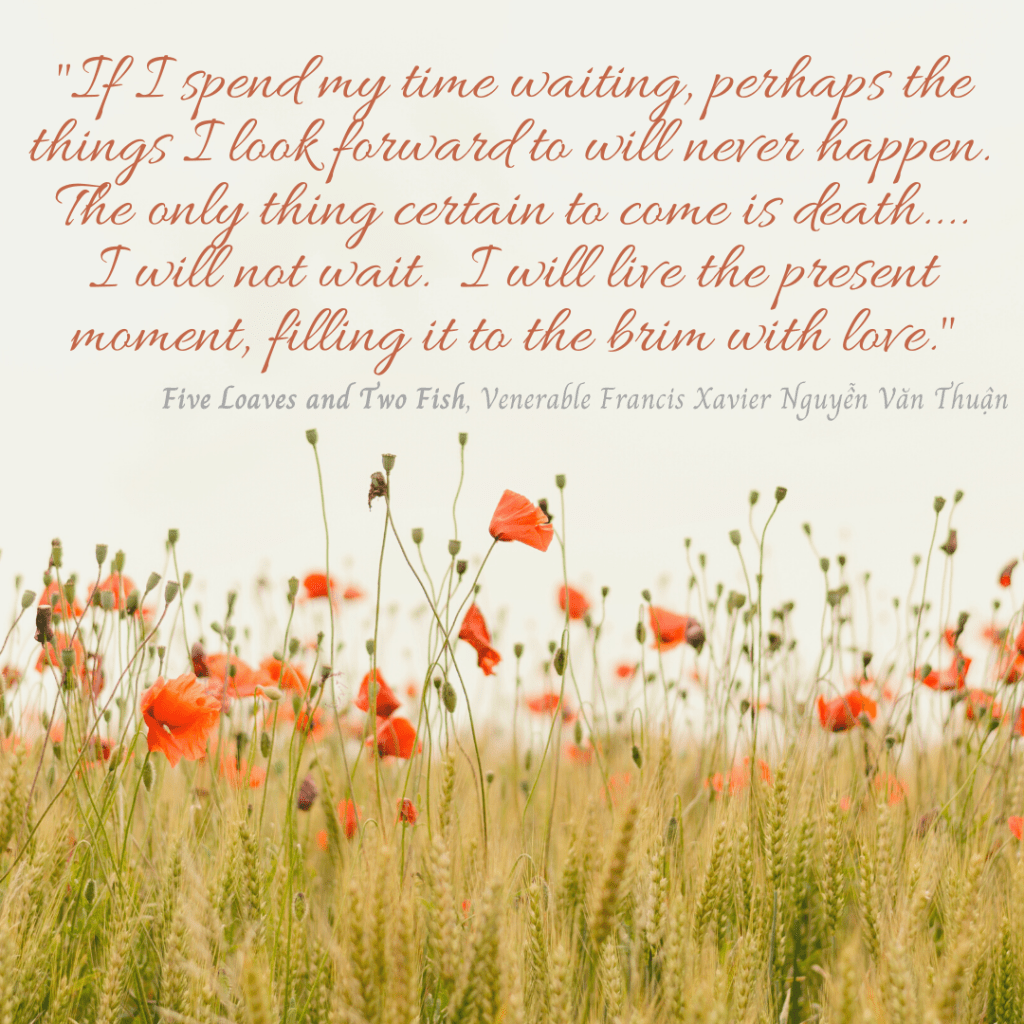
The first truth Francis shares is to live in the present moment. Honestly, if I were confined to a cell for nine years, I might be inclined to live in anywhere but the present moment. The perspective Francis has is, “If I spend my time waiting, perhaps the things I look forward to will never happen. The only thing certain to come is death.” Keeping in mind where he found himself when he considered those words, it was reasonable for Francis to assume he would not survive prison. He chose to embrace the moment and do what he could with what he had.

Through the smuggling efforts of a seven-year-old, Francis sent out messages of hope that he composed during the night. He focused on filling each moment to the brim with love, concentrating on each gesture toward the guards being as loving as possible. The fruit of this was the conversion of many guards. Initially, they rotated the guards often so that he wouldn’t convert them, but then they decided to keep the same ones with him so he would convert as few as possible.

Continue reading “Five Loaves and Two Fish”

Two Bearers of Hope

Two Bearers of Hope

So often I find that when I am teaching my students, I am actually teaching myself. I listen to the words come out of my mouth and find that I am convicted to live in a new way. It isn’t as though I talk about the Gospel and the Lord all day long and pat myself on the back. Rather, I find myself over and over having to admit that I am falling short of living the Good News fully.

One of my classes is finishing up a section on martyrs. They researched fairly recent martyrs with most of them living at some point during the 1900s. Then I showed two videos from Chris Stefanick about two priests who lived boldly during times of war. One priest was Fr. Emil Kapaun and the other was Fr. Vincent Capodanno, both of whom are at various stages of the canonization process.

Each video revealed how these men offered hope in situations that seemed hopeless. Fr. Kapaun became a POW during the Korean War and Fr. Capodanno died in a battle in the Vietnam War. In spite of persecution, Fr. Kapaun encouraged the men, leading them in prayer and risking his own safety to help them survive. As a war raged, Fr. Capodanno ran across the battlefield, offering last rites to wounded soldiers and bringing tangible peace with his presence and words. Their ability to provide hope in war changed the people they encountered. For some, it saved their lives and for others, it brought a calm in the midst of the storm.

As we reflected on these priests in class, I found myself inviting them (and by extension myself) to be hope-bearers in this world. High school can be such a difficult place for them, but the frustrations they experience are often carried into life beyond high school. What if they were people that others found hope in? What if we were able to provide a calm in the midst of the storm? A battle rages around us: wouldn’t it be beautiful if others found a place to rest when they were in our presence?

Continue reading “Two Bearers of Hope”

There Is Always Hope

There Is Always Hope

I don’t recall exactly what it was about. During parent teacher conferences, I spoke with a parent and it was either about the grade, the student’s faith, or something, but whatever it was, the parent ended with, “So there’s hope?” And I, filled with a conviction that stretched beyond the moment, replied, “Yes. There is always hope.”

I felt the weight of that truth in the moment after the parent left.

Always. Hope endures despite all difficulties.

For someone who often skews toward pessimism, it is helpful to remember that hope persists, even when it seems illogical. I mean, we worship a God who rose from the dead after three days. He chose the most unlikely people to pass on the faith, who continually misunderstood Jesus and ran away when scared. Yet this Church still lasts. In spite of corrupt popes, Church scandals, intense persecutions, harsh dictatorships, and every other difficulty, we see that life can still burst forth from death just as the frozen ground will one day again yield to the gentle strength of new flowers.

The other day in class, I found myself saying, “Death isn’t the worst thing.” For me, it was obvious that this was true. I spent much of my first year of teaching hoping for death. Not in a morbid or depressed way. Rather, I was thoroughly convinced of the glory of the Beatific Vision and I was also thoroughly convinced that I wasn’t yet experiencing it in a room filled with angsty, complaint-filled teens.

Continue reading “There Is Always Hope”

Whatever God Chooses Should Be All the Same to Us

Whatever God Chooses Should Be All the Same to Us

I didn’t expect to feel sadness at a wedding.

Anything near tears, I assumed, would come from the overwhelming joy of seeing a good friend get married. And while I was definitely happy, I was startled by the profound loneliness that pervaded my heart, even as I sat in a pew with beloved friends and was surrounded by many people I knew. Grateful that my friend was receiving that for which she had long prayed, I discovered a sorrow that I didn’t want to find at that time or in that place. The human heart frequently seems inconvenient, but I’ve found that leaning into that is more helpful than ignoring it.

Near the beginning of the liturgy, I heard the priest proclaim a single word in the midst of a longer prayer. He said “home” and I was immediately asking the Lord where my home was. Looking over the priest’s head, I saw the crucifix, arms stretched wide and side pierced, and within myself I heard Him say that my home was there. In His side, opened so that mercy could pour out, was my home, my refuge, the only place I belonged on either side of Heaven.

As my blog slowly moves from being thoroughly unread to something that people I know and don’t know read, I find myself hesitant to ever speak of being single. Some of my former students occasionally look at my blog as do co-workers, and it feels odd to share this particularly deep desire, even if it seems obvious or assumed or commonplace. Yet it also feels odd to share so many other parts of my heart and then withhold speaking of the vocation I feel called to, simply because God hasn’t fully answered that prayer.

I’m a melancholic and as such I am accustomed to longing. One of the most enduring longings has been for marriage and a family. It isn’t my only desire, but it is the one that seems the most fervent. This newly married friend is one I often spoke of this longing with, as we questioned when it would be fulfilled and wondered how it would happen. So I understand to a degree why this wedding also filled my heart with a bit of sadness. It was because my compatriot had what she longed for and I was still waiting, still hoping, still wondering when and if it would happen.

Continue reading “Whatever God Chooses Should Be All the Same to Us”