This Is Us

This Is Us

I have a friend who once said that some things are cliché because they are true.  Phrases that seem trite and overused are sometimes the best way to say what we want to say.  They have become clichés because they express a truth like nothing else really can.

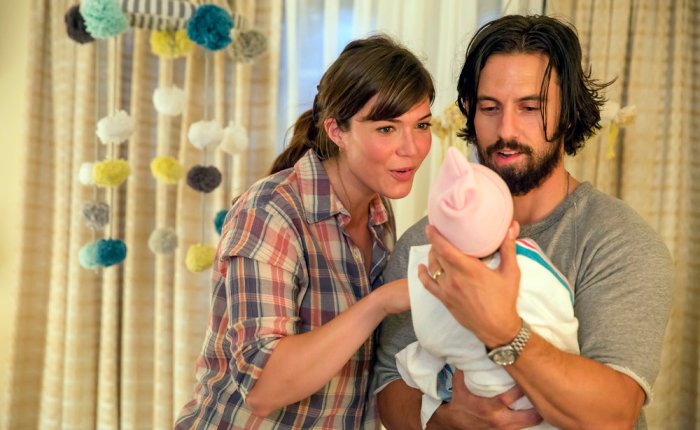
At times, I fight against what it seems a lot of people like or consider to be the best.  But sometimes, it is because it is actually good that so many people rave about specific things.  On Facebook, I’ve seen quite a few people talking about how much they loved the show “This Is Us.”  With the school year wrapped up, I decided to give it a try.

I don’t think a show has ever pulled at my heart as much as this one has.

I love how they portray the complexity of the human heart.  In this show, families are messy, imperfect, and crucial to our own identity.  As the show unfolds, perfect facades crumble to reveal that everyone is striving to get through life doing the best they can and making numerous mistakes along the way.  It is very human, which makes it simultaneously beautiful and frustrating.  Though the families can be chaotic, a theme interwoven in the show is the importance of family.  Whether they are blood relations or adopted family, the experiences we have in our homes shape how we interact with the rest of the world.

This Is Us- Season 1
THIS IS US — Pictured: “This Is Us” Horizontal Key Art — (Photo by: NBCUniversal)

In a world that seems to insist that families can be replaced with technology or friend groups, it is refreshing to see families upheld as the place where we grow, change, and become who we are.  Imperfect families, with parents fighting their own struggles and children feeling their own unique pains, are the places that shape us and show us how to love.  “This Is Us” doesn’t claim that all families are perfect or should be perfect.  I would say they are simply claiming that the role of family is irreplaceable.   Continue reading “This Is Us”

The Deepest Longing of Our Hearts

The Deepest Longing of Our Hearts

“I guess I don’t like the argument from desire because I’ve never felt a desire for something that can’t be satisfied on earth.”

As a melancholic who has nearly always longed for something beyond this world, I was a bit surprised by this admission.  My class was reviewing arguments for God’s existence and as we went over each one, I would ask a few students to share if they liked or disliked the argument.  Then they needed to voice why, perhaps the most difficult part of it all for them.

I wanted them to reflect on the arguments and see which ones they found personally compelling.  Each person is different and so I wasn’t too concerned if they liked all of the arguments or not.  Yet it is always interesting to me which ones they dislike and why.  Some other students voiced a dislike for the desire argument, but the declaration that they had never desired something beyond this world seemed foreign to me.

Melancholic that I am, I have always longed for perfection.  Ever since high school and college, that has translated into a longing for Heaven.  So as my students were voicing that they have never experienced this unfulfilled desire for something beyond this world, I was left wondering why they don’t have a longing that I never remember being without.

In my first year of teaching, I prayed frequently for death.  Not in a morbid way, but in a longing-for-home-and-yet-knowing-everything-around-me-is-temporary way.  The more I battled with my students over Church teaching, the more I wanted to be in a place of eternal Goodness, Truth, and Beauty.  Yet that was far from the first time that I had felt an unfulfilled desire.  Why are my students not experiencing this also? Continue reading “The Deepest Longing of Our Hearts”

Simple Witnesses: The Newly Canonized Fatima Visionaries

Simple Witnesses: The Newly Canonized Fatima Visionaries

May 13, 1917

Our Lady chooses to reveal herself to three children tending sheep in the Cova da Iria.  Tenderly, she tells them to not be afraid and yet she asks them to sacrifice for the conversion of the world.  They are mere children, the oldest one is ten years old, but they agree to offer up their sufferings and sacrifices for love of Jesus and for the conversion of others.

That may seem abstract to many of us.  However, they are quick to concretize this request.  Whenever poor children ask for food, the three children give them their lunch.  As they tend to the sheep, they see how long they can go without water and offer this thirst to Jesus.  Little Jacinta finds out that she will die alone in a hospital in Lisbon and, although she is scared, she chooses to offer this trial up to Our Lady for the sake of others.

We can take as our examples Saint Francisco and Saint Jacinta, whom the Virgin Mary introduced into the immense ocean of God’s light and taught to adore him.  That was the source of their strength in overcoming opposition and suffering.  God’s presence became constant in their lives, as is evident from their insistent prayers for sinners and their desire to remain ever near “the hidden Jesus” in the tabernacle.

Canonization Mass Homily of Pope Francis, 5/13/2017

These sacrifices, though small in the course of human history, are monumental.  Children are shown to be capable of leading the way to holiness.  Their tangible witness is felt in particular in the place one would expect it: Fatima, Portugal.

IMG_6003.JPG

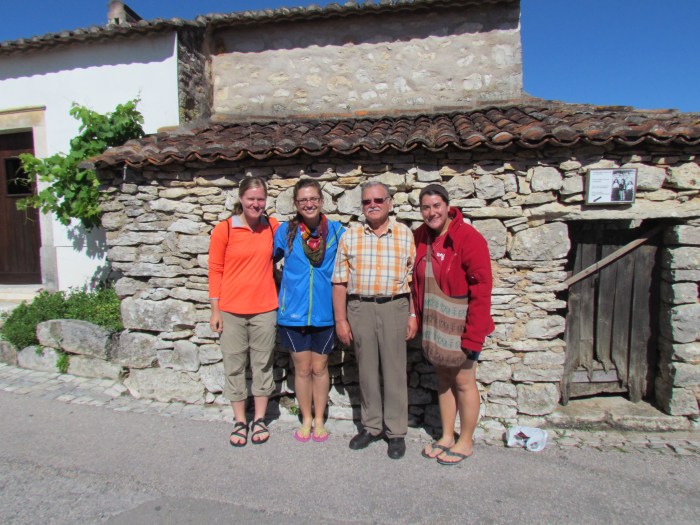
It has been a tremendous gift of mine that I have been to Fatima three times.  The picture above is from the most recent trip.  The man in the picture happens to be the nephew of St. Francisco and St. Jacinta Marto.  His father was their older brother, John.  Proud of his close relation, he showed us the page in Lucia’s book where she speaks about his father.

Each time I am in Fatima, I experience a great peace that comes from resting in a place that is so dear to my Heavenly Mother.  My birthday aligns with the anniversary of her first appearance in Fatima and so I have a filial devotion to this particular feast.  As I have read more about the children and how they fervently responded to her words, I have grown an even deeper love for Our Lady of Fatima and her little children.

May 13, 2017

In so many ways, their lives were insignificant.  Francisco and Jacinta were two children who fell victim to the influenza epidemic in 1919-1920.  Their lives were spent in poor circumstances in a town in Portugal for which few people cared.  While generally good children, they were not known to be perfect.  Yet on May 13, 2017, they were declared canonized saints in the Catholic Church.

Indeed, God created us to be a source of hope for others, a true and attainable hope, in accordance with each person’s state of life.

Pope Francis 5/13/2017

Continue reading “Simple Witnesses: The Newly Canonized Fatima Visionaries”

Build Up the Ancient Ruins

Build Up the Ancient Ruins

After finishing a silent retreat, I opened my Bible to where I had some papers sticking out.  I had marked this section because of the first three verses of Isaiah 61.  They were the Scripture verses my college women’s group considered “our” passage.  While they speak beautifully about the Spirit of the Lord and how it works in us, my attention was attracted to the following verse.

“They shall build up the ancient ruins,
they shall raise up the former devastations;
they shall repair the ruined cities,
the devastations of many generations.”
(Isaiah 61:4)

For the first time, I read this verse and realized the great hope attached to it.  I look at the world around me and I see a lot of things falling into ruin.  This isn’t the result of one generation but of many generations over the years, the buildup of human sin over the course of human history.  Yet here in Isaiah, the Lord is promising to re-build that which is ruined.  And Isaiah isn’t saying the Lord is going to do this all apart from us, but rather that He will use us to re-build and raise up new things.

I cannot help but think that this new life will come from the way the Spirit of the Lord will move.

The Spirit of the Lord God is upon me, because the Lord has anointed me to bring good tidings to the afflicted; he has sent me to bind up the brokenhearted, to proclaim liberty to the captives, and the opening of the prison to those who are bound; to proclaim the year of the Lord’s favor, and the day of vengeance of our God; to comfort all who mourn…

(Isaiah 61:1-2)

When we allow the Spirit of the Lord to work in and through us, He will re-build the broken world in which we live.  I see it already happening in small ways.  On the silent retreat, I was primarily surrounded by moms, several of them visibly pregnant with another child.  It is beautiful to think of how families will be strengthened and renewed simply by their mother’s dedication to her faith.   Continue reading “Build Up the Ancient Ruins”

The Holy Spirit Wants to Kill You

The Holy Spirit Wants to Kill You

Thankfully, I’m dying bit by bit.

I had a professor in college who liked to shock us by saying, “The Holy Spirit is trying to kill you.”  And, honestly, there is a lot in me that He needs to kill.

At the end of last week, I was frustrated with many of my students and tired of teaching.  One class seemed to be intensely critical of everything I was saying, perhaps a reaction from an impromptu assignment the day before.  Then a phone went off in class.  Finally, I asked students to take down papers I had them stick to the board and a few seemed to think it would be funny to tear them off, leaving them slightly crumpled.

It was all more than I wanted to deal with at the time.  And so I reacted.  I spoke a bit too harshly to the students who didn’t seem to care about the activity I had thrown together for them.  They were upset, but I was perhaps more upset.  One wanted to argue the matter and I told them to come back later if they wanted to discuss it.

I had a couple class periods to reflect on the situation.  My response, I soon realized, was not to that isolated situation but to the frustration of the entire day.  And I knew that wasn’t fair, but I couldn’t undo my unfair reaction.  So when one of the students stopped by after school, I was surprised, but glad.  We had a conversation and a few moments of it I could feel myself getting a little upset again.

In the end, part of me died.  I told the student I over-reacted and the punishment I threw out wasn’t fair.  While apologizing, I admitted that I hadn’t responded in the way that I should have responded.  “I agree with you: you don’t deserve a detention.  I’m sorry.” Continue reading “The Holy Spirit Wants to Kill You”

The Burden of Perfection

The Burden of Perfection

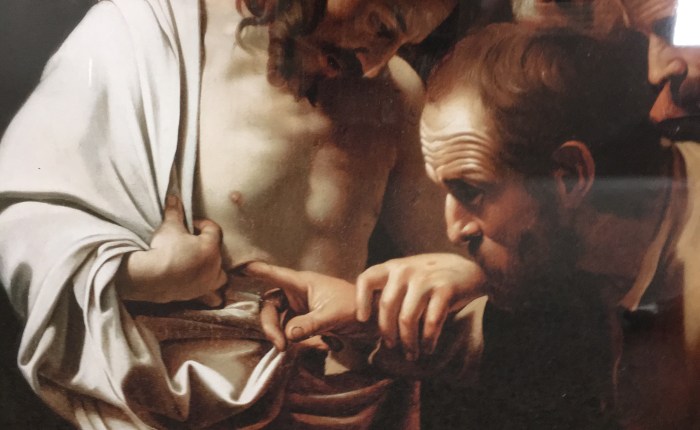
When Jesus appeared to His Apostles after the Resurrection, His hands, feet, and side still bore the marks of the crucifixion.  His glorious, death-conquering body held the holes that won salvation.  To be certain, His body was different than it was before.  He was strangely appearing and disappearing, passing into locked rooms, and yet still able to eat and be touched.  Dying and rising had changed His body.  Gone was the appearance scarred beyond human recognition.  However, His body still showed where nails and a spear had pierced Him through.  Why was that?

There are several theological reasons, but I would like to focus on one minor, personal reason.  I would argue that Christ kept His wounds to destroy our image of perfection.  Here is the conquering King, the One who has fought death and won and yet–He still shows signs of this arduous battle.  As the commander of this battalion, as the King who leads His people into battle, Christ is not unaware of the price of this fight.  Our whole lives seem to be a battle towards Heaven.  Christ doesn’t need perfect looking soldiers; He simply needs faithful ones.

The burden of perfection is one we place upon ourselves.  We want lives that are neat and tidy, yet none of us have it.  Sometimes we brand others as perfect, but that is only because we see portions of their lives and not the whole of it.  And when we expect this perfection from them, we encourage them to fake it instead of living authentically.

Often, when I tell people that my two older sisters are religious sisters, I can see them mentally placing my family in a certain type of box.  Years ago, I gave my witness in preparation for a summer of catechizing youth, and one of the critiques I received was that teens probably couldn’t relate to my story.  While I understood what they meant, I couldn’t help but take it a bit personally.  My story of an aching heart being separated from my sisters was not something they deemed relatable.  Since then, I have discovered that it is something to which others can relate.  Perhaps they don’t have siblings in religious life, but many have experienced anger and frustration with God and a plan you never wanted for your life. Continue reading “The Burden of Perfection”

Attractive Misery

Attractive Misery

We feel…shame at seeing our misery and our baseness exposed.  Yet this misery possesses the mysterious privilege of attracting our Lord.  This is difficult to understand, yet it is an incontestable truth.  Our nothingness and our misery constitute the force that attracts our Lord.

(Secrets of the Interior Life)

I’ve never really understood this idea of how our misery attracts the Lord to us.  Generally, when I see my own miserableness, it is repulsive or something I want to hide.  It isn’t something that is attractive or pleasant.  When it comes to seeing the miserableness of others, I’m not much better.  My personality is one that desires perfection.  The people around me (including me) are continually letting me down because they don’t live up to my image of perfection.

Yet the Lord uses all things for good.  The cheating incident I mentioned a couple posts back has really pushed my heart.  It made me move from anger to forgiveness.  A few days later when the individuals came back and we spoke, I found great freedom in being able to express how they had hurt me and to hear them apologize.  The relief on their faces was incredible.  It was though they walked into my room carrying a burden and then through the exchange of a few words, that burden was lifted.  My burden was lifted, too.

Strangely, over the last couple weeks, I have found a special tenderness in my hearts toward those individuals.  No longer angry, I am able to love them as they are: flawed human beings.  The Lord knows I have difficulty loving people in their humanity and so I am beginning to be grateful for this incident.  I don’t want to love them only when I think they are perfect, but for the beautiful complexity that is wrapped up within their hearts and souls.  I know myself and so I know I do not want to be loved merely for my seeming perfection but rather in my entirety.  In the midst of this, I experienced for the first time, at least consciously, the way that misery attracts my heart.   Continue reading “Attractive Misery”

To Be the Face of God

To Be the Face of God

The other day, I gave a test in all of my classes.  In the midst of this, I discovered a student cheating on the test.  As I spoke with the student and some details were revealed, I found that I wasn’t angry with the student.  I simply felt this incredible sadness.

I always want to be able to trust my students.  When something happens that betrays that trust, I find myself a bit frustrated and sad.  I don’t want to doubt what they tell me or question their integrity.  But they are humans and sometimes humans cheat or lie.

During the rest of the day, this incident weighed on my mind.  I was sad and disappointed with this student but also with students in general.  Cheating is something I do not understand.  Perhaps because I enjoyed school and generally like a challenge, but I could never see myself cheating in school.  In middle school and parts of high school, people thought I was semi-ridiculous for how cautiously I guarded my paper during tests or quizzes.  I didn’t want to be the unknowing person from whom others stole their answers.  Some of my students have a very different perspective.

So I began to wonder how God takes in the continually disappointing behaviors of humanity.  It is a love that I cannot comprehend because it is truly a love without condition.  My love is conditional.  I have a great affection for my students, but when confronted with their weaknesses and their imperfections, I struggle with how to move forward.  I know a single action does not define who they are, but it shapes how I perceive them.  How can the Lord look at us in the midst of every sin and love us wholly and entirely?   Continue reading “To Be the Face of God”

A Laity of Saints: How God Uses the Little for Greatness

A Laity of Saints: How God Uses the Little for Greatness

When I mention that my two older sisters are religious sisters, people often wonder what my parents did to make that happen.  In a way, I understand, because it is mildly unusual in today’s world to hear about young women making vows of poverty, chastity, and obedience.  Yet I also want to fight against this mentality that holiness is primarily for priests, religious, and consecrated persons.  Sanctity is for everyone and we need to continue to proclaim this good news.  

If you are what you should be, you will set your whole world on fire.

~St. Catherine of Siena

Venerable Jan Tyranowski recently came into my life and he inspires me in the quest for a saintly laity.  He was born at the turn of the twentieth century in Poland.  For over three decades, he led a rather unremarkable life.  But at Mass one day, he heard the priest say that it isn’t difficult to be a saint.  From that day forward, he pursued virtue and holiness with an incredible ardor.

When Nazis invaded Poland, they deported several of the priests in parish, leaving behind only a couple elderly priests.  Knowing of his deep faithfulness, the priests ask Jan to minister to the young of the parish.  Despite his introverted nature and little formal education, Jan began this ministry even though he considered himself incapable.  He formed prayer groups comprised of fifteen young men each.  Each man was responsible for daily praying a decade of the rosary and striving to live out particular virtues.  The groups were called “Living Rosaries” and Jan chose a leader for each group, investing time to spiritually form each leader.

Venerable Jan Tyranowski never married and never became a priest, yet his life of holiness impacts us today.  The Second Vatican Council called for the laity to live more fully the mission of the Church.  This call was anticipated in the life of Jan and he did this in the midst of a Nazi occupation.  One of the young men who was in his prayer group and was spiritually formed by this simple tailor was Karol Wojtyla, better known as Pope St. John Paul II. Continue reading “A Laity of Saints: How God Uses the Little for Greatness”

A House Divided

A House Divided

Satan, the father of lies, loves division.

It matters very little what the division is actually over.  In fact, I think the more religious-oriented the division, the more it pleases Satan.  But he will take any dispute, so long as it seeks to divide.

Knock down drag out brawls over the liturgy?  Disputes over the placement of the altar?  Feuding over Lenten fasting?  Frustrations with priests and bishops?  Sides forming over who is more Catholic than the pope?

Satan is delighted.

We spend our time considering what we think is best and we tend to lose sight of the Lord.  I’m not arguing for an “anything goes” mentality.  Far from it, I am encouraging us to focus on what is the most important rather than repeatedly increasing the divisions within humanity.

For the bonds which unite the faithful are mightier than anything dividing them. Hence, let there be unity in what is necessary; freedom in what is unsettled, and charity in any case.

(Gaudium Et Spes)

In The Great Divorce, C.S. Lewis portrays Hell as a place of isolation.  The opening pages start in a town that is approaching the evening hours but seems empty of people.  Yet the narrator finds people waiting in line at a bus stop.  As the minutes pass, people leave the line because they keep quarreling with each other about one thing or another.  The town is empty because the inhabitants cannot bear to be in such close proximity to other people with all their flaws and imperfections.  So they keep moving, distancing themselves from others until they find themselves in complete isolation. Continue reading “A House Divided”