Surprised by Grief

Surprised by Grief

Grief is a tricky thing.

I keep thinking this as the days and weeks have gently rolled by and yet I keep being surprised by it.

Several weeks ago, a man I knew from prison died.

Were we friends? Yes, in a way that I feel inclined to categorize in my head as “prison friends.”

There is almost no chance we would have known each other except for meeting in prison, life and circumstances being so entirely different for each of us. I never quite knew how many of his stories to believe or how to wrap my brain around his understanding of Scripture. I was often unsure what transpired inside his mind, as he would silently survey all and thoughtfully form an opinion which, if asked, would take several minutes to unfurl. How did all of his stories mesh together? What happened in the years he was silent about? How exactly did he end up where he did?

A mystery.

He was very much a mystery to me.

It was in prison that he chose to enter the Catholic Church. At a Saturday evening Mass, he was baptized and confirmed. In a place where touching between inmate and visitor is frowned upon, it was memorable to step up behind him and place my hand on his shoulder as he was confirmed. I prayed for the Holy Spirit to descend powerfully upon him and remain with him even while I also wondered why he picked me as his sponsor.

Over the years, we spent hours talking. He spoke more than I did, but he would remember to follow up about different things in my life about which I had shared. What I was teaching, what I was learning, the paper I was supposed to be writing. He’d share fantastic stories about his youth, about his thoughts on a passage of Scripture, about advice other guys would ask for, about observations about staff and inmates. There was always something formulating, fermenting, bubbling up inside of him.

So it is a bit striking for all of it to stop.

Suddenly.

A surprise death. One which lingered suspensefully for a few days as we sat in the “is he dead or isn’t he?” And even when it was revealed that, yes, he was dead, it was still unbelievable. A memorial Mass was offered and a visit to the gravesite occurred and yet it still seems unresolved. There was a statement from the DOC, a smattering of news reports, and an oversized pile of dirt in a small rural cemetery. But there was no body that I saw, no funeral pictures, no casket, no obituary, no headstone. Just enough to show that he was gone and little enough to force my brain to recognize how absolute it is.

Continue reading “Surprised by Grief”

Honey From the Rock

Honey From the Rock

I looked up from my sink of dishes to see a plump baby bird and his mom perched on the railing of my deck. The squat baby tipped his head back, opened his yellow-orange beak, and received what the mom graciously offered. The mom’s intense blue-black head flickered to the tree and then to the sky, cautious and attentive, before bolting away in search of more food. Meanwhile, the baby bird hunkered down on the railing, no squawk or complaint issuing from his mouth as his mom left him.

For God alone my soul waits in silence; from him comes my salvation. He only is my rock and my salvation, my fortress; I shall not be greatly moved.
(Psalm 62:1 RSVCE)

This little bird, trusting in the faithful return of his mother, made me see again how I should be with God. Every time the mother took flight, the baby waited quietly, resting in the firm and certain knowledge that she would return. The most squawking happened when the mother had landed on the railing and the baby chirruped incessantly, eagerly clamoring for the food which was soon to be given. Otherwise, he was silent. He hardly moved. He never made an attempt to go get food on his own or to make any sort of search for his mother. He just waited in confidence.

Or perhaps he simply followed his bird instincts that said his mom would return with food. Yet how much more should I wait hopefully on the Lord, trusting that as He has promised, so He will deliver. The Lord will not abandon me or forget me. He can be completely trusted and relied upon. Though He might seem absent or far away, He is always laboring to provide the very best possible in each moment.

I am the Lord your God, who brought you up out of the land of Egypt. Open your mouth wide, and I will fill it.
(Psalm 81: 10 RSVCE)

No conversation, no questions, no complaints. Just a neck craning back and a beak opened wide to receive whatever the mom was going to give him. And the mom provided each time. Sometimes she took part of the food back out, held for a bit in her mouth, and then deposited it again in his waiting mouth. Whatever she gave was received as good. I didn’t see the baby spit it back out or question if he would like what would be offered. Simple receptivity.

In these actions, repeated several times as the dirty dishes passed through my hands and became clean, I found a challenge offered to me from the Lord. Would I be like that little bird and receive all that He would offer me? Would I not question if it was really good or if I would like it or if there was anything else, but would I instead just receive from the Lord all He gifted? Could I trust the God of all creation, Who has led me up out of my own Egypts many times, as simply as the little bird trusted his mother? Will I take the offered cup and drink fully?

But my people did not listen to my voice; Israel would have none of me. So I gave them over to their stubborn hearts, to follow their own counsels. O that my people would listen to me, that Israel would walk in my ways! I would soon subdue their enemies, and turn my hand against their foes….I would feed you with the finest of the wheat, and with honey from the rock I would satisfy you.
(Psalm 81: 11-14, 16)

Recently, I’ve been pondering the truth that God is always giving us our greatest good in every moment. It isn’t something new I learned, but it isn’t something I have often found myself considering. While I often don’t receive fully what the Lord is offering, it has been renewing my perspective of life events and situations when I try to view it from this perspective of unfathomable goodness.

The priest who spurred this pondering shared a story which I have also been ruminating over. He mentioned praying for rain as a child and how this nearly destroyed his belief in the goodness of God since the rain often didn’t come or was delayed. As a child, his perspective was that if God heard enough people, He would give what they were asking for or be convinced to give them what they wanted. Yet he offered a more Christian perspective of what prayer should be with the Lord. When begging and pleading for rain and it doesn’t come, the faithful follower of Jesus should be able to prayerfully wonder, Lord, what greater good are you doing here in this place of our need?

Continue reading “Honey From the Rock”

Five Loaves and Two Fish

Five Loaves and Two Fish

Venerable Francis Xavier Nguyễn Văn Thuận spent thirteen years imprisoned in Communist Vietnam without receiving a trial. Of those thirteen years, nine were spent in solitary confinement. The prison conditions he suffered in makes the prison I go to for prison ministry look like a luxurious hotel. From his cell being so humid that mushrooms grew on his sleeping mat to his cell light being left on (or off) for days at a time, Venerable Francis suffered in ways I cannot fathom.

Yet from this suffering emerges a life shaped and formed in the crucible of humiliation. Despite the hatred of his persecutors, he continued to seek after the Lord. Years after being released from prison, Venerable Francis wrote Five Loaves and Two Fish, a simple yet profound book based on his experiences in prison. While most of us cannot relate to the particulars of his life, the truths that emerge are ones that ought to resonate deeply with each of us.

The general theme of his book, as you may have guessed, is based on the Gospel where the little boy offers the little he has (five loaves and two fish) to feed the multitudes present. The boy doesn’t know how it will be enough, but he trusts that offering it to the Lord is what he is called to do. Venerable Francis focuses on the little that we can do to offer ourselves to the Lord. He went from an active ministry as a bishop, serving God’s people with energy and zeal to a life imprisoned, unable to speak to his flock or do the work God was allowing him to do before. Yet even in this lack, or perhaps especially in this lack, he finds that God is still working, just not as he expected.

The book is short and beautiful, so I recommend getting a copy and pouring over the simple truths found in it. But I wanted to highlight two points that stood out to me.

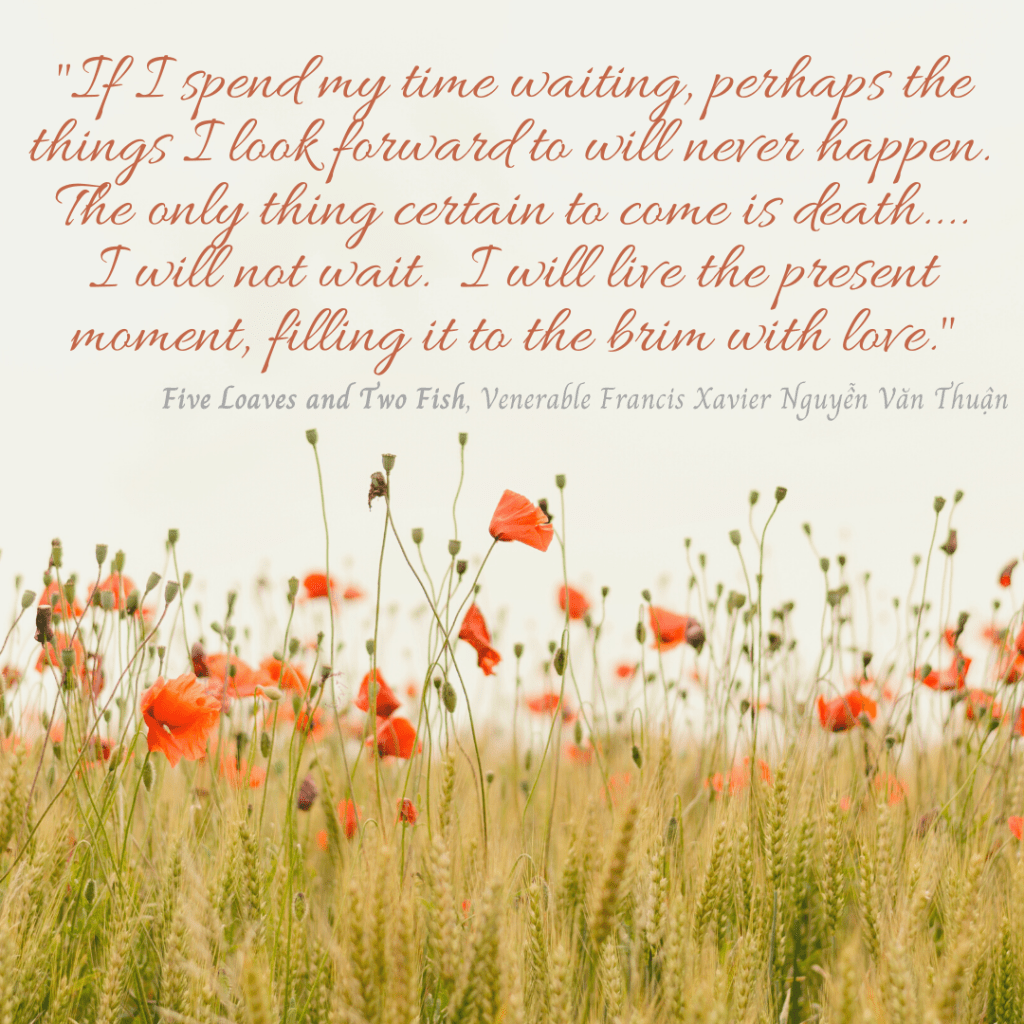
The first truth Francis shares is to live in the present moment. Honestly, if I were confined to a cell for nine years, I might be inclined to live in anywhere but the present moment. The perspective Francis has is, “If I spend my time waiting, perhaps the things I look forward to will never happen. The only thing certain to come is death.” Keeping in mind where he found himself when he considered those words, it was reasonable for Francis to assume he would not survive prison. He chose to embrace the moment and do what he could with what he had.

Through the smuggling efforts of a seven-year-old, Francis sent out messages of hope that he composed during the night. He focused on filling each moment to the brim with love, concentrating on each gesture toward the guards being as loving as possible. The fruit of this was the conversion of many guards. Initially, they rotated the guards often so that he wouldn’t convert them, but then they decided to keep the same ones with him so he would convert as few as possible.

Continue reading “Five Loaves and Two Fish”

The Gift of a Slower Pace

The Gift of a Slower Pace

Of course there was some stress involved, but the school year ended with fairly little fanfare and at a much slower pace than usual. No massive liturgies to plan for hundreds of people, no finals to prepare, no feeling like everything needs to happen right now. I fully understand that this pandemic is causing suffering for many people, but I can’t help but consider the blessings found in the midst of the difficulties.

For a variety of reasons, this school year was difficult in different ways. I found myself stressed and in continual need of a break. Many life-giving things were happening in my life, yet the breaks from school were never long enough, the time to relax never quite rejuvenating enough, my grasp on responsibilities never quite firm enough. After overcoming the initial stress of the transition, I slid into an indefinite period of teaching from home….relieved.

The time gave me the gift of reading a little more, enjoying the comforts of home much more, and the unchosen halt of many ministries. Things I could never say “no” to before (and I don’t generally have a problem saying no), like some work responsibilities, and things I enjoy, like prison ministry, were suddenly over or put on a long pause. While there was a sadness in missing some things, I mostly found the break to be good for me. And as a definite introvert, I was really okay with hours spent alone at home. With nine weeks of teaching from home wrapping up, I can honestly say I never got very sick of being at home. Sometimes staring at a computer screen was painful or the endless assignments that needed grading were unwelcomed. Despite all of that, the pandemic provided the opportunity to come up for a breath of much needed air.

Continue reading “The Gift of a Slower Pace”

Ever Ancient, Ever New: The Gift of the Liturgical Year

Ever Ancient, Ever New: The Gift of the Liturgical Year

On a plane ride a few weeks ago, I found myself seated next to the founder of a Protestant church. He laughed because he was sandwiched between two Catholics, a married man who had been in Catholic seminary for a little while on his right and me, a Catholic high school Theology teacher, on his left. The conversation was pleasant, but the pastor shared one thing that seemed rather significant to me. Although he founded and now pastors an extremely contemporary church, he said his personal prayer is quite liturgical. This point fascinated me because it spoke of the true desire for liturgy is woven into the fabric of our beings.

As humans, we are bound to worship, whether our focal point is God or something else varies for the individual.  Perhaps overly simplified, the liturgy is our communal worship, the traditional rites we follow to offer praise, thanksgiving, and supplication to God.  Of the various liturgies in the Catholic Church, the highest is the Eucharist, the Sacrament of sacraments.  Beyond the structure of this liturgy is the structure of the year.  Too often I take for granted the beautiful gift that is found in the yearly passing through the major points of the life, death, and resurrection of Jesus Christ.

Several years ago, I heard it said that in the Church’s wisdom she developed the liturgical year to satisfy mankind’s love of change and stability.  Having never before thought of it like that, I experienced a new perspective of something that had always been present in my life.  In delving into the rich rhythm of the liturgical year, I have discovered that the feasting and fasting, as well as the ordinary and extraordinary times, provide a healthy balance in life.  Since humanity often tires of the same thing, the Church moves us through different seasons to celebrate and recall the different parts of the mystery of Christ.  Yet constant change is difficult and so the seasons are cyclical, each new year of grace seeking to lead us deeper into these same mysteries of Christ but in a fresh way.

While the Gregorian calendar tells us a month is left of this year, the liturgical calendar is reminding us that a new year is close at hand.  Personally, I like that the two calendars that govern my life are slightly off-center.  It reminds me that I am in the world but not of it.  As a follower of Christ, it calls me to acknowledge that His grace should cause me to see the year in a different way since my sight is imbued with an otherworldly perspective.

With the Church in the first days of a new year, let us consider the gift of the changing liturgical seasons.

Advent: Waiting for Christ’s Coming

The year starts off in joyful anticipation. Joining our hearts and minds with the Israelites, we wait for the coming of the Messiah. Yet knowing that Jesus has already come and ascended, we wait for His Second Coming at the end of time. This pregnant season of waiting calls to mind St. Paul’s words in Romans 8:22-25.

We know that the whole creation has been groaning with labor pains together until now; and not only the creation, but we ourselves, who have the first fruits of the Spirit, groan inwardly as we wait for adoption as sons, the redemption of our bodies. For in this hope we were saved. Now hope that is seen is not hope. For who hopes for what he sees? But if we hope for what we do not see, we wait for it with patience.

We do not wait without a purpose. As parents of a newborn prepare for the child’s birth, so we make our hearts ready for Christ’s new birth into our hearts and our birth into eternal life. While Advent is culturally forgotten or seen merely as a time of wrapping presents and sending Christmas cards, it should cause us to remember that we need to make Him room, in our hearts and in our lives.

The best Advent I have ever had was the semester I took an Old Testament Scripture class in college. For months we made our way through salvation history, learning about the covenants that God repeatedly offered man and the ways humanity broke those covenants. We ended the semester with a unit on the prophets and, for the very first time, I encountered a taste of the longing that the Israelites must have experienced. Scripture passages that I had heard before were filled with a new life, a new pleading that God would send a Redeemer. While I knew the Savior had already come, I experienced the “wait” in a new way and thus experienced the joy of Christmas in a new way. Continue reading “Ever Ancient, Ever New: The Gift of the Liturgical Year”

Advent: What Lies Ahead

Advent: What Lies Ahead

In our culture’s mad rush to start the Christmas season, I am left feeling a bit Scrooge-like.  I like Advent.  The anticipation that gradually builds as candle after candle are lit on the Advent wreath adds to the beauty of Christmas when it finally arrives.  If we jump headlong into Christmas right after Thanksgiving, I believe we miss part of the joy of the season.  Waiting has a sweet longing to it and I want that sweetness for as long as I can have it.

As a child, I remember the eagerness as I would watch the presents beneath the tree grow as time passed.  My younger sister and I would check to find the ones with our names and then try to analyze what was inside.  It was tempting to tear the wrapping off, but we didn’t.  The soft, foldable presents were obviously clothes.  Yet the ones in boxes?  Those were unidentifiable.  We would give them a light shake and then simply wonder about what lay nestled inside for us to discover.  The waiting was half the fun.  Even if I wanted to figure out what the present was before Christmas (my competitive nature desired to win), I also wanted to be surprised.

I won’t argue that I’m extremely patient, however I appreciate waiting for something good.  When I get my mail, I am excited if I find a letter from a friend or a package that I ordered.  Yet I generally open the less fun things first, allowing the excitement and longing for the most desired thing to build.  After trick-or-treating at Halloween when I was a kid, I tried to eat my least favorite candies first, saving the best for last.  Even now, I often find myself saving a bite of the best part of the meal for the end, as if to end the meal on a good note.  Waiting doesn’t change the contents of the letter or the taste of the food, but it seems to add a bit of sweetness as I anticipate what is to come. Continue reading “Advent: What Lies Ahead”

Seeking the Face of God, Even in Tragedy

Seeking the Face of God, Even in Tragedy

“We live in a crazy world,” I told my class near the beginning of a class period.

“One of you asked if I had heard of the truck bombing and I thought I had, but I wasn’t sure if it was from last week or this week.  Then I looked it up.  Two hundred and seventy people died and it just sounded an awful lot like several other events.  We live in a world where it is possible to be uncertain if a tragedy like this is news or something from a couple of weeks ago.”

This particular class period, we were reflecting on the Ignatian theme of finding God in all things.  It is easy to find God in bits of beauty–in the sunset, the splendor of fall foliage, or the smile of a newborn.  The difficulty is found in seeing the face of God in tragedy–the shooting in Las Vegas, the 9/11 attacks, or the truck bombing in Somalia.

Practice makes perfect, though, right?  Or, at least, better?

So our class time was spent in small groups brainstorming a few tragedies and then considering how we can see God in the midst of these situations.  I challenged them to go beyond the cliché lines they hear or the standard Theology class answers.  Instead, I wanted them to delve into these painful situations and to truly seek the face of God.

This class period had the most somber tone of all my classes and I found myself telling them that I viewed this exercise in a hopeful way.  Yes, we were talking about a loved one being diagnosed with cancer, terrorist attacks, natural disasters, and struggles in relationships, but we were doing so because we believe God can be found even there.  Perhaps, especially there.

After a group presented how they found God in a particular situation, I opened it up to the entire class.  Time after time, I asked, “Anything else?  Any other ways you can see God in that situation?”  There wasn’t a particular answer I wanted from them, I just wanted them to deeply reflect on all the possible ways God could be found in difficulty.  My hope was that if they did this while a bit removed from some situations, they will be able to try to do it in the midst of suffering.  I want them to remember that God can be found in all suffering.  And I want them to know it in a visceral, heart-wrenching way and not simply a pat answer on a Theology exam. Continue reading “Seeking the Face of God, Even in Tragedy”