Where Saints Are Made

Where Saints Are Made

Young St. Francis kept trying to leave home to pursue greatness. Dazzled by the heroism of knights and soldiers, St. Francis attempted twice to enter into battle or to join the military. Sickness, imprisonment, and the continued call to return home became his lot instead of armed valor and glory. While he did eventually travel great distances, St. Francis grew to be great by condescending to become very little.

On a recent pilgrimage to Italy, I was near the castle fortress overlooking Assisi as I took in the quiet beauty of the medieval town as the sun slowly lowered. The place of burial for St. Francis was awash in warm light and I soaked up the stillness of the moment. As my mind rifled through memories from the past few days, I thought of the holy places I had visited and the different talks and tours I had taken in. A simple thought came to mind and I made a note on my phone so as to not forget it.

“St. Francis kept trying to leave home to do great and noble things. Instead, it was in Assisi that he became a saint.”

It was in Assisi, the place where the follies of his youth were known and the place where people were aware of his flaws, that the Lord chose to craft Francis into St. Francis. In many ways it is easier to go elsewhere to become holy. To be holy at home, where your lack of holiness is clearly known, is one of the most difficult things. Yet it was this point that the Lord wanted to remind me of as I stood at the end of my pilgrimage. Home is where we can become holy.

I, too, like Francis often find myself wanting to run off to some corner of the world and do great and heroic things. Noble missions or bold adventures or grand quests for the Lord are enticing. To do something enduring and memorable seems to be a desire within all humans, even if what we consider memorable varies from person to person. Yet here the Lord was reminding me that in our native place, in our homes, among the people who know us, He can and does make us holy, if we permit Him.

Continue reading “Where Saints Are Made”

Joy in Everyday Things

Joy in Everyday Things

Marie Kondo advocates asking yourself if the things that fill your house spark joy. While I don’t live her method, there is something intriguing about asking that question about the items that fill our visual landscape. Many things in my home don’t do that (I suppose I find it hard for spoons and forks to greatly spark joy in me—yet they are pretty useful for eating), but it is perhaps more interesting to consider the things that do fall into that category.

During the pandemic, I’ve spent a lot of time at home. But given this abundance of time at home, I notice that my affections continue to be drawn to particular things in my home and I find once again compelled to acknowledge that beautiful, practical (and impractical) items are so helpful for ushering joy into our lives.

For example, I have a wooden serving tray and it is perhaps odd the number of times I stop to admire the varying grains that run across and throughout the wood. Either as I’m arranging food on it or washing it off, I generally am thinking, “This is so beautiful.”

Or I have a serving bowl that was handpainted in Italy that I purchased last summer while in Assisi. The bright colors that fill the interior bring me a thrill of joy every time I fill it with salad or an array of fruit. As I use it, I frequently remember the peace of Assisi, the quiet of the streets during our time there, and the beauty of being in a place so old.

Continue reading “Joy in Everyday Things”

When Beauty Bores

When Beauty Bores

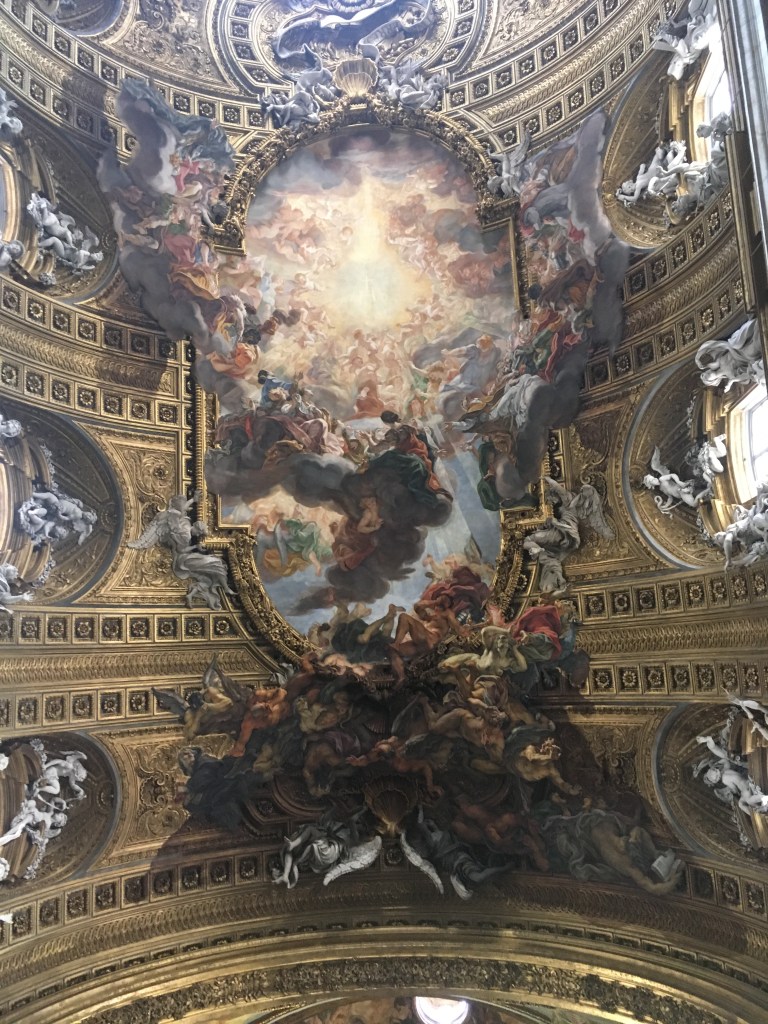
The first day or two that we were on pilgrimage in Rome, the students were entering church after church with necks that craned heavenward. It was the natural response to the beautiful architecture that we were encountering. They took pictures galore, marveling over magnificent domes and intricate mosaics that adorned the walls. Our hearts were overflowing with beauty. My students from South Dakota were encountering some of the greatest artists the world has ever had to offer.

By day three, however, they were growing bored with the church after church schedule, regardless how beautiful they were. One of the girls that seemed quite invested in photography went from executing creative basilica photo shoots to nonchalantly sitting in a pew during a stop in another church.

“Isn’t it funny how quickly we get bored of all this beauty?” I asked her as I watched other students mill around aimlessly.
“Yes!” she replied, perhaps noticing for the first time how much her response had changed to the loveliness around her.

And we spoke for a few minutes about how amazed we all were the first day and how quickly we were tired of what had been novel only a couple days before. My tiredness didn’t match the students’ expressions, but I did have to remind myself to keep looking at the churches with wonder and not simply let my eyes glaze over.

Too much beauty–is there even such a thing?

Continue reading “When Beauty Bores”