Heroic Action or Infringement of Rights?

Heroic Action or Infringement of Rights?

As much as our world changes and the values and morals alter concurrently, sometimes it is good to see that embedded deep within us is a natural understanding of how we should respond.  Many health situations that create controversy and endless disagreements often start from a good intention that is found within us as human beings.  The push for assisted suicide generally comes from seeing someone suffering and acknowledging that things shouldn’t be that way.  Our desire to eliminate suffering in others is good, but we don’t always pursue the correct course of action.

What this tends to create in society is the belief that each individual should be able to do what they think is best.  As an individualistic society, we are quick to argue that nobody can force their beliefs and opinions on me.  I am free to do whatever I want, whenever I want.  Sometimes we will add the caveat “as long as I am not hurting anyone,” but often, culturally, we see our freedom as the one objective truth.  

Do you remember hearing roughly a month ago about a MLB umpire who saved a woman from jumping off the Roberto Clemente bridge in Pittsburgh?  I found the story a beautiful testament of someone caring about a stranger and doing something when others just walked by.  What I find particularly interesting about the story is how it was reported.  People came together to help a woman who was trying to jump off the bridge and commit suicide.  John Tumpane, the man who first started helping the woman, is spoken of as a hero and as someone who saved another person’s life.  These weren’t Christian news agencies, but this event was reported very similarly in several mainstream secular articles.

I agree that he was able to help save someone’s life, but I find the cultural inconsistency obvious.

This woman didn’t want to live.  She made a plan, she started to carry out that plan, and then she was stopped by someone walking by.  Most people will look at this as a positive ending to a story that could have been tragic.  We see someone wanting to end it all and we rejoice that someone noticed and she was able to hopefully receive the help she needed.

In a purely individualistic sense, what I see is a woman who was not allowed to make a choice she wanted to make.  She wanted to end her life, but other people decided that her life was worth living, worth saving.  To us, it is easy to see this as heroism in action.

Why do we as a culture not view this as an infringement on her rights?   Continue reading “Heroic Action or Infringement of Rights?”

Teaching: To Pursue The Truth Together

Teaching: To Pursue The Truth Together

I’ve spent a great deal of the summer considering how this next school year will unfurl.  Each fall, I start with the hopes that this will be the best year ever.  And, in many ways, that has largely proven to be true.  The more I teach, the more confident I feel teaching.  The longer I am there and the more experiences I have, the more prepared I feel to handle future problems and situations.  Yet despite all of my preparations and extra reading I do during the summer, one thing is certain: I will never be perfectly prepared for every question they ask me.

Honestly, I think I am able to answer most of the questions that arise in the classroom.  If I have never considered the question or even heard the answer, I am surprised how often I am able to give an answer anyway.  I’m not lying to them or just trying to look smart.  I’ve come to realize that the longer one knows the Lord and studies His Church, the better one is able to think with the mind of the Church.  So even if that question has never been posed to me before, I can often give a pretty confident answer because I have come to know and understand the Church to a degree.

There is, however, a lingering concern that I will be unable to answer a question.  Or, worse yet, that my lack of knowledge will appear to mean that the Church has never considered that question or that her theology is found wanting.  Regarding those fears, I think back to the summer before my first year of teaching.  I was presenting these concerns to a trusted priest and he asked if I thought that a student could ask a question that the Church couldn’t answer or that would prove her wrong.  I told him that I was certain the Church had answers and that I trusted her to be true in all things she affirmed as true.  For him, that was the end of it.  So what if I didn’t know the answer?  I knew the Church had an answer and I was fairly confident I could find it if needed.

For the last five years, that is what I have sought to do.  To a generation that I struggle to understand, I have striven to present truths they struggle to find relevant or accurate.  I ask them to consider the truths of the Church and they echo Pilate by saying, “What is truth?”  They question if it matters to know the truth.  They ask if everything could be true.  And I try to use logic and personal examples to show them the beauty of knowing and pursuing the truth.   Continue reading “Teaching: To Pursue The Truth Together”

This Is Us

This Is Us

I have a friend who once said that some things are cliché because they are true.  Phrases that seem trite and overused are sometimes the best way to say what we want to say.  They have become clichés because they express a truth like nothing else really can.

At times, I fight against what it seems a lot of people like or consider to be the best.  But sometimes, it is because it is actually good that so many people rave about specific things.  On Facebook, I’ve seen quite a few people talking about how much they loved the show “This Is Us.”  With the school year wrapped up, I decided to give it a try.

I don’t think a show has ever pulled at my heart as much as this one has.

I love how they portray the complexity of the human heart.  In this show, families are messy, imperfect, and crucial to our own identity.  As the show unfolds, perfect facades crumble to reveal that everyone is striving to get through life doing the best they can and making numerous mistakes along the way.  It is very human, which makes it simultaneously beautiful and frustrating.  Though the families can be chaotic, a theme interwoven in the show is the importance of family.  Whether they are blood relations or adopted family, the experiences we have in our homes shape how we interact with the rest of the world.

This Is Us- Season 1
THIS IS US — Pictured: “This Is Us” Horizontal Key Art — (Photo by: NBCUniversal)

In a world that seems to insist that families can be replaced with technology or friend groups, it is refreshing to see families upheld as the place where we grow, change, and become who we are.  Imperfect families, with parents fighting their own struggles and children feeling their own unique pains, are the places that shape us and show us how to love.  “This Is Us” doesn’t claim that all families are perfect or should be perfect.  I would say they are simply claiming that the role of family is irreplaceable.   Continue reading “This Is Us”

The Deepest Longing of Our Hearts

The Deepest Longing of Our Hearts

“I guess I don’t like the argument from desire because I’ve never felt a desire for something that can’t be satisfied on earth.”

As a melancholic who has nearly always longed for something beyond this world, I was a bit surprised by this admission.  My class was reviewing arguments for God’s existence and as we went over each one, I would ask a few students to share if they liked or disliked the argument.  Then they needed to voice why, perhaps the most difficult part of it all for them.

I wanted them to reflect on the arguments and see which ones they found personally compelling.  Each person is different and so I wasn’t too concerned if they liked all of the arguments or not.  Yet it is always interesting to me which ones they dislike and why.  Some other students voiced a dislike for the desire argument, but the declaration that they had never desired something beyond this world seemed foreign to me.

Melancholic that I am, I have always longed for perfection.  Ever since high school and college, that has translated into a longing for Heaven.  So as my students were voicing that they have never experienced this unfulfilled desire for something beyond this world, I was left wondering why they don’t have a longing that I never remember being without.

In my first year of teaching, I prayed frequently for death.  Not in a morbid way, but in a longing-for-home-and-yet-knowing-everything-around-me-is-temporary way.  The more I battled with my students over Church teaching, the more I wanted to be in a place of eternal Goodness, Truth, and Beauty.  Yet that was far from the first time that I had felt an unfulfilled desire.  Why are my students not experiencing this also? Continue reading “The Deepest Longing of Our Hearts”

Build Up the Ancient Ruins

Build Up the Ancient Ruins

After finishing a silent retreat, I opened my Bible to where I had some papers sticking out.  I had marked this section because of the first three verses of Isaiah 61.  They were the Scripture verses my college women’s group considered “our” passage.  While they speak beautifully about the Spirit of the Lord and how it works in us, my attention was attracted to the following verse.

“They shall build up the ancient ruins,
they shall raise up the former devastations;
they shall repair the ruined cities,
the devastations of many generations.”
(Isaiah 61:4)

For the first time, I read this verse and realized the great hope attached to it.  I look at the world around me and I see a lot of things falling into ruin.  This isn’t the result of one generation but of many generations over the years, the buildup of human sin over the course of human history.  Yet here in Isaiah, the Lord is promising to re-build that which is ruined.  And Isaiah isn’t saying the Lord is going to do this all apart from us, but rather that He will use us to re-build and raise up new things.

I cannot help but think that this new life will come from the way the Spirit of the Lord will move.

The Spirit of the Lord God is upon me, because the Lord has anointed me to bring good tidings to the afflicted; he has sent me to bind up the brokenhearted, to proclaim liberty to the captives, and the opening of the prison to those who are bound; to proclaim the year of the Lord’s favor, and the day of vengeance of our God; to comfort all who mourn…

(Isaiah 61:1-2)

When we allow the Spirit of the Lord to work in and through us, He will re-build the broken world in which we live.  I see it already happening in small ways.  On the silent retreat, I was primarily surrounded by moms, several of them visibly pregnant with another child.  It is beautiful to think of how families will be strengthened and renewed simply by their mother’s dedication to her faith.   Continue reading “Build Up the Ancient Ruins”

The Burden of Perfection

The Burden of Perfection

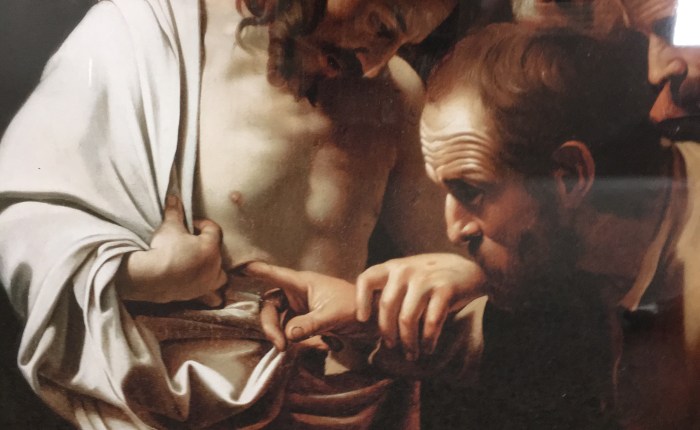
When Jesus appeared to His Apostles after the Resurrection, His hands, feet, and side still bore the marks of the crucifixion.  His glorious, death-conquering body held the holes that won salvation.  To be certain, His body was different than it was before.  He was strangely appearing and disappearing, passing into locked rooms, and yet still able to eat and be touched.  Dying and rising had changed His body.  Gone was the appearance scarred beyond human recognition.  However, His body still showed where nails and a spear had pierced Him through.  Why was that?

There are several theological reasons, but I would like to focus on one minor, personal reason.  I would argue that Christ kept His wounds to destroy our image of perfection.  Here is the conquering King, the One who has fought death and won and yet–He still shows signs of this arduous battle.  As the commander of this battalion, as the King who leads His people into battle, Christ is not unaware of the price of this fight.  Our whole lives seem to be a battle towards Heaven.  Christ doesn’t need perfect looking soldiers; He simply needs faithful ones.

The burden of perfection is one we place upon ourselves.  We want lives that are neat and tidy, yet none of us have it.  Sometimes we brand others as perfect, but that is only because we see portions of their lives and not the whole of it.  And when we expect this perfection from them, we encourage them to fake it instead of living authentically.

Often, when I tell people that my two older sisters are religious sisters, I can see them mentally placing my family in a certain type of box.  Years ago, I gave my witness in preparation for a summer of catechizing youth, and one of the critiques I received was that teens probably couldn’t relate to my story.  While I understood what they meant, I couldn’t help but take it a bit personally.  My story of an aching heart being separated from my sisters was not something they deemed relatable.  Since then, I have discovered that it is something to which others can relate.  Perhaps they don’t have siblings in religious life, but many have experienced anger and frustration with God and a plan you never wanted for your life. Continue reading “The Burden of Perfection”

Attractive Misery

Attractive Misery

We feel…shame at seeing our misery and our baseness exposed.  Yet this misery possesses the mysterious privilege of attracting our Lord.  This is difficult to understand, yet it is an incontestable truth.  Our nothingness and our misery constitute the force that attracts our Lord.

(Secrets of the Interior Life)

I’ve never really understood this idea of how our misery attracts the Lord to us.  Generally, when I see my own miserableness, it is repulsive or something I want to hide.  It isn’t something that is attractive or pleasant.  When it comes to seeing the miserableness of others, I’m not much better.  My personality is one that desires perfection.  The people around me (including me) are continually letting me down because they don’t live up to my image of perfection.

Yet the Lord uses all things for good.  The cheating incident I mentioned a couple posts back has really pushed my heart.  It made me move from anger to forgiveness.  A few days later when the individuals came back and we spoke, I found great freedom in being able to express how they had hurt me and to hear them apologize.  The relief on their faces was incredible.  It was though they walked into my room carrying a burden and then through the exchange of a few words, that burden was lifted.  My burden was lifted, too.

Strangely, over the last couple weeks, I have found a special tenderness in my hearts toward those individuals.  No longer angry, I am able to love them as they are: flawed human beings.  The Lord knows I have difficulty loving people in their humanity and so I am beginning to be grateful for this incident.  I don’t want to love them only when I think they are perfect, but for the beautiful complexity that is wrapped up within their hearts and souls.  I know myself and so I know I do not want to be loved merely for my seeming perfection but rather in my entirety.  In the midst of this, I experienced for the first time, at least consciously, the way that misery attracts my heart.   Continue reading “Attractive Misery”

Unrestricted Access to My Heart

Unrestricted Access to My Heart

Jesus, looking at him, loved him and said to him,
“You are lacking in one thing.
Go, sell what you have, and give to the poor
and you will have treasure in heaven; then come, follow me.”

Mark 10:21

It is because Jesus loves this young man that He challenges him.  By many standards, this man has done all that he has been asked to do.  He has kept the law since his earliest days.  Yet, he comes to Jesus to ask what he must do to inherit eternal life.  Either he wants to be affirmed in how excellently he has kept the law or he feels there is something more to which he is called.

Jesus looks at him with that gaze that pierces through the heart and is filled with a great love for this young man.  The authenticity of His love compels Him to call the young man to something greater.  Jesus tells the young man to put aside everything of this world and to follow Him.  It is out of love that He invites the young man to run with reckless abandon in the race for Heaven.

Yet the man leaves saddened.  Though he follows the law, he is unwilling to set aside everything for the Kingdom of Heaven.

Jesus issues His challenges out of love, but they vary based on the person.  Some He invites to follow Him and they cannot, refusing to leave behind possessions or family.  Others long to follow Him and He tells them to remain home, sharing the Good News among their own people.  When it comes to living in God’s will, there seems to be no one-size-fits-all approach for the Lord.  His will is customized to the individual and it often seems to be contrary to what we want.

This is why the life of contemplation is the boldest and most adventuresome of undertakings, for what could be more radical, more truly earth-shattering, than the willingness to be dismantled and created anew, not once or twice in a lifetime, but day after day?

The Way of the Disciple, Erasmo Leiva-Merikakis

He is not satisfied by things done half-way.  Our souls, though we may attempt it often enough, cannot be half His.  The young man wanted to comfortably follow the law and yet Jesus calls him to a life he did not expect.  Sell everything?  Why?  Where is that in the law? 

While I may be tempted to mentally chastise the young man (Jesus was asking you to follow Him!  How could you not?!), I must admit that I am he. Continue reading “Unrestricted Access to My Heart”

My Seeking Heart is a Sought After Heart

My Seeking Heart is a Sought After Heart

This blog is entitled “Seeking After His Heart.”  Ideally, I like to think of my life as a pursuit of the good, the true, and the beautiful.  Yet sometimes I overlook the fact that it is really about the Good, the True, and the Beautiful pursing me.

God initiates all of our encounters with Him.  If He did not reveal Himself, we would not know Him.  If He did not allow us to perceive Him, then we would be completely unaware of His presence.  Even prayer, which can sometimes be viewed as something we do for God, is actually something He does for us.

In conversation with my spiritual director, he told me to not overlook begging Jesus for the grace to go to Him in prayer.  And sitting in the adoration chapel the other evening, I reminded myself that I was there simply because I responded to God’s grace.  I mean, it kind of felt like it was purely my choice, but I knew that it was God offering His grace and me, finally, responding to it.

1400222_10153497936375484_1246065451_o

This initiation on God’s part is timeless.  All of the Old Testament covenants are made because God interacts with a human person and desires to be in relationship with them.  They don’t start the process.  “Hey, God!  I’d like to be a part of Your family!”  God reaches down to us and adopts us as His own.  Even greater still, He enters into the human family so as to bridge all gaps between us.  There is nothing left for us to do but to respond.

In John’s Gospel, Jesus speaks to the Samaritan woman with simple words, “Give me a drink.”  He seeks her out, He encounters her, and He asks her to enter into relationship with Him.  Yet I love the way that the Lord does this.  He reaches out to her and expresses His thirst for her. Continue reading “My Seeking Heart is a Sought After Heart”

The Best Defense is Encountering Love

The Best Defense is Encountering Love

You can, in the broadest terms, call it “Catholic culture.”  However it’s described, though, it’s not something you simply argue yourself into.  Rather, it’s something you experience aesthetically as well as intellectually, with the emotions as well as the mind, through friendships and worship and experiences-beyond-words as well as through arguments and syllogisms.

“Letters to a Young Catholic” by George Weigel

Something I am intent on drilling into my students this semester is that Christianity is necessarily a life of encounter.  It is the tremendous beauty of being able to experience an authentic and lived relationship with Christ while also delving into the rich intellectual tradition of the Church.  Catholicism is chock-full of the “both/and” that makes life so simple and yet so deep.

I teach high school Theology to sophomores and seniors, making it somewhat safe to assume that I am not an advocate of an anti-intellectual, touchy-feely Christianity.  Specifically, one of my courses is apologetics, which is teaching how to defend the faith against attacks.  And there are many, many attacks launched against the Church in every age, no less in this one.  Defending the faith, though, is not merely done through well-chosen words or precisely articulated statements.  These are helpful, but much of the battle is done through actions.  If my students do not love the Church, they will be far less inclined to defend or understand Her.

I am well aware that the love I have in my heart for the Catholic Church is not the norm.  My students need to encounter more than the beauty of truth to be convinced.  I read the Church’s teachings and my heart stirs with the acknowledgement that these are profound truths.  Often when my students hear the Church’s teachings, they hear how their freedoms are being minimized or that they are being told what not to do.  However, if they love the Church, they will see that She is a mother caring for and protecting Her children, even if they do not always understand.

This is where the necessity of encounter comes in.  Catholicism, in Our Lord’s great wisdom, is a faith filled with the tangible.  We hear the words of absolution at Confession, we feel (and smell) the oils at Baptism and Confirmation that claim us as members of the Church.  The incense, like our prayers, rises up to the Heavens as we adore Our Lord in the Eucharist.  On pilgrimage, we travel to the places where the bones of the Apostles and saints of the Church rest.  Oddly, we touch our rosaries and prayer cards to their tombs, praying that we will follow the Lord’s will as radically as they did.  We light candles before altars, hoping that our intentions will be continually presented to Our Lord’s throne.  As George Weigel says throughout Letters to a Young Catholic, there is a grittiness in Catholicism.  In this book, he also says the following:

Catholicism does not rest on a pious myth, a story that floats away from us the more we try to touch it.  Here, in the scavi [excavations under St. Peter’s], we’re in touch with the apostolic foundations of the Catholic Church.  And those foundations are not in our minds.  They exist, quite literally, in reality.  Real things happened to real people who made real, life-and-death decisions–and staked their lives–not on stories or fables but on what they had come to know as the truth.

To be Catholic, George Weigel argues and I concur, means to live in reality.  And as someone who so often feels that people think my ideals mean that I don’t live in reality, that is uplifting to hear.  Being Catholic means living in the greatest love story while also fighting the greatest battle of all time, primarily because it transcends time.  As a romantic with more than a touch of stubbornness, these intertwining elements make the Church my perfect home.  It is not merely a battle of the wits, arguing and defending a supernatural institution to a world rooted in earthly affairs.  It is also, and primarily, an encounter with Love, being transformed by Love, seeking to enter into Love.  If love is not at the heart, all is meaningless and in vain.   Continue reading “The Best Defense is Encountering Love”