A Thousand Deaths

A Thousand Deaths

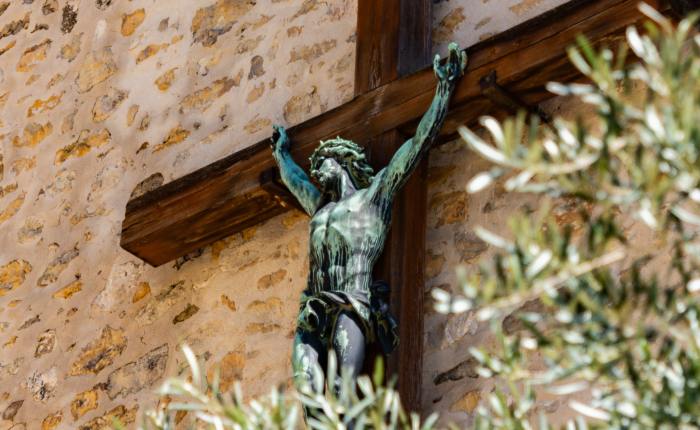
When Jesus was confronted with untrue accusations, do you remember what He did? As the Sanhedrin gathered false testimony, as Pilate presented questions given by the chief priests, as Jesus struggled beneath the weight of the cross and the jeers of the people, as Jesus was maligned while on the cross, do you remember what He chose?

Silence.

How hard it is to not rush to our own defense! When situations are misrepresented, when intentions are skewed, when honest questions are left unanswered, it is a tremendous act of the will to not attempt to set all things right. Sometimes, it is necessary to provide clarity and correctness and other times it is completely unnecessary. And sometimes it is necessary to try to show the misunderstandings, but to ultimately fail in convincing them of their skewed view.

We always feel the pains of injustice acutely when it offends our own sense of justice. I look at the lives of the saints and martyrs and I tend to think about how glorious and courageous were their deaths. Yet each of those martyrdoms was preceded by many, many small bloodless deaths. St. Paul didn’t only suffer beheading in Rome. Before that, he was imprisoned, he experienced riot after riot when preaching the Gospel, he was looked upon with distrust by the Jews and the Christians after his striking conversion, and he spent much time in chains for the sake of the Gospel. His final suffering, the death of a martyr, was simply the last death he experienced in a long line of dying to self.

Most of our stories won’t be quite that dramatic. We probably won’t sit unjustly condemned in terrible prisons awaiting our cruel deaths. We will, however, suffer in other ways. And it will be in ways that will be easy to want to reject or feel the need to correct. As Jesus heard false testimony, I am certain He had at least part of a desire to simply say, “I didn’t say that. That isn’t right. You weren’t there. You are intentionally misrepresenting me.” Instead, He suffered in silence with the Lord. He knew that the truth would be revealed and He rested with the Lord in the midst of being misunderstood. He invites us to do the same, in the small and the large sufferings of our daily life.

Continue reading “A Thousand Deaths”

In Defense of Summers

In Defense of Summers

A lovely perk of teaching is that most of my work stops in mid to late-May and resumes in early to mid-August.  It is a schedule I have held since I was about seven years old when I started school.  Since I have never known anything else, I sometimes have to remind myself that this is not the norm.

People frequently ask me what my plans are for the summer.  Sometimes they are curious about where I am traveling or what extra activities I will be involved in.  Other times, however, I think they are questioning why I am not getting a job for the summer.  Isn’t that what adults do?  This lingering question is also mixed with the slight jealousy that I have a few months to not work a 9 to 5 job.  I wish I had a job like that, I can almost hear them say.

Well, I’ve decided on a newer tactic this year.  If people comment on wishing they had the luxurious schedule that I have, I will tell them a little secret: this dream can be yours, too!  All you need to do is go to school, get the appropriate degree, and get a job teaching.  Last I heard, there wasn’t a surplus of teachers in our state and teaching here doesn’t require advanced degrees.

But, you see, that is the thing–there just might be a reason schools aren’t overflowing with insane numbers of candidates, at least not where I live.  I do get a summer to step away from it all, but that is a perk that must be taken with the less preferable parts of the job.  I never argue that I have the most difficult or demanding job in the world.  I don’t believe that I do.  Yet I hear over and over again from various intelligent people, “I could never do your job.”  Which I think is slightly exaggerated, but also quite telling.  I think many people could do the job I do, it is simply that many don’t want to. Continue reading “In Defense of Summers”

The Best Defense is Encountering Love

The Best Defense is Encountering Love

You can, in the broadest terms, call it “Catholic culture.”  However it’s described, though, it’s not something you simply argue yourself into.  Rather, it’s something you experience aesthetically as well as intellectually, with the emotions as well as the mind, through friendships and worship and experiences-beyond-words as well as through arguments and syllogisms.

“Letters to a Young Catholic” by George Weigel

Something I am intent on drilling into my students this semester is that Christianity is necessarily a life of encounter.  It is the tremendous beauty of being able to experience an authentic and lived relationship with Christ while also delving into the rich intellectual tradition of the Church.  Catholicism is chock-full of the “both/and” that makes life so simple and yet so deep.

I teach high school Theology to sophomores and seniors, making it somewhat safe to assume that I am not an advocate of an anti-intellectual, touchy-feely Christianity.  Specifically, one of my courses is apologetics, which is teaching how to defend the faith against attacks.  And there are many, many attacks launched against the Church in every age, no less in this one.  Defending the faith, though, is not merely done through well-chosen words or precisely articulated statements.  These are helpful, but much of the battle is done through actions.  If my students do not love the Church, they will be far less inclined to defend or understand Her.

I am well aware that the love I have in my heart for the Catholic Church is not the norm.  My students need to encounter more than the beauty of truth to be convinced.  I read the Church’s teachings and my heart stirs with the acknowledgement that these are profound truths.  Often when my students hear the Church’s teachings, they hear how their freedoms are being minimized or that they are being told what not to do.  However, if they love the Church, they will see that She is a mother caring for and protecting Her children, even if they do not always understand.

This is where the necessity of encounter comes in.  Catholicism, in Our Lord’s great wisdom, is a faith filled with the tangible.  We hear the words of absolution at Confession, we feel (and smell) the oils at Baptism and Confirmation that claim us as members of the Church.  The incense, like our prayers, rises up to the Heavens as we adore Our Lord in the Eucharist.  On pilgrimage, we travel to the places where the bones of the Apostles and saints of the Church rest.  Oddly, we touch our rosaries and prayer cards to their tombs, praying that we will follow the Lord’s will as radically as they did.  We light candles before altars, hoping that our intentions will be continually presented to Our Lord’s throne.  As George Weigel says throughout Letters to a Young Catholic, there is a grittiness in Catholicism.  In this book, he also says the following:

Catholicism does not rest on a pious myth, a story that floats away from us the more we try to touch it.  Here, in the scavi [excavations under St. Peter’s], we’re in touch with the apostolic foundations of the Catholic Church.  And those foundations are not in our minds.  They exist, quite literally, in reality.  Real things happened to real people who made real, life-and-death decisions–and staked their lives–not on stories or fables but on what they had come to know as the truth.

To be Catholic, George Weigel argues and I concur, means to live in reality.  And as someone who so often feels that people think my ideals mean that I don’t live in reality, that is uplifting to hear.  Being Catholic means living in the greatest love story while also fighting the greatest battle of all time, primarily because it transcends time.  As a romantic with more than a touch of stubbornness, these intertwining elements make the Church my perfect home.  It is not merely a battle of the wits, arguing and defending a supernatural institution to a world rooted in earthly affairs.  It is also, and primarily, an encounter with Love, being transformed by Love, seeking to enter into Love.  If love is not at the heart, all is meaningless and in vain.   Continue reading “The Best Defense is Encountering Love”