What does it mean to be a priest? Amidst the scandals within the Church, many have a fundamental misunderstanding of the priesthood. In Scott Hahn’s Many Are Called: Rediscovering the Glory of the Priesthood, the multi-faceted beauty of the ordained priesthood is revealed. Hahn’s work delves into what a priest is in his roles as mediator, provider, teacher, warrior, judge, bridegroom, celibate father, and brother.
Today

Today was a good day.
I slept in later than I should have and rushed to get ready in time. Rushing around, I didn’t eat breakfast and threw a bagel in my lunch bag. Preparing to submit my grades during my lunch time, I completely forgot to eat my lunch/bagel. A student asked me why we don’t have a class that covers all of the bad things Catholics have done in the past. And my supervisor mentioned (in a kind way) that I never date. (I had noticed.)
But today was still a good day.
I met this morning with lovely young ladies and we talked about preparing ourselves for the relationships for which we all long. I had multiple times today where I would realize, “Hey, I’m doing this teaching thing!” A couple moments with my seniors resulted in laughter, partly because I am less defensive than I’ve been in previous years and I was able to take things in stride with a smile. Today, I laughed: when a student flipped his pencil to the ceiling (and looked like he surprised himself), when a student asked if I would take them all to walk the Camino (my answer: I don’t think we would all make it to the end alive), and with various friends during conversations. I had a cup of coffee in a mug decorated with pictures from a trip my sister and I took. During school, I prayed the Holy Sacrificed of the Mass. I made Thai food. I read more in my current book. I was able to talk about art and martyrdom today and feel passionate for the topics even if my students appeared less than excited to hear about them. One of my housemates shared her leftover cheesecake. And I can hear a couple of my housemates trying to figure out the suspenseful show they are watching.
Today was a good day. The Lord used the nothing that I had and He brought about something. It wasn’t perfect and it probably could have been better if I had given more of myself. Thank You, Jesus, for this day.
Ever-New

Do you remember? Do you remember?
The voices are hushed but brimming with excitement. It is dark with only flickering candlelight illuminating joyous faces. Of course they all remember.
By all rights, this should be a story that is told with sadness, one where sorrow should be the predominant feeling. It should be tragic and riddled with painful memories. That is not the case, however.
They can barely keep the laughter at bay. Wide smiles show how their hearts desire to break out of their chests. They are simultaneously on the brink of crying and shouting, so full are their hearts.
Do you remember? Why is this night different from all other nights?
The second question is a carryover from their Jewish roots–but it is fitting here. It is perfectly fulfilled here.
There are numerous possible narrators to the story, each holding a piece that contributes to the full picture. John is there and he tells of His last moments on the cross and the ache in his heart as he watched Him die. Mary Magdalene speaks of her sleepless night, the long Sabbath, and rushing with spices to the tomb early on the first day of the week. Peter speaks of walking into the empty tomb, marveling at the clothes that remain where the body once was placed. Each person adds another detail to a story they have told over and over again. Yet it is one of which they can never tire. It isn’t simply a story from the past but rather re-tells an encounter they had with the living God.

Saturday evening as I stood in a dark church while the Easter candle was being lit, I considered something I never have before: what would it have been like to be at the second Easter? The first Easter would have been incredible, but as I stood in the church, it was very clear that I wasn’t at the first Easter. But the second Easter? When they gather together to re-live what had happened a year ago? I could imagine that. If I closed my eyes and focused on the prayers, I could feel this uncontrollable joy welling up in my heart. Before long, I was fighting back tears and grinning like a fool in the darkness.
I had encouraged my students to delve into Holy Week and to consider the well-known story in a new light. Chances are really good that none of them remembered what I said, but I found myself taking my own advice. What if I wasn’t at Easter Vigil (like I am every year) but rather was at the first anniversary of the first Easter? They couldn’t even wait until Sunday to gather. Instead, they gather together in the darkness to hold a vigil for the Resurrection.
A lot can change in a year. One year earlier, they were wrapping their minds around the Passion, vacillating between numbness and crushing sorrow. Even in the finding of the empty tomb and the first appearances of Jesus, there were still so many questions and much confusion. A year later and they were witnesses of the Resurrection, filled with the Holy Spirit, and traveling to proclaim the Gospel. They didn’t have all of their questions answered but their mission was certain. Gathering together, their joy grew exponentially as they considered again those three sacred days.
Do you remember? Do you remember? The new followers, the ones who were not there one year earlier, listen eagerly to the story, caught up in the drama of human salvation. Even as they re-tell the Passion and Death of Jesus there is an undercurrent of joy. They enter into His death deeply, recalling where they had been during those moments of agony, but they know that He lives now. With solemnity, they trace the providence of God from the beginning. From creation to freedom from Egypt to the challenges of the prophets, they recall how God had prepared them for the fulfillment of all the old covenants. Soon they are talking about Easter Sunday, with all the little details pouring in:
“I thought He was a gardener!” Mary Magdalene recalls.
“I ran faster than Peter,” John says with a youthful wink at the Vicar of Christ.
“I didn’t go to the tomb, because I knew He had risen,” Mary, the mother of Jesus, says with a smile of remembrance.
The central point of Christianity is not about following rules or attending excessively long religious services. Christianity is about encountering the person of Jesus Christ. Everything else is aimed at fulfilling or bringing about that encounter. As I sat in Easter Sunday Mass, listening to the priest’s homily, I couldn’t help but glance around a little and see some tired, bored faces. And I wondered, “How many of these people here have never really encountered Jesus Christ?” They attend Mass because their husband or wife or parents want them to or because they feel some guilt if they should stop attending. How sad would it be if a relationship with God that is intended to be marked with joy is instead filled with simply surface level commitment.
The joy of Easter should not be mainly that we can now eat or do what we previously could not eat or do during Lent. It should be because we once again remember that Jesus Christ is the Savior we need. He died, He is risen, and that changes everything. It is not old news or historical details but is something that is ever-ancient yet ever-new. In that dark church on the eve of Easter, I thought of the joy and fulfillment that filled the hearts of the early Christians as they recalled the previous year. And I longed for that joy only to realize that it could and should be mine. We should be like the early Christians, gathering with hearts of praise to recall what the Lord has done for us.
Do you remember? Do you remember? He died, He rose, and He lives. And it continues to change my entire life.
A Mercy Divine

“My people, what have I done to you or how have I offended you? Answer me! I led you out of Egypt, from slavery to freedom, but you led your Savior to the cross. My people, what have I done to you? How have I offended you? Answer me! For forty years I led you safely through the desert. I fed you with manna from heaven, and brought you to a land of plenty; but you led your Savior to the cross. What more could I have done for you? I planted you as my fairest vine, but you yielded only bitterness: when I was thirsty you gave me vinegar to drink, and you pierced your Savior with a lance.” (Reproaches of Good Friday)
Good Friday is a day of worlds colliding. We acknowledge the death of Our Lord and our role in it, but we also recall this as the glorious means for our salvation. The cross is an instrument of torture and yet we take time to exalt the cross, coming forward on bended knee to kiss Our Savior as He is fastened to it.
Today, we begin the Divine Mercy Novena which concludes on Divine Mercy Sunday. After the Good Friday service, we prayed the first day of the novena. And I couldn’t help but remember another time when I had prayed the Divine Mercy Chaplet. It was about six years ago and I stood on the cold, snowy ground of the Auschwitz concentration camp.
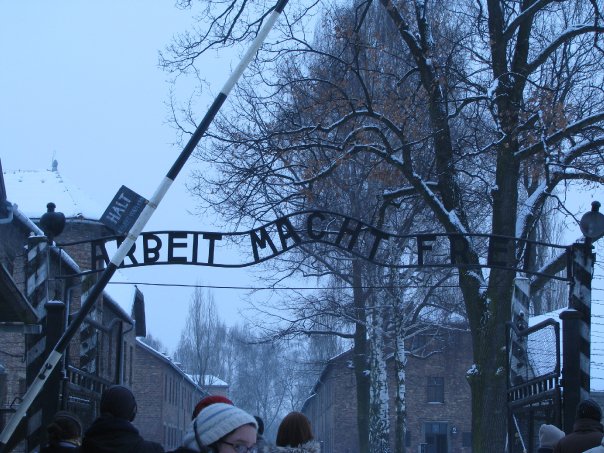
For the sake of His sorrowful Passion, have mercy on us and on the whole world.
We had already toured Auschwitz I. There I saw picture after picture of people who had entered that place of death. Next to each picture was a little card that gave the person’s name, their entrance date, and the date of their death. But the faces were what became engraved on my heart. I had heard for years about the number of people who died in the Nazi concentration camps, but to see only a fraction of their pictures changed statistics into human lives.

In silence, we loaded the bus so that we could go to Auschwitz II. Here we saw long barracks and miles of barbed wire fences. And we struggled to understand that human beings did this to other human beings. We saw cattle cars that humans arrived in and we surveyed the watchtowers that were situated to keep all under surveillance.

In the last few minutes of being there, we prayed the Divine Mercy Chaplet. Because what else can you do when surrounded by such a witness to the depravity of humanity? We could only make appeals to the mercy of God. I could not offer to God my own merit or good works because they are insufficient in the face of such tragedy. I can only offer His Son back to Him.
Eternal Father, I offer You the Body and Blood, Soul and Divinity of Your dearly beloved Son, Our Lord Jesus Christ, in atonement for our sins and those of the whole world.
Kneeling during the Good Friday service and during the Divine Mercy Chaplet, I could not help but consider this again. In the wake of the death of Jesus Christ, I can offer nothing to atone for it. These hands were not physically there, but my sins were bought and paid for with His blood on that day. Even if I lived a perfect life, I could not make up for what has been done. The only offering I can make is Jesus Himself.
A couple years ago, I considered the words of the Divine Mercy Chaplet and I realized that it is truly a mercy that can only come from God. We plead our cause by offering to God the very One we killed. In any other situation, this would seem laughably grotesque. Imagine a murderer asking for clemency from a mother or father by invoking the name of the child killed. Not simply through their name but asking that through the child’s death mercy and forgiveness will be shown to the murderer. Such mercy is what can only come from God.
Good Friday comes down to accepting that I cannot do anything. In the Passion narrative, I am the one calling for His crucifixion and claiming that He is not my king. And I must say those words because I profess them often enough with my life. Good Friday isn’t about beating yourself up or trying to make yourself feel lousy. It is about accepting the role we have played in the death of Jesus Christ. He didn’t die, though, so that we could wallow in guilt and self-pity. He came to make us new. He came to utterly transform us. He came to take every part of us and to pour His perfect mercy over all the parts of our heart that most need it, yet are too fearful or prideful to plead for it.
Christ says “Give me All. I don’t want so much of your time and so much of your money and so much of your work: I want You. I have not come to torment your natural self, but to kill it. No half-measures are any good. I don’t want to cut off a branch here and there, I want to have the whole tree down. I don’t want to drill the tooth, or crown it, or stop it, but to have it out. Hand over the whole natural self, all the desires which you think innocent as well as the ones you think wicked–the whole outfit. I will give you a new self instead. In fact, I will give you Myself: my own will shall become yours.” (Mere Christianity, p. 166)
Eternal God, in whom mercy is endless and the treasury of compassion–inexhaustible, look kindly upon us and increase Your mercy in us, that in difficult moments we might not despair nor become despondent, but with great confidence submit ourselves to Your holy will, which is Love and Mercy itself.
(Closing prayer for the Divine Mercy Chaplet)
Thirst

Today, during my sophomore classes, we prayed the Stations of the Cross. Though I’ve prayed them many times before, God seems to repeatedly sow new meaning into the lines. Phrases I hadn’t before realized, come to life in a startling way.
The thirst of Christ struck me in prayer today.
“My God, my God, why have you forsaken me, far from my prayer, far from the words of my cry? O my God, I cry out by day, and you answer not; I cry out by night, and there is no relief for me. All my bones are racked. My heart has become like wax melting away within my chest. My throat is dried up like baked clay, my tongue cleaves to my jaws; they have pierced my hands and my feet; I can count all my bones.” (Ps. 21/22, The Way of the Cross)
I’ve grown up hearing about Bl. Mother Teresa saying that Christ was thirsting for our souls while on the cross. And that took on a new depth today and will be something I will return to throughout this Holy Week.
For a few brief seconds, I was able to imagine the intense thirst of Christ. I considered a couple moments in my life where I have felt extremely thirsty, when my tongue seems to stick to my mouth. The instances have been few and far between. I had always passed over these words with little thought, but today I was unable to. I could imagine Christ’s dry mouth and His tongue sticking to His jaws, as He tried to peel it away to speak a few words. He longed for a little water.
This thirst Christ had was one aspect of His intense suffering. He also had the scourging on His back, His hands and feet were pierced, His head was seeping blood as the thorns bit into His scalp, and He was repeatedly pushing Himself up to take in some air. His thirst was one part of the physical agony. But it struck me. For a few seconds, I imagined, to a degree, that thirst and my heart seemed unready to take in the rest of the Passion while surrounded by a bunch of teenagers.
A new depth of thirst was realized. If I now have a greater understanding of His physical thirst, how much deeper was His thirst for souls. Even more than for a cup of cool water, Christ was longing for our souls. The intensity of such a thirst pains my heart. Here Christ so deeply desires my heart and I am slow to give Him it in its entirety. May a new thirst fill my own heart for the Lord. May the intense thirsting of Christ on the cross be my new attitude toward Christ Himself.
As a deer longs for flowing streams, so my soul longs for you, O God. My soul thirsts for God, for the living God. When shall I come and behold the face of God? (Ps. 42)
Small Heart

Oh, you of little faith. Oh, you of little heart.
Jesus is calling us to cast out into the deep. But isn’t it easier to not? It is easier to stay on the shallow side. Yet we long for the depths, for the great things that can happen on the other end of the pool, the other end of the lake. Sometimes we just wish it wasn’t so deep.
“You desire greatness, but you keep your heart small.” The Lord told me this during my retreat and I had to admit that it was true. I was in one of my favorite Scripture passages–Jeremiah 18–and the Lord was the potter at the wheel, shaping and forming my heart. Over the next few days, I spent time considering the ways I keep my heart small. I’m sure my list was not exhaustive, but there were a few convicting realizations. The small heart is often maintained because of fear. Fear that expanding the heart will mean pain or disappointment. Jesus, though, is asking me to cast out into the deep. “Do not be afraid…” Ah, Jesus, but I am.
In conversation this past week, I came to a renewed realization of the necessity of seeking healing for the sake of myself and for others. My small heart, if it expanded, could be a catalyst for others to let their hearts grow. If I allow my heart’s state to be dictated by how others respond, then why couldn’t I flip that around? Why can’t my choice to be large-hearted move others to embrace the same? Even if it doesn’t, my internal freedom will be transforming my own heart.
“To love at all is to be vulnerable. Love anything and your heart will be wrung and possibly broken. If you want to make sure of keeping it intact you must give it to no one, not even an animal. Wrap it carefully round with hobbies and little luxuries; avoid all entanglements. Lock it up safe in the casket or coffin of your selfishness. But in that casket, safe, dark, motionless, airless, it will change. It will not be broken; it will become unbreakable, impenetrable, irredeemable. To love is to be vulnerable.” (C.S. Lewis, The Four Loves)
He calls us to cast out into the deep. Not content to simply tell us, He models the pathway for us. He casts His net into the depths of our hearts, the places we hoped were sufficiently covered, the areas we ourselves had almost forgotten. And He shines His light there, His mercy a mantle covering it all. Then He turns the net over to us and asks us to do the same. Cast deep into my heart, He says. Go deeper, plunge further in. In the safety of such a vast heart, we are then able to let Him plumb the depths of our own. We will want Him to bring all to light and we won’t resist when He pushes the edges of our heart, widening the chambers to be filled with more of Him.
There is a greatness of heart that awaits us if we relinquish our clasp on our small hearts. Give the Potter free reign over the size of your heart and follow His lead in casting into the deep. Who knows what you will catch?
Bold Claims
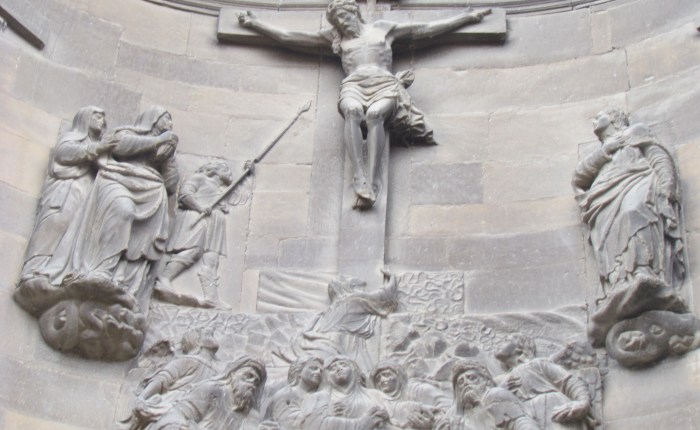
The Lord is the goal of human history, the focal point of the longings of history and of civilization, the center of the human race, the joy of every heart and the answer to all its yearnings. (Gaudium et Spes, 45)
Christianity makes shockingly bold claims. It does this because Christ made bold claims. If the Gospel message that you have heard doesn’t ruffle feathers or irk people, then it isn’t the same Gospel that Jesus Christ proclaimed.
Think about how people responded to Jesus Christ. Numerous times we hear about Jesus being driven to the brow of the cliff, or people picking up stones as He spoke, or people simply becoming angry at His words. This wasn’t because He told people that they just needed to be nice people. His words challenged. His words provoked. His words called people to look inside themselves and to realize that they could not save themselves.
Though we may accept the Gospel and profess to believe it, if we are honest with ourselves, each must continue to wrestle with the call of Jesus in our lives. There are still teachings of Jesus that have yet to be fully accepted in our hearts.
And there are bound to be things in his teachings that each of us finds offensive if we look at the totality of those teachings rather than confining ourselves to comfortable and familiar ones. (The Pocket Handbook of Christian Apologetics, p. 60)
For example, Jesus tells us that we are to forgive. The love of Christ compels us to love and forgive all. That means the survivors of the Holocaust are to forgive the very people who imprisoned them and took the lives of their friends and family members. It means the families of those who died in 9/11 are to forgive those who applauded themselves for being the masterminds of the attack. No, neither of those situations have impacted me in a directly personal way. But it is the message of Jesus Christ and it is not a message meant simply for forgiving the person who cut you off in traffic or the store clerk who is annoyed that you need her assistance. The Gospel message is precisely for those moments that seem unforgivable. It is then that we can recognize that it must be Christ working through us, that grace must be received in order to live out this bold life.
Christianity is not calling us to a life of ease and comfort. The King of this kingdom was crucified and the Queen watched it all unfold. Christianity, in its truest sense, is calling us to such a death. But it is a death that must be experienced so that we may embrace a fullness of new life. Once we experience that death and new life, the next death doesn’t really matter anymore. It will be a mere parting of the veil, a stepping into the throne room of the King, entering into the Holy of Holies. From life we will pass into Life.
With such a reward, it is no wonder that the early Christians were willing to lay down their lives for the sake of Jesus Christ. They looked upon death with no fear, but rather with joyful anticipation. Because, in that moment, they recognized that the Gospel of Jesus Christ was for those particularly difficult times.
We cannot accuse Christ of shielding the disciples or us from the realities of what following Him would require. He is direct and His voice is clear: if we love anything above Him, we will need to re-order our heart, even if the beloved is our family or our own selves. For Christ, we give all up and we received it back one hundred fold. I do not claim to have perfected this, but I know there is a tremendous freedom that is found in giving all to Christ. When my sisters entered the convent, the bitterness I felt was a result of not letting them go or surrendering them to the Lord. I’m a slow learner and so years later, when I actually began to sincerely let them go, I felt a tremendous freedom in my relationships with them. Problems may still arise in my heart regarding my sisters’ vocations, but I think God’s grace has pretty much vanquished that demon as of this past summer: but it took me eleven years. That freedom, though, is tremendous.
The Lord seeks to answer the deepest longings of our hearts. He boldly declares that He not only has the answer but that He is the answer. The fulfillment of all our desires is Him. The longings we experience are for relationship with Him. The joy we yearn to have fill our hearts is found in none other than He who fashioned our hearts. It isn’t Titanic-style love. It is rugged cross, pierced with beauty and sacrifice, blood pouring out that transforms hearts of stone to hearts of flesh-style love. And it asks for a great price. It asks for all we have. The return, though, is worth the investment.
Jesus said, “Truly, I say to you, there is no one who has left house or brothers or sisters or mother or father or children or lands, for my sake and for the gospel, who will not receive a hundredfold now in this time, houses and brothers and sisters and mothers and children and lands, with persecutions, and in the age to come eternal life.” (Mark 10:29-30)
Pierced by Beauty

Nearly all of my students disagree with me, but you cannot convince me that beauty is not one of the most compelling arguments for God’s existence.
I understand, at least in part, the seeming flaws of the argument. They protest that beauty is subjective and that nobody would believe in God simply because someone says there is lovely music or they saw a sunset. Perhaps, perhaps most people would not listen to Bach and then profess belief in God. But, perhaps some would, perhaps some have.
When I was in middle school, I read the book A Memory for Wonders. It was by a French woman who was raised in Morocco because her parents, staunch atheists and communists, didn’t want anyone to speak to her about God, filling her mind with such superstitions. Despite her parents’ best intentions, her initial experience of God took place when she was three years old.
“Suddenly the sky over me and in some way around me, as I was on a small hillock, was all afire. The glory of the sunset was perhaps reflected in the myriads of particles of powdery sand still floating in the air. It was like an immense, feathery flame all scarlet, from one pole to the other, with touches of crimson and, on one side, of deep purple. I was caught in limitless beauty and radiant, singing splendor. And at the same time, with a cry of wonder in my heart, I knew that all of this beauty was created, I knew God. This was the word that my parents had hidden from me. I had nothing to name him: God, Dieu, Allah or Yahweh, as he is named by human lips, but my heart knew that all was from him and him alone and that he was such that I could address him and enter into relationship with him through prayer. I made my first act of adoration.” A Memory for Wonders, Mother Mary Francis, p. 30
My parents spoke freely to me of God while I was growing up. So this experience of seeing the beauty of a sunset and being unable to name the author of it, isn’t something I can share. Yet I can share, in part, the feeling of piercing beauty at different sights and sounds.
It was during a semester studying abroad that the power of beauty become real to me. Surrounded by history and architecture unlike any in the United States, I was continually amazed at what I saw. In Switzerland, my heart ached as I walked around a lake and soaked in the beauty of mountains. I was nearly in tears as I surveyed God’s handiwork, and I kept thinking, “No atheist can live in Switzerland. How could you deny God in the midst of such splendor?”


I climbed a radio tower on a mountain in Austria and watched the sun rise. As the light spread across the mountains, I felt fully alive. My heart was in awe at the magnificence, at a beauty that did not need to be there even if the sun was necessary for our survival. The glory of a sunrise is entirely “extra.”

My awareness of the power of beauty began during my European adventure, but it has continued ever since. Probably three times this week I have been near tears as I watched the sun rise or set. My heart cannot stop itself from aching and expanding, my mouth uttering the briefest of prayers, “Lord!” Beauty is not always warm and delightful. Sometimes it aches: it is a blade, a spearing of the heart, a breaking into my world, and an unearthing of the hidden wellspring within.
For most, beauty may never transform their hearts of disbelieving atheism into ones of faith. Yet for me, beauty is one of the most potent reminders of God’s presence. It is a sunrise offered to millions and I look at it, bold colors covering the expanse of the prairie skies, and I think, “For me, Lord?” For a little girl in Morocco decades ago, it was a sunset that started a relationship with the living God, one that grew into her conversion to Catholicism and her entrance into a religious community.
A heart that is able to see beauty is one that is more fully alive. Beauty opens us up to an experience of something outside of ourselves. It places us in a feeling of smallness at such majesty and yet a feeling of greatness to glimpse such sights. You must be open to such beauty, however, to be transformed by it.
So, perhaps my students are right. Beauty will never force people to believe in God. It cannot overcome your free will. But beauty, if you are open to it, can seize your heart, providing the ineffable conviction that the Creator of all this splendor must be worth seeking, following, and loving.

It doesn’t have to be perfect

It doesn’t have to be perfect.
I’m sitting in my college Honors class. The two hour class occurs twice each week and is entirely discussion based. We are reading the classics and then we discuss them, seated in a circled with annotated copies of Western Civilization’s greatest works at hand. I cannot bring myself to talk and I feel helpless as class after class passes and I say nothing. The longer my silence goes, the more convinced I am that the first time I say something, it must be brilliant. It must be perfect. It must redeem the previous hours of silence. But with such pressure, how can I ever speak? After a class mid-way through the semester, one of my peers tells me that I have things to say, I just need to say them. The perfectly sculpted answer never comes into my head, though.
It doesn’t have to be perfect.
It is my senior year of college and I am sitting in my boyfriend’s car. It doesn’t matter what the question was that he had just asked me. It wasn’t a one time occurrence. He asks me a question and the little introvert retreats into her mind. Maybe the question really required some deep thought, but sometimes it was just trying to come up with the perfect way to phrase my response. Sometimes we sat there for fifteen minutes, the silence heavy and my brain actively trying to arrive at perfection. I was asked to just say something and I found it difficult. It needed to be just right. It should be a perfect answer after twenty minutes of deep thought.
It doesn’t have to be perfect.
But I want it to be perfect.
Twice over the past week it has been presented to me that it is alright that something is not perfect. I am an idealist through and through. While I live in this reality, my mind is often caught up in a world of what should be. After a talk I recently attended, there was a bit of discussion. One of the women who attended shared a bit of her heart with the group and one of the guys there responded to her. There was an exchange of dialogue and then a couple beats of awkward silence, the group trying to transition to the next subject. I found that the awkward transition bothered me. My idealistic self wanted the conversation to flow naturally, for people to share their hearts and for everyone to respond in the perfect way.
It doesn’t have to be perfect, Trish.
Humanity is a sea of imperfection. I should be used to it: I’m a little pool of imperfection. And yet I find myself wanting for things to play out as they do in the movies or in book: perfectly scripted where everybody knows their cues. But it is fine for things to not be perfect.
Then I went to a retreat and there were a few times when people were able to share a little witness of what they had received in prayer. When people got up to speak, I felt sorry for them if they seemed a bit nervous. Yet I found myself internally willing them to not be nervous and hoping they would say everything perfectly.
It made me pause: what is my hopeless addiction to things being perfect? I’ve scripted and re-scripted how I meet the man I will marry. I look through food blogs and I pin recipe after recipe of perfectly photographed culinary delights. I imagine running race after race to become perfectly in shape.
It doesn’t have to be perfect. In the midst of someone’s suffering, some words spoken in comfort are far better than the nothingness while you seek for perfection. When hungry, something adequate is far better than the perfectly pulled together meal that never happens. When training for a race, the ugly flailing of limbs is better than waiting for perfection to spontaneously take root in you.
I am now beginning to understand the phrase that a dear priest would say repeatedly: if something is worth doing, it is worth doing badly. So he was quoting dear G.K. Chesterton, but I will always think of him with that phrase. And now I am getting it. At the time I probably thought: wouldn’t it be best to do it well? Of course, if one can do it well, they should do it well. But some things, one must simply do, whether or not they do it well. If the race is worth running at all, then I should do it, even if I do poorly. If the class is worth teaching, then I should teach it, even if I don’t do it perfectly. If the words are worth speaking, I should speak them, even if I fumble and don’t find the exact phrasing I want.
Chesterton and that dear priest were advocating trying, even if you failed. That has not been my life motto. Mine would be pretty close the opposite. “If something is worth doing, think about it for a long time until you think you can do it perfectly, otherwise don’t do it at all because it might not be quite right.” A bit of a different worldview, I would say.
I cannot advocate the absolute crushing of the ideals I have, but I can propose that the ideals should be remembered as something to strive for, not the intended starting point. The goal isn’t to be imperfect, but it is impossible to plan to arrive at perfection immediately. Instead, the reality of humanity must be taken into full account. It is acceptable to stumble and fall along the way, as long as we keep getting back up and moving forward. If I come to terms with the imperfection that is naturally within others, perhaps I can give myself greater permission to come to terms with the imperfection that is overflowing within me. Instead of masking it, I could acknowledge it and then set about pursuing something more, something better.
Reality isn’t perfect. It is flawed, messy, and doesn’t follow a neat set of rules. But it is what I have.
If life is worth living at all, then it is worth living badly while in the pursuit of something great. And this little heart of my deeply needs to just live without the strain of perfection. Jesus said His yoke is easy and the burden is light. Being perfect is not a part of that easy and light.
I’m not perfect and I don’t need to be…yet.
Encounter

“You’ll enjoy it. You’ve been excited for this talk since you heard about it. You don’t go out much…you really should go out tonight.”
This wasn’t me trying to convince a friend to go out. This was me trying to convince myself to go out last night for a theology talk at a bar. Shouldn’t be that hard of a sell except I have one little quirk: sometimes my introvert takes over. Going to bed early or spending the night at home reading or doing some needed homework sounded like lovely alternatives to going out to talk to people.
Introverts like social interactions (humans are social beings…and introverts are humans), but it doesn’t take much for me to prefer a quiet evening. Or at least just a few friends and not a potentially crowded room where I would engage in the ever-hated small talk. But I did it. I went. Initially, I was annoyed that I was an introvert and it took so much convince myself to go out. But, gradually, I forgot about it and enjoyed the evening.
When I got home, I listened to a voicemail from a friend and I had to laugh. She was telling me about how that evening she went out to a party with co-workers. For a couple days she had not been herself, but after an hour of talking to co-workers at a crowded bar, she left happier. We’re both introverts and so we get the lack of desire to do social things sometimes. But a question she posed in the voicemail resonated with me. She said, “Why, Trish, why would going and talking to my co-workers at a crowded bar change things/make me happier?” (I paraphrased it a bit, but that is the gist.)
My first thought was because we need community. On our own, we can become isolated and it can be a bit miserable to be lost inside your own head. But community brings us outside of ourselves. I was grinning as I listened to my friend ask this question because I had just experienced the fruit of being with people. It wasn’t that I was with my best friends or that it was the most fun I ever had. Rather, it was the experience of the encounter.
What is amusing to me is that the talk I attended focused around the fact that Christianity is not a set of rules but is an event, an encounter with a person. We are Christians not because we follow the Christian code of conduct (although Christ definitely asked us to live in a certain way and how we live does matter) but because we have encountered the person of Jesus Christ and have been changed because of it. This encounter with Jesus can happen through our encounter with other people. We experience the presence of God in a situation and it can seem magnificent, but it is acknowledging a truth that is constant: God is here with us. He is dwelling among us. We can find Him in one another, experiencing the same person of Jesus Christ even though He has the face of a stranger.
One of my Lenten goals/penances is to personally encounter my students more. It is so easy to have them come in, sit down, ask the class a general question about their weekend, and then launch into the subject at hand. And it is important to actually teach them something substantial. However, I have a desire to know my students. Small talk doesn’t come naturally to me, so I am making an effort to have a little conversation with different students. Today, I talked to one of my quieter students who seems to just be slipping by in the class. It isn’t that the grade is low, but the student seems to not have close friends or reach out to many people. So we talked briefly. She was one of the first ones in my classroom and we talked about her job that she was working at this weekend. In the midst of this conversation (neither very monumental nor very deep), I was struck by the encounter. It was something small, but it was something. She didn’t bare her soul to me, but she shared something about herself that I didn’t know before. We found something we had in common and we shared it with each other.
We are communal beings and in encountering each other, we can encounter Christ. That is why a trip to a noisy bar with co-workers can transform us from glum to joyful. It wasn’t where we went or even what we talked about or what we imbibed.
It was the encounter.
 Seeking After His Heart