The Best Defense is Encountering Love

The Best Defense is Encountering Love

You can, in the broadest terms, call it “Catholic culture.”  However it’s described, though, it’s not something you simply argue yourself into.  Rather, it’s something you experience aesthetically as well as intellectually, with the emotions as well as the mind, through friendships and worship and experiences-beyond-words as well as through arguments and syllogisms.

“Letters to a Young Catholic” by George Weigel

Something I am intent on drilling into my students this semester is that Christianity is necessarily a life of encounter.  It is the tremendous beauty of being able to experience an authentic and lived relationship with Christ while also delving into the rich intellectual tradition of the Church.  Catholicism is chock-full of the “both/and” that makes life so simple and yet so deep.

I teach high school Theology to sophomores and seniors, making it somewhat safe to assume that I am not an advocate of an anti-intellectual, touchy-feely Christianity.  Specifically, one of my courses is apologetics, which is teaching how to defend the faith against attacks.  And there are many, many attacks launched against the Church in every age, no less in this one.  Defending the faith, though, is not merely done through well-chosen words or precisely articulated statements.  These are helpful, but much of the battle is done through actions.  If my students do not love the Church, they will be far less inclined to defend or understand Her.

I am well aware that the love I have in my heart for the Catholic Church is not the norm.  My students need to encounter more than the beauty of truth to be convinced.  I read the Church’s teachings and my heart stirs with the acknowledgement that these are profound truths.  Often when my students hear the Church’s teachings, they hear how their freedoms are being minimized or that they are being told what not to do.  However, if they love the Church, they will see that She is a mother caring for and protecting Her children, even if they do not always understand.

This is where the necessity of encounter comes in.  Catholicism, in Our Lord’s great wisdom, is a faith filled with the tangible.  We hear the words of absolution at Confession, we feel (and smell) the oils at Baptism and Confirmation that claim us as members of the Church.  The incense, like our prayers, rises up to the Heavens as we adore Our Lord in the Eucharist.  On pilgrimage, we travel to the places where the bones of the Apostles and saints of the Church rest.  Oddly, we touch our rosaries and prayer cards to their tombs, praying that we will follow the Lord’s will as radically as they did.  We light candles before altars, hoping that our intentions will be continually presented to Our Lord’s throne.  As George Weigel says throughout Letters to a Young Catholic, there is a grittiness in Catholicism.  In this book, he also says the following:

Catholicism does not rest on a pious myth, a story that floats away from us the more we try to touch it.  Here, in the scavi [excavations under St. Peter’s], we’re in touch with the apostolic foundations of the Catholic Church.  And those foundations are not in our minds.  They exist, quite literally, in reality.  Real things happened to real people who made real, life-and-death decisions–and staked their lives–not on stories or fables but on what they had come to know as the truth.

To be Catholic, George Weigel argues and I concur, means to live in reality.  And as someone who so often feels that people think my ideals mean that I don’t live in reality, that is uplifting to hear.  Being Catholic means living in the greatest love story while also fighting the greatest battle of all time, primarily because it transcends time.  As a romantic with more than a touch of stubbornness, these intertwining elements make the Church my perfect home.  It is not merely a battle of the wits, arguing and defending a supernatural institution to a world rooted in earthly affairs.  It is also, and primarily, an encounter with Love, being transformed by Love, seeking to enter into Love.  If love is not at the heart, all is meaningless and in vain.   Continue reading “The Best Defense is Encountering Love”

Getting to the Heart of the Matter

Getting to the Heart of the Matter

“I will not let Satan use my heart against me.”  

Arguably, the topic I write about most is the human heart.  This is probably because I am always struggling to come to terms with having one.  The Lord redeemed the human heart  when He became incarnate.  I am certain it provided difficulties for Him, also, but He handled all of those temptations and challenges to prove that, with His grace, it can be done.

Scripture speaks often of the heart.
“For where your treasure is, there your heart will be also.” (Mt. 6:21)
“My heart overflows with a goodly theme; I address my verses to the king; my tongue is like the pen of a ready scribe.”  (Ps. 45:1)
“Keep your heart with all vigilance, for from it flow the springs of life.”  (Proverbs 4:23)
“And the peace of God, which surpasses all understanding, will guard your hearts and your minds in Christ Jesus.”  (Philippians 4:7)

Fyodor Dostoyevsky, in The Brothers Karamazov, said, “The awful thing is that beauty is mysterious as well as terrible. God and the devil are fighting there and the battlefield is the heart of man.”  Beauty is a powerful force and both God and Satan use it for their own purposes.  It moves our hearts, sometimes against our wishes or in spite of our intentions.

Our hearts are being fought over and so I guess it makes sense that mine so often feels like a war zone.  Too often, however, the main focus can be me and not about how the Lord could be using feelings, situations, and circumstances to draw me closer to Himself.  And when the focus rests on me, it becomes a pretty dismal outlook.  In The Screwtape Letters, C.S. Lewis recognizes this tendency in a letter to Wormwood, a young demon-in-training.  “The simplest is to turn their gaze away from Him towards themselves.  Keep them watching their own minds and trying to produce feelings there by the actions of their own wills.” Continue reading “Getting to the Heart of the Matter”

That Heartburn

That Heartburn

Last year, Fr. Mike Schmitz came out with a video.  And this year, I showed it again to all of my classes.  Sometimes I mind watching the same video six times in one day, but this was not one of those times.  Each time I watched it, I was filled with this desire to be holy and to persevere in running the race.

“Therefore, since we are surrounded by so great a cloud of witnesses, let us also lay aside every weight and the sin that clings so closely, and let us run with perseverance the race that is set before us, looking to Jesus the pioneer and perfecter of our faith, who for the sake of the joy that was set before him endured the cross, disregarding its shame, and has taken his seat at the right hand of the throne of God.”  (Hebrews 12:1-2)

Before we watched the video, I put this passage on the board and gave my students time to reflect on it.  Each class period, I found something new to consider in the passage.  I could go through it, line by line, and tell you what stood out to me, but that probably wouldn’t be interesting for you.  Instead, I’ll highlight just a couple.  Of course, the video focused on the “cloud of witnesses” that surrounds us and how the saints are there to push us forward when we want to give up.  Yet I also noticed the “also lay aside every weight” as it shows that we are to, like the saints, strip ourselves of everything that does not help us reach the finish line.  Finally, I was struck by how we are to run the race “set before us” and that it is not necessarily the race that we choose or would want to run.

In listening to Fr. Mike Schmitz and reflecting on that Scripture passage, I am filled again with the desire to be holy.  Though my life is a good one, I do not always feel the adrenaline of being in the midst of a race.  I want it to be exciting always, otherwise I tend to forget that I am in a battle/race. Continue reading “That Heartburn”

His Terrifying Vulnerability

His Terrifying Vulnerability

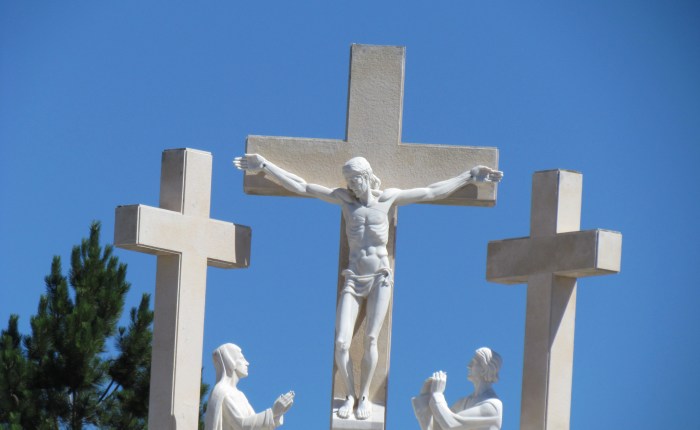
There is a terrifying vulnerability in how His arms are outstretched.

I’m not certain I had ever quite seen it that way before.  At Sunday Mass, I was looking up at the large crucifix behind the altar and I was slightly fearful.  That wide open heart, that vulnerable heart, that posture of being unable to defend oneself is what He wants from me.  And it scares me.

A nail pierces each hand, fixing them in place.  He is unable to shield Himself from anything: not the hurled insults, not the mockery, not the physical blows should it come to that.  Briefly, I pictured myself unable to curl up into a ball to protect my heart, to shield my face.  It was terrifying.  I would not be simply defenseless before loved ones but before my enemies.  That place of weakness seemed to be too much to bear.  At least in the face of persecution and mockery, I like to appear to be strong and resilient.

And the people stood by, watching; but the rulers scoffed at him, saying, “He saved others; let him save himself, if he is the Christ of God, his Chosen One!”  The soldiers also mocked him, coming up and offering him vinegar, and saying, “If you are the King of the Jews, save yourself!  (Luke 23:35-37)

Continue reading “His Terrifying Vulnerability”

Into the Wilderness

Into the Wilderness

“A voice cries out: ‘In the wilderness prepare the way of the Lord, make straight in the desert a highway for our God…'” (Isaiah 40: 1)

For some reason, Jesus is really intent on going into forests and deserts.  As I am looking at this passage, one I have heard numerous times, I am struck by His desire to go to the wild places.  A bit comically, I begin to imagine Jesus delving into the thick underbrush of a forest or having a road built into a stretching expanse of sand.

What is that wilderness He wants to dive into?

Ah.  My heart.  

It is a wild place, overgrown with weeds and bad habits.  Other places are deserts, barren and uninhabited.  Jesus wants to enter into those places.

I find myself attempting to redirect Him.  “Look, Jesus, a lovely little valley!  Come admire this place that has it all together, a place that isn’t messy….Oh, a lively garden, teeming with life.  Isn’t this nice, Jesus?”  He looks at these places, smiles at me, and then heads back into the desert.

But, Jesus, there is nothing to see there. Continue reading “Into the Wilderness”

Co-Workers

Co-Workers

Blessed are you, Lord God of all creation, for through your goodness we have received the wine we offer you: fruit of the vine and work of human hands it will become our spiritual drink. (Preparation of the Gifts Prayer)

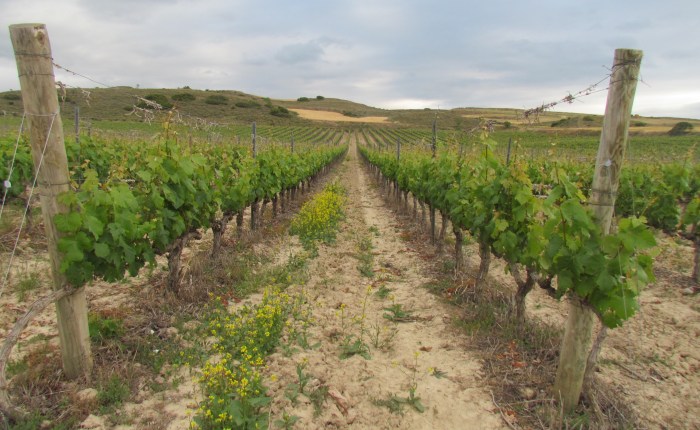
I’ve been to Mass thousands of times, but I don’t believe these words ever stood out to me before.  Yet as Father said these words, I was struck by the beautiful interplay between God and man.  It is through the Lord providing the sun, rain, and nutrients that we have the grapes of the vine.  But the work does not all fall on God.  We tend to the vines, we harvest the grapes, we change them from simple fruit into wine.  Then we offer it back to the Lord and He transforms it into something far beyond us. Continue reading “Co-Workers”

More Than Rules

More Than Rules

“Being Christian is not the result of an ethical choice or a lofty idea, but the encounter with an event, a person, which gives life a new horizon and a decisive direction.”  (Pope Benedict XVI, Deus Caritas Est)

Sometimes I struggle to make relevant connections for my students.  Other times, the perfect words come to mind and I am pleased that, despite myself, I was able to connect it to their lives.

I was reviewing the above quote from Pope Benedict XVI’s encyclical Deus Caritas Est.  Ethics, I told them, are a part of Christian living but they are not the reason we are Christian.  Intellectual Theology, while beautiful and true, is also not the primary focus of Christianity.  Instead, we are Christian because we have encountered the Living God.  I told them that if Christianity was merely a system of rules, then I could not do what I do.  I would never be able to remain passionate, day in and day out, if I simply presented an intricate system of rules.  It would not bring such joy to my life to belong to an institution situated around rules.

In a similar way, I told them that our relationship with God should in some ways mirror our relationships with friends.

“What are some of the ‘unwritten rules’ of friendship?” I asked them.
“Listen to the other person.”
“Don’t tell their secrets.”
“Be nice to them.” Continue reading “More Than Rules”

Receive Mercy

Receive Mercy

For we have not a high priest who is unable to sympathize with our weaknesses, but one who in every respect has been tempted as we are, yet without sinning.  Let us then with confidence draw near to the throne of grace, that we may receive mercy and find grace to help in time of need.  (Hebrew 4:15-16)

One of the first times I really heard this passage, several things about it struck me as completely perfect for my life in that moment.  And even if I don’t remember the specific state of my life, I am able to point to several parts of this passage that have a perennial blast of truth. Continue reading “Receive Mercy”

Nothing Wasted

Nothing Wasted

“Gather the fragments left over,
so that nothing will be wasted.”

At Mass yesterday, this verse from John’s Gospel struck me.  I heard it that morning when a group of students and faculty gathered in the chapel to open the day with prayer. Once again, it stood out to me during Mass.

Nothing will be wasted.

What a beautiful promise the Lord makes to us in that one verse.  He was speaking of the bread that had been multiplied to feed the hungry who had come together to hear Him preach.  If He says this about bread, how much more would He say it about my life? Continue reading “Nothing Wasted”

Small Heart

Small Heart

Oh, you of little faith.  Oh, you of little heart.

Jesus is calling us to cast out into the deep.  But isn’t it easier to not?  It is easier to stay on the shallow side.  Yet we long for the depths, for the great things that can happen on the other end of the pool, the other end of the lake.  Sometimes we just wish it wasn’t so deep.

“You desire greatness, but you keep your heart small.”  The Lord told me this during my retreat and I had to admit that it was true.  I was in one of my favorite Scripture passages–Jeremiah 18–and the Lord was the potter at the wheel, shaping and forming my heart.  Over the next few days, I spent time considering the ways I keep my heart small.  I’m sure my list was not exhaustive, but there were a few convicting realizations.  The small heart is often maintained because of fear.  Fear that expanding the heart will mean pain or disappointment.  Jesus, though, is asking me to cast out into the deep.  “Do not be afraid…”  Ah, Jesus, but I am.

In conversation this past week, I came to a renewed realization of the necessity of seeking healing for the sake of myself and for others.  My small heart, if it expanded, could be a catalyst for others to let their hearts grow.  If I allow my heart’s state to be dictated by how others respond, then why couldn’t I flip that around?  Why can’t my choice to be large-hearted move others to embrace the same?  Even if it doesn’t, my internal freedom will be transforming my own heart.

“To love at all is to be vulnerable. Love anything and your heart will be wrung and possibly broken. If you want to make sure of keeping it intact you must give it to no one, not even an animal. Wrap it carefully round with hobbies and little luxuries; avoid all entanglements. Lock it up safe in the casket or coffin of your selfishness. But in that casket, safe, dark, motionless, airless, it will change. It will not be broken; it will become unbreakable, impenetrable, irredeemable. To love is to be vulnerable.” (C.S. Lewis, The Four Loves)

He calls us to cast out into the deep.  Not content to simply tell us, He models the pathway for us.  He casts His net into the depths of our hearts, the places we hoped were sufficiently covered, the areas we ourselves had almost forgotten.  And He shines His light there, His mercy a mantle covering it all.  Then He turns the net over to us and asks us to do the same.  Cast deep into my heart, He says.  Go deeper, plunge further in.  In the safety of such a vast heart, we are then able to let Him plumb the depths of our own.  We will want Him to bring all to light and we won’t resist when He pushes the edges of our heart, widening the chambers to be filled with more of Him.

There is a greatness of heart that awaits us if we relinquish our clasp on our small hearts.  Give the Potter free reign over the size of your heart and follow His lead in casting into the deep.  Who knows what you will catch?