Seeking the Face of God, Even in Tragedy

Seeking the Face of God, Even in Tragedy

“We live in a crazy world,” I told my class near the beginning of a class period.

“One of you asked if I had heard of the truck bombing and I thought I had, but I wasn’t sure if it was from last week or this week.  Then I looked it up.  Two hundred and seventy people died and it just sounded an awful lot like several other events.  We live in a world where it is possible to be uncertain if a tragedy like this is news or something from a couple of weeks ago.”

This particular class period, we were reflecting on the Ignatian theme of finding God in all things.  It is easy to find God in bits of beauty–in the sunset, the splendor of fall foliage, or the smile of a newborn.  The difficulty is found in seeing the face of God in tragedy–the shooting in Las Vegas, the 9/11 attacks, or the truck bombing in Somalia.

Practice makes perfect, though, right?  Or, at least, better?

So our class time was spent in small groups brainstorming a few tragedies and then considering how we can see God in the midst of these situations.  I challenged them to go beyond the cliché lines they hear or the standard Theology class answers.  Instead, I wanted them to delve into these painful situations and to truly seek the face of God.

This class period had the most somber tone of all my classes and I found myself telling them that I viewed this exercise in a hopeful way.  Yes, we were talking about a loved one being diagnosed with cancer, terrorist attacks, natural disasters, and struggles in relationships, but we were doing so because we believe God can be found even there.  Perhaps, especially there.

After a group presented how they found God in a particular situation, I opened it up to the entire class.  Time after time, I asked, “Anything else?  Any other ways you can see God in that situation?”  There wasn’t a particular answer I wanted from them, I just wanted them to deeply reflect on all the possible ways God could be found in difficulty.  My hope was that if they did this while a bit removed from some situations, they will be able to try to do it in the midst of suffering.  I want them to remember that God can be found in all suffering.  And I want them to know it in a visceral, heart-wrenching way and not simply a pat answer on a Theology exam. Continue reading “Seeking the Face of God, Even in Tragedy”

Are You Envious Because I Am Generous?

Are You Envious Because I Am Generous?

The Gospel reading from this past Sunday is one that I find intriguing.  Jesus presents a parable that speaks to the nature of God.  Yet it is a nature that we struggle to understand since it is far beyond what seems natural to our humanity.  The line that stood out to me was near the end.  It was a lovingly spoken parting blow from Jesus, aimed at the egos of His followers down through the ages.

“Are you envious because I am generous?”

Sometimes.

The situation that came to mind was from a recent class as we discussed a few attributes of God.  We spoke of the limitlessness of God’s knowledge, love, and power.  As we waded into what it means that God knows all, questions arose, as I was certain would happen.

“If God knows everything, then why did He…”

You can fill in the blank with whatever you would like.  Sometimes they questioned why God would create specific people, knowing the hurt and pain they would inflict.  Other times they questioned if we truly have free will since God knows everything we will do.  They are interesting questions and ones I try to wrestle with for my students.

The closer to home I can make the examples, the more they seem to understand.  Why would God create people who do evil things when He knows they will do them?  I connected it to free will and asked, rather than answered, another question.

“Is it free will if God only chooses to create the people He knows will be good?  What would it mean if God surveyed our lives and then only created the people who would follow Him anyway?”

While still a difficult concept, I believe they began to see that God loves and creates people regardless of their future actions.  As humans, we are quick to separate ourselves into different groups.  There is Hitler and other really bad people on one side.  On the other, good people like you and me.  So I decided to pose another question to them, one that tries to pry into their idea of “good people.”

“If God chose to only create the people who were good, would we have been created?”

Our instinctual reaction of “I’m a good person” kicks in, only to be checked by, “Am I?”  I do not know what I will do in my future, maybe it will be something awful.  From my vantage point of the present, I can see the mean and sinful things I have done in the past.  I want my students to realize that appearances can be deceiving and goodness difficult to measure if we use subjective standards.

“I am uncertain that I would have been created if God only made the good people.”

This is where I think it connects to St. Matthew’s Gospel from Sunday.  At times, I question why God permits certain things to happen, certain atrocities to be committed by other humans.  Why does He create them at all?

Granted, this is a different situation than the Gospel, but it makes me pause and wonder.  Am I envious that God generously creates everyone, even when I find it difficult to love people who willingly hurt others?  Do I wish He applied a stricter test to people’s futures before He made them?  I don’t think I do, but I question His level of generosity. Continue reading “Are You Envious Because I Am Generous?”

Making a Mountain Out of a Molehill and Back Again

Making a Mountain Out of a Molehill and Back Again

Sometimes, I do stupid things.  Sometimes, I make small, insignificant situations into large problems.  That seems foolish, but then sometimes I turn around and make a big deal of the little thing I made a big deal of.

Because: logic isn’t always my strong suit when it comes to feelings.

A situation at school that I could, and should, have handled better, snowballed into something more than it ever should have been.  Yet when it reached its conclusion, I found myself quickly sliding into annoyance with myself over the entire situation.

“Trish, really?  You let a little thing become so much bigger than it logically should have been.  This is your sixth year and you are in charge of the department.  Shouldn’t you know better?”

Maybe, I should have.  But that isn’t what happened.

Instead, I experienced a situation where I didn’t do the best.  It is even more self-defeating, though, to beat myself up over the situation.  I would thereby perpetuate the problem.  In the scheme of my day, this was a small matter and I shouldn’t give it more weight by focusing more time and energy on how I mismanaged the problem. Continue reading “Making a Mountain Out of a Molehill and Back Again”

Joyless Pragmatism

Joyless Pragmatism

“I just wanted you to know that I won’t offer to pray in class because I’m not Catholic.  If you want, you can email my parents and ask them about it.  But when you look around the room for volunteers to pray, that’s why I’m not offering.”

A student had approached me after class one day and started our brief conversation with that explanation.

“Oh?  That is fine that you aren’t Catholic.  I assume your parents are not either, so I wouldn’t email them about it.  I still expect you to answer questions and participate in class, though”
“No, they are Catholic.”
“They are, but you aren’t?”
“Yes.”

I’ve often wondered why some people remain faithful to the religion of their parents and others don’t.  Considering that this student brought this conversation up in the first place, I figured I could try to ask some questions to get some bearing on the situation.

“Are you Christian?”
“No.  I believe in God, because I think it is silly not to.  I just believe he created the world but isn’t really active in it.  I’m not against Christians or anything.  I just think you do your thing and I’ll do mine.”

This student seemed so…pragmatic.

I think the thing that struck me the most was how reasonable the student was striving to be.  Granted, I am grateful when students are reasonable, but I couldn’t help but sense an absence of joy in this system of belief.  In many ways, I was impressed with the responses I received to my questions.  Yet I also wondered if this lack of belief stemmed more from a desire to be intelligent rather than closely examining the issues.

The popular notion of ‘you do you, I’ll do me’ continues to baffle me.  If there is any honest pursuit of the truth, then clearly you doing your own thing and me doing my own separate thing cannot both lead to the correct answer.  Continual diversity in beliefs cannot lead to unity in the end. Continue reading “Joyless Pragmatism”

When the Exciting Journey Becomes Tiring, Carry On

When the Exciting Journey Becomes Tiring, Carry On

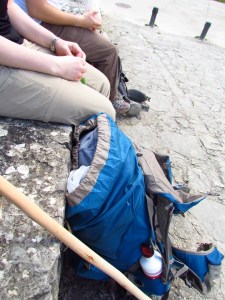
Over three years ago, I filled a hiking backpack, flew to Europe, and walked El Camino de Santiago.  The first day on the Camino, though difficult, was exhilarating.  We walked from the beautiful little town of Saint-Jean-Pied-de-Port in France, over the Pyrenees, and into Roncesvalles in Spain.  The newness of the adventure combined with spectacular views made me excited nearly every step of the way.

The next morning, we were tired and sore, but eager to continue this 500-mile trek.  So we set out again, walking for hours, taking in gorgeous scenery, and dining at little cafes or from our packed lunches.

IMG_4301

Then we did that again.  And again.

Sleep, rise, walk, eat, walk, Mass, eat, sleep.  Repeat.

IMG_4255

The tiredness soon was eclipsed by pain.  My feet ached in a way they never had before.  Blisters developed in tender places.  The beginning of the day meant pressing my feet into my shoes and then starting the delicate process of walking.  After a while, the pain dulled and seemed to fade into my subconscious.  However, if we ever paused, my feet gave a fiery reminder to sit down or keep walking.

Yet even these blisters didn’t completely dampen my spirits.  I knew they could happen and it was, in a way, part of the Camino adventure.  Each day, I offered up my pain for different intentions and this made the journey a pilgrimage instead of a hiking trip.

One day, I no longer wanted to walk.  

The intense desires to sleep in, be in the same place for more than 15 hours, or watch a movie were things I hadn’t anticipated when I started walking.  There was a definite shift from “This is fun!” to “This is a pilgrimage.”  Internally resistant to another day of plodding along, I realized that this adventure would require work and an embracing of the daily struggle.

And then I realized, this is a lot like life. Continue reading “When the Exciting Journey Becomes Tiring, Carry On”

If We Understood the Mass

If We Understood the Mass

“I don’t think God would send someone who loves Him and follows Him to Hell.”

A conversation about exorcisms somehow veered into a free-for-all rapid fire of questions.  As I’ve said before, though, if my students ask questions about the faith and they are interested, I have a difficult time telling them no.

“I don’t believe the Church teaches that,” I told the student.

“But if I don’t go to church on Sunday, the Church says that is a mortal sin.  I don’t believe that if I love God and He loves me that He would send me to Hell for missing one Mass on Sunday.”

Understandably, this is a question I hear quite often.  My students find it difficult to accept that missing Mass is a grave sin.  They aren’t skipping it maliciously, I believe, and so I get where they are coming from with their confusion.  Usually, it is out of laziness or boredom or busyness.

So I did what I generally do–I tried my best to explain why the Church teaches what she does.

“I think if we understood what the Mass was, then we wouldn’t ask this question.  God is asking us to go to Mass to encounter Him and receive Him.  He is offering His very self to us out of love.  And if we love Him, I don’t think we would say that we aren’t able to come for one hour once a week.  The bare minimum in having a relationship with the Lord is this one hour.  We couldn’t say no to encountering the Lord and letting Him live in us if we truly loved Him.”

The answer seemed to touch a chord and we moved on to other questions.

Students are prone to question why we have to go to Mass and adults are more prone to critique the Mass itself.   Continue reading “If We Understood the Mass”

Honey, I love you, but being married to you is a burden

Honey, I love you, but being married to you is a burden

“Honey, I love you, really, I do.  But being married to you is a burden.”

My students were asked to imagine that a husband came home and said this to his wife.  Already, there was a bit of disdain in their eyes for the husband.

“Oh, I am?  How am I so burdensome?”
“Well, I love you, but sometimes I want to do things and I can’t because of you.”
“Like what?”
“There are a lot of attractive and smart women I run into at work and I can’t date any of them.  Sometimes I want to just catch a plane and fly to Florida for a week, but I would have to tell you first and you might want to come.  You are interesting and wonderful and I love you, but sometimes marriage is restrictive.”

Each time I told this to my students, it worked.  They did not think highly of the husband and were, rightfully so, annoyed with his list of burdens.

Wow, they gasp, he is the worst.

But aren’t these things true?  I asked my students.  He isn’t allowed to date other women, is he?

No, they reply.

Shouldn’t he talk to his wife about flying off to Florida for a week before he does it?

Yes, they say.

So what is wrong about what he is saying?  Why shouldn’t he say these things when they are true?

After very little discussion, because it seems so obvious, they tell me that he has the wrong perspective.  He isn’t focusing on his relationship with his wife, but simply all the things he cannot do because of his relationship with her.

Being Christian is not the result of an ethical choice or a lofty idea, but the encounter with an event, a person, which gives life a new horizon and a decisive direction.

Deus Caritas Est, Pope Benedict XVI

You are correct, I tell them, the husband focuses only on the restrictions of this relationship instead of the love he has for her.

But isn’t this sometimes what we do with God? Continue reading “Honey, I love you, but being married to you is a burden”

Avenues to My Heart

Avenues to My Heart

When I started college, I wanted to be a high school English teacher.  I have loved reading since elementary school and I wanted to encourage others to love reading, too.  Along with reading, I also enjoyed writing.  With these two loves, I assumed teaching English would be a fitting career.

The second semester of my freshman year of college found me taking a Theology class.  Since I had exclusively attended public school growing up, this was my first formal Theology class.  Other students who had attended Catholic schools didn’t seem as impressed as I was with the class.  Simply praying before a math class at college was an exciting concept for me.  Reading encyclicals and Church documents?  That was a complete thrill and I remember marveling at how accessible I found them.

After this introductory class, I was hooked.

I kept slipping extra Theology classes into my schedule.  Until, finally, my adviser asked what I was doing.  My heart wanted a Theology degree simply because it meant I could study more about what the Church thought and did.  So I dropped my Education major and paired my English major with Theology.  While I still loved reading and writing, I knew that I could never be quite as passionate about English as I could be about Theology.

Even with a Theology degree and a day full of teaching Theology classes, it still satisfies a desire of my heart when I can sit down and read good theological works.  Whether they are more dogmatic or more spiritual, I find the truths they speak to be balm for my soul.  I read Bishop Conley’s address to a group of Catholic school educators and administrators and I found myself underlining several points.  Bishop Conley said, “If you want authentically Catholic culture, you need authentically Catholic schools.”  This makes me applaud and then question, “How?”  Hearing about the faith is enlightening and joyous for me.  Learning about my role as a Catholic educator is inspiring.  It fills me with truths I know to be solid.

Despite the length of time I have spent on Theology (the beauty and the teaching of it), the inspiration for this post is not Theology.  Rather, it was in conversation with a co-worker that I realized that while theological reading is beautiful and soul-lifting, so is literature. Continue reading “Avenues to My Heart”

Recurring Bad Dream Means School is Near

Recurring Bad Dream Means School is Near

The start of the school year is just around the corner.

As if the date wasn’t enough of an indicator, several other factors have drawn my attention to this fact.
1. I’ve seen a steady uptick in emails from the school, including schedules for in-services and faculty information.
2. People have started beginning conversations with me by asking, “Are you ready for school?”
3. Finally, I had my first bad dream.

Dreams have a funny way of revealing our inner state to ourselves.  I don’t remember many of my dreams, but I have a fairly consistent dream that happens as I approach a new school year.  I dream that I am running late for school.  The whole, restless dream consists of me waking up late, realizing I won’t get to school in time (while also being a bit confused because I didn’t think the school year had started yet), and the stressful experience of trying to figure out what to do.  Usually, it is a short dream, but one that is replayed multiple times, giving me the feeling that I am in a constant state of panic and stress.  When I pull myself out of the dream, I reassure myself that school hasn’t started and that it was all just a dream.  Sometimes my heart is panic racing so fiercely that it is difficult to fall back asleep.

One summer, I had this running late for school dream in June and I was pretty annoyed.  I had months of summer left and here I was, panicking in the middle of the night because dream Trish thought it was 7:50 on a school morning.  This year, it held off a bit longer and the first dream came this past week. Continue reading “Recurring Bad Dream Means School is Near”

Teaching: To Pursue The Truth Together

Teaching: To Pursue The Truth Together

I’ve spent a great deal of the summer considering how this next school year will unfurl.  Each fall, I start with the hopes that this will be the best year ever.  And, in many ways, that has largely proven to be true.  The more I teach, the more confident I feel teaching.  The longer I am there and the more experiences I have, the more prepared I feel to handle future problems and situations.  Yet despite all of my preparations and extra reading I do during the summer, one thing is certain: I will never be perfectly prepared for every question they ask me.

Honestly, I think I am able to answer most of the questions that arise in the classroom.  If I have never considered the question or even heard the answer, I am surprised how often I am able to give an answer anyway.  I’m not lying to them or just trying to look smart.  I’ve come to realize that the longer one knows the Lord and studies His Church, the better one is able to think with the mind of the Church.  So even if that question has never been posed to me before, I can often give a pretty confident answer because I have come to know and understand the Church to a degree.

There is, however, a lingering concern that I will be unable to answer a question.  Or, worse yet, that my lack of knowledge will appear to mean that the Church has never considered that question or that her theology is found wanting.  Regarding those fears, I think back to the summer before my first year of teaching.  I was presenting these concerns to a trusted priest and he asked if I thought that a student could ask a question that the Church couldn’t answer or that would prove her wrong.  I told him that I was certain the Church had answers and that I trusted her to be true in all things she affirmed as true.  For him, that was the end of it.  So what if I didn’t know the answer?  I knew the Church had an answer and I was fairly confident I could find it if needed.

For the last five years, that is what I have sought to do.  To a generation that I struggle to understand, I have striven to present truths they struggle to find relevant or accurate.  I ask them to consider the truths of the Church and they echo Pilate by saying, “What is truth?”  They question if it matters to know the truth.  They ask if everything could be true.  And I try to use logic and personal examples to show them the beauty of knowing and pursuing the truth.   Continue reading “Teaching: To Pursue The Truth Together”