Avenues to My Heart

Avenues to My Heart

When I started college, I wanted to be a high school English teacher.  I have loved reading since elementary school and I wanted to encourage others to love reading, too.  Along with reading, I also enjoyed writing.  With these two loves, I assumed teaching English would be a fitting career.

The second semester of my freshman year of college found me taking a Theology class.  Since I had exclusively attended public school growing up, this was my first formal Theology class.  Other students who had attended Catholic schools didn’t seem as impressed as I was with the class.  Simply praying before a math class at college was an exciting concept for me.  Reading encyclicals and Church documents?  That was a complete thrill and I remember marveling at how accessible I found them.

After this introductory class, I was hooked.

I kept slipping extra Theology classes into my schedule.  Until, finally, my adviser asked what I was doing.  My heart wanted a Theology degree simply because it meant I could study more about what the Church thought and did.  So I dropped my Education major and paired my English major with Theology.  While I still loved reading and writing, I knew that I could never be quite as passionate about English as I could be about Theology.

Even with a Theology degree and a day full of teaching Theology classes, it still satisfies a desire of my heart when I can sit down and read good theological works.  Whether they are more dogmatic or more spiritual, I find the truths they speak to be balm for my soul.  I read Bishop Conley’s address to a group of Catholic school educators and administrators and I found myself underlining several points.  Bishop Conley said, “If you want authentically Catholic culture, you need authentically Catholic schools.”  This makes me applaud and then question, “How?”  Hearing about the faith is enlightening and joyous for me.  Learning about my role as a Catholic educator is inspiring.  It fills me with truths I know to be solid.

Despite the length of time I have spent on Theology (the beauty and the teaching of it), the inspiration for this post is not Theology.  Rather, it was in conversation with a co-worker that I realized that while theological reading is beautiful and soul-lifting, so is literature. Continue reading “Avenues to My Heart”

Saints and Sinners: The Indelicate Reality of Christ’s Church

Saints and Sinners: The Indelicate Reality of Christ’s Church

In college, I took a course called “Theology of the Church” and the professor made certain to cement a specific truth in my mind.  He spoke frequently of how the Church is the spotless Bride of Christ, without blemish or error.  Yet he spoke just as often about how the Church is stained and tarnished, filled with sin and weakness.  Each Catholic must come to terms with this dichotomy if he or she desires to fully understand this living organism we call the Catholic Church.

The saints are beautiful models of following Christ and seeking holiness in the midst of a chaotic world.  For most of the difficulties we face in life, we can turn to a specific saint who had similar struggles.  There are saints who had difficult relationships with their parents or children, saints who were falsely accused, saints who had superiors who treated them unjustly, saints who lost loved ones, saints who experienced poverty, saints who struggled with drinking or drugs, saints who battled anger and violence, and saints who people thought were foolish or incapable.

IMG_5994

Yet we know the Church is not merely comprised of saints.  I belong to the Church and I am most definitely not a saint yet.  So while it is easier to focus on the virtues and gifts of the saints, we also know we are a Church filled with sinners.  We have sinners in the pews, in the choir, in the streets, at the altar, in the diocesan offices, in the Vatican, and in the chair of St. Peter.  Each of us, on our journey to become the saints God desires, must fight our own battles as we acknowledge our sinfulness.  The goal is not to make perfect masks that cover up our imperfections.  Rather, we seek to let Christ into our deepest sins and allow Him to transform us.

IMG_5323

It is with this knowledge of myself, as a sinner striving to be a saint, that I can recognize this reality within the Church herself.  She is perfect: Christ instituted her, the Holy Spirit guides her, and the Father welcomes her members into Heaven, one by one.  Yet she is us: flawed, broken, dragging our weary hearts to Calvary and to Heaven.  All of the romantic notions I have about the Church and her beautiful, soul-shaking theology necessarily contrast painfully with the reality of the Church that I see around me.  Reality is certainly not so romantic and not so obviously beautiful.  Nonetheless, it is still the Church I love.

When we encounter scandal in the Church, it is helpful to remember this inherent dichotomy, one that existed from the beginning of the Church, yet one which will end when we are purified and in Heaven.  While I love quite fiercely different humans within the Church, I also know that my love for the Church is not solely based on these humans.  My spiritual director is wise and I find myself able to share the workings of my heart with him.  My pastor leads me to a deeper understanding of how to encounter Christ in the daily moments.  Yet even should these priests fail me, I would not stop loving the Church.
Continue reading “Saints and Sinners: The Indelicate Reality of Christ’s Church”

“Beauty and the Beast” Gave Me the Perfect Phrase for Holy Week

“Beauty and the Beast” Gave Me the Perfect Phrase for Holy Week

I watched Beauty and the Beast this weekend and I’ve been turning one lyric over and over in my mind ever since.  “How in the midst of all this sorrow can so much hope and love endure?” (from ‘Days in the Sun’)  For several reasons, it seemed to be the perfect phrase to carry into this Holy Week.

In the midst of experiencing again the Passion of Jesus Christ, how can we still find hope and love?  When I read the news, how can I find hope and love in the events of strife and discord?  In tragedy on a personal or community level, how can I wade through the hurt and find hope?

The short answer is that it is difficult to do, but it must be possible.  It isn’t a matter of denying the pain or sorrow.  The Lord knew we would experience pain.  He understands the depths of feeling forsaken and abandoned.  His closest friends fell asleep during His moments of great agony.  When soldiers came to arrest Him, the apostles all fled.  Jesus isn’t asking us to deny pain or to act like it doesn’t impact us.  Rather, He is asking us to choose to find the Resurrection in the midst of every crucifixion.  Or, at the very least, to acknowledge that there will be a Resurrection, even if death seems to be victorious right now. Continue reading ““Beauty and the Beast” Gave Me the Perfect Phrase for Holy Week”

To Be the Face of God

To Be the Face of God

The other day, I gave a test in all of my classes.  In the midst of this, I discovered a student cheating on the test.  As I spoke with the student and some details were revealed, I found that I wasn’t angry with the student.  I simply felt this incredible sadness.

I always want to be able to trust my students.  When something happens that betrays that trust, I find myself a bit frustrated and sad.  I don’t want to doubt what they tell me or question their integrity.  But they are humans and sometimes humans cheat or lie.

During the rest of the day, this incident weighed on my mind.  I was sad and disappointed with this student but also with students in general.  Cheating is something I do not understand.  Perhaps because I enjoyed school and generally like a challenge, but I could never see myself cheating in school.  In middle school and parts of high school, people thought I was semi-ridiculous for how cautiously I guarded my paper during tests or quizzes.  I didn’t want to be the unknowing person from whom others stole their answers.  Some of my students have a very different perspective.

So I began to wonder how God takes in the continually disappointing behaviors of humanity.  It is a love that I cannot comprehend because it is truly a love without condition.  My love is conditional.  I have a great affection for my students, but when confronted with their weaknesses and their imperfections, I struggle with how to move forward.  I know a single action does not define who they are, but it shapes how I perceive them.  How can the Lord look at us in the midst of every sin and love us wholly and entirely?   Continue reading “To Be the Face of God”

A House Divided

A House Divided

Satan, the father of lies, loves division.

It matters very little what the division is actually over.  In fact, I think the more religious-oriented the division, the more it pleases Satan.  But he will take any dispute, so long as it seeks to divide.

Knock down drag out brawls over the liturgy?  Disputes over the placement of the altar?  Feuding over Lenten fasting?  Frustrations with priests and bishops?  Sides forming over who is more Catholic than the pope?

Satan is delighted.

We spend our time considering what we think is best and we tend to lose sight of the Lord.  I’m not arguing for an “anything goes” mentality.  Far from it, I am encouraging us to focus on what is the most important rather than repeatedly increasing the divisions within humanity.

For the bonds which unite the faithful are mightier than anything dividing them. Hence, let there be unity in what is necessary; freedom in what is unsettled, and charity in any case.

(Gaudium Et Spes)

In The Great Divorce, C.S. Lewis portrays Hell as a place of isolation.  The opening pages start in a town that is approaching the evening hours but seems empty of people.  Yet the narrator finds people waiting in line at a bus stop.  As the minutes pass, people leave the line because they keep quarreling with each other about one thing or another.  The town is empty because the inhabitants cannot bear to be in such close proximity to other people with all their flaws and imperfections.  So they keep moving, distancing themselves from others until they find themselves in complete isolation. Continue reading “A House Divided”

Unrestricted Access to My Heart

Unrestricted Access to My Heart

Jesus, looking at him, loved him and said to him,
“You are lacking in one thing.
Go, sell what you have, and give to the poor
and you will have treasure in heaven; then come, follow me.”

Mark 10:21

It is because Jesus loves this young man that He challenges him.  By many standards, this man has done all that he has been asked to do.  He has kept the law since his earliest days.  Yet, he comes to Jesus to ask what he must do to inherit eternal life.  Either he wants to be affirmed in how excellently he has kept the law or he feels there is something more to which he is called.

Jesus looks at him with that gaze that pierces through the heart and is filled with a great love for this young man.  The authenticity of His love compels Him to call the young man to something greater.  Jesus tells the young man to put aside everything of this world and to follow Him.  It is out of love that He invites the young man to run with reckless abandon in the race for Heaven.

Yet the man leaves saddened.  Though he follows the law, he is unwilling to set aside everything for the Kingdom of Heaven.

Jesus issues His challenges out of love, but they vary based on the person.  Some He invites to follow Him and they cannot, refusing to leave behind possessions or family.  Others long to follow Him and He tells them to remain home, sharing the Good News among their own people.  When it comes to living in God’s will, there seems to be no one-size-fits-all approach for the Lord.  His will is customized to the individual and it often seems to be contrary to what we want.

This is why the life of contemplation is the boldest and most adventuresome of undertakings, for what could be more radical, more truly earth-shattering, than the willingness to be dismantled and created anew, not once or twice in a lifetime, but day after day?

The Way of the Disciple, Erasmo Leiva-Merikakis

He is not satisfied by things done half-way.  Our souls, though we may attempt it often enough, cannot be half His.  The young man wanted to comfortably follow the law and yet Jesus calls him to a life he did not expect.  Sell everything?  Why?  Where is that in the law? 

While I may be tempted to mentally chastise the young man (Jesus was asking you to follow Him!  How could you not?!), I must admit that I am he. Continue reading “Unrestricted Access to My Heart”

My Seeking Heart is a Sought After Heart

My Seeking Heart is a Sought After Heart

This blog is entitled “Seeking After His Heart.”  Ideally, I like to think of my life as a pursuit of the good, the true, and the beautiful.  Yet sometimes I overlook the fact that it is really about the Good, the True, and the Beautiful pursing me.

God initiates all of our encounters with Him.  If He did not reveal Himself, we would not know Him.  If He did not allow us to perceive Him, then we would be completely unaware of His presence.  Even prayer, which can sometimes be viewed as something we do for God, is actually something He does for us.

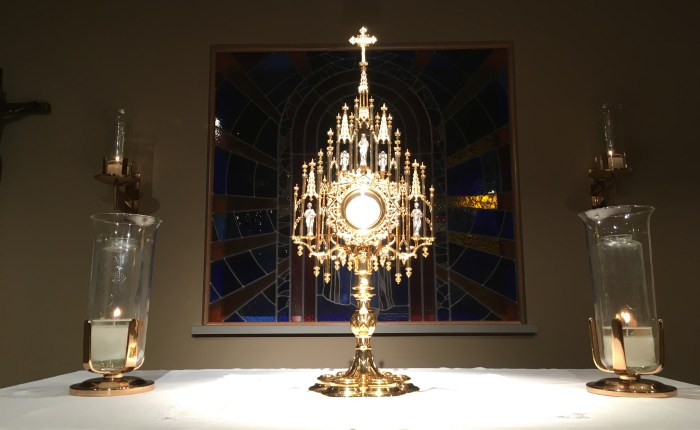
In conversation with my spiritual director, he told me to not overlook begging Jesus for the grace to go to Him in prayer.  And sitting in the adoration chapel the other evening, I reminded myself that I was there simply because I responded to God’s grace.  I mean, it kind of felt like it was purely my choice, but I knew that it was God offering His grace and me, finally, responding to it.

1400222_10153497936375484_1246065451_o

This initiation on God’s part is timeless.  All of the Old Testament covenants are made because God interacts with a human person and desires to be in relationship with them.  They don’t start the process.  “Hey, God!  I’d like to be a part of Your family!”  God reaches down to us and adopts us as His own.  Even greater still, He enters into the human family so as to bridge all gaps between us.  There is nothing left for us to do but to respond.

In John’s Gospel, Jesus speaks to the Samaritan woman with simple words, “Give me a drink.”  He seeks her out, He encounters her, and He asks her to enter into relationship with Him.  Yet I love the way that the Lord does this.  He reaches out to her and expresses His thirst for her. Continue reading “My Seeking Heart is a Sought After Heart”

God Died

God Died

“God died, Trish.  God died.”

I was a little surprised at this statement, coming from my five year old nephew.  We had just started the drive from my house to my parents’ house.  Perhaps it was the fact that we were passing a Catholic church or maybe the thought just came into his mind, but the statement seemed like it was out of left field.

“Who told you that?”  Even though my mind was immediately jumping to Nietzsche’s famous ‘God is dead’ statement, I was pretty certain my nephew had a different source.  Did he have a little atheist friend at school?  Did his teacher say something?  Was an older student filling his mind with such things?

“My mom and dad.”  Well, that changed it a bit.
“What did they say?”
“They said that He died.  He really died.”
“And that He rose from the dead?”
“Yeah.”  That detail didn’t seem quite as important to him.

Yet the Resurrection of Jesus is one of the most important details of all.  If He was who He said He was, then the Resurrection verifies His claims.  If not, then there could be no greater blasphemy than claiming to be God and, by all rights, the Jewish leaders were correct to condemn Him to death.

The incredible aspect of the Resurrection is sometimes lost on those of us who have spent our whole lives hearing about it.  But if we take a step back, we might be able to appreciate more fully the bold claim we are making.

We claim the Incarnation is true, that God took on human flesh–He didn’t just appear to be human or was merely human–and dwelt among us.

Later, He was condemned to death, scourged, crucified, and then died.  After wrapping His body in clothes, He was laid in a tomb, which was sealed with a large stone and had a Roman guard stationed in front of it.

Three days later, the tomb is empty, the guards are confused, and His body is nowhere to be found.

We claim that He rose from the dead.  He actually died and then He resurrected.  Not “came to” or was revived, but entered into a new life, one that could never end again in death. Continue reading “God Died”

The Best Defense is Encountering Love

The Best Defense is Encountering Love

You can, in the broadest terms, call it “Catholic culture.”  However it’s described, though, it’s not something you simply argue yourself into.  Rather, it’s something you experience aesthetically as well as intellectually, with the emotions as well as the mind, through friendships and worship and experiences-beyond-words as well as through arguments and syllogisms.

“Letters to a Young Catholic” by George Weigel

Something I am intent on drilling into my students this semester is that Christianity is necessarily a life of encounter.  It is the tremendous beauty of being able to experience an authentic and lived relationship with Christ while also delving into the rich intellectual tradition of the Church.  Catholicism is chock-full of the “both/and” that makes life so simple and yet so deep.

I teach high school Theology to sophomores and seniors, making it somewhat safe to assume that I am not an advocate of an anti-intellectual, touchy-feely Christianity.  Specifically, one of my courses is apologetics, which is teaching how to defend the faith against attacks.  And there are many, many attacks launched against the Church in every age, no less in this one.  Defending the faith, though, is not merely done through well-chosen words or precisely articulated statements.  These are helpful, but much of the battle is done through actions.  If my students do not love the Church, they will be far less inclined to defend or understand Her.

I am well aware that the love I have in my heart for the Catholic Church is not the norm.  My students need to encounter more than the beauty of truth to be convinced.  I read the Church’s teachings and my heart stirs with the acknowledgement that these are profound truths.  Often when my students hear the Church’s teachings, they hear how their freedoms are being minimized or that they are being told what not to do.  However, if they love the Church, they will see that She is a mother caring for and protecting Her children, even if they do not always understand.

This is where the necessity of encounter comes in.  Catholicism, in Our Lord’s great wisdom, is a faith filled with the tangible.  We hear the words of absolution at Confession, we feel (and smell) the oils at Baptism and Confirmation that claim us as members of the Church.  The incense, like our prayers, rises up to the Heavens as we adore Our Lord in the Eucharist.  On pilgrimage, we travel to the places where the bones of the Apostles and saints of the Church rest.  Oddly, we touch our rosaries and prayer cards to their tombs, praying that we will follow the Lord’s will as radically as they did.  We light candles before altars, hoping that our intentions will be continually presented to Our Lord’s throne.  As George Weigel says throughout Letters to a Young Catholic, there is a grittiness in Catholicism.  In this book, he also says the following:

Catholicism does not rest on a pious myth, a story that floats away from us the more we try to touch it.  Here, in the scavi [excavations under St. Peter’s], we’re in touch with the apostolic foundations of the Catholic Church.  And those foundations are not in our minds.  They exist, quite literally, in reality.  Real things happened to real people who made real, life-and-death decisions–and staked their lives–not on stories or fables but on what they had come to know as the truth.

To be Catholic, George Weigel argues and I concur, means to live in reality.  And as someone who so often feels that people think my ideals mean that I don’t live in reality, that is uplifting to hear.  Being Catholic means living in the greatest love story while also fighting the greatest battle of all time, primarily because it transcends time.  As a romantic with more than a touch of stubbornness, these intertwining elements make the Church my perfect home.  It is not merely a battle of the wits, arguing and defending a supernatural institution to a world rooted in earthly affairs.  It is also, and primarily, an encounter with Love, being transformed by Love, seeking to enter into Love.  If love is not at the heart, all is meaningless and in vain.   Continue reading “The Best Defense is Encountering Love”

Jim and Pam

Jim and Pam

I have a tendency to resist liking things that other people like simply because other people like them.  Make sense?  Of course not.  But I learned that “don’t give into peer pressure” thing really well in elementary school and it just maybe turned me into a bit of a contrarian.  In elementary school, I was pretty adamant about not liking any of the boy bands or Britney Spears.  I was a sharp critic of modern fashions and I was never the first to have anything trendy.

I like to think I have balanced out a bit and that I allow myself to like things that other people like.  Nevertheless, I do like to go against the flow and not adopt things simply because lots of other people do.  So I’ve heard people talk about “The Office” for years and I was never really interested in learning more about it.  I watched “Parks and Rec” because my housemates were into it at the time, but that was one of the first TV series I had invested in.  When I got around to watching “The Office,” I was surprised that I enjoyed it, once I was familiar with the characters.  And, being the romantic that I am, I fell for Jim and Pam’s relationship. Continue reading “Jim and Pam”