The Need for Reform

The Need for Reform

A group of atheists in my town is spending money to buy billboard space to convince people there is nothing.  The only other group that quickly comes to mind that spends so much time and money to prove that there is nothing are those fiercely for abortion.

The atheist group has chosen to utilize one of the best arguments for there not being a God: evil and suffering exist.  The billboard points to the millions who died in World War II as evidence of there being nobody who heard the prayers of the Christians and Jews.  It is a compelling argument.  Nearly everyone can point to an instance in their life or in the life of someone they know that seems to not mesh with a good and all-loving God.  But what if the state of the world pointed more to the depravity of which mankind is capable rather than the non-existence of God? Continue reading “The Need for Reform”

Surrendering

Surrendering

One of my friends and I were looking at a listing of the different “definitions of Hell” based on a person’s Myers-Briggs personality type.  There were a few that seemed to fit well with me, but the one that stood out was for the INTJ personality.  “Every time you open your mouth to say something intelligent, something entirely idiotic comes out instead.”

We agreed that the scenario would be pretty awful.  Then I remembered when I had my four wisdom teeth removed.  I was awake for the procedure, but my mouth was injected and numbed so that I couldn’t feel pain.  Afterwards, my mom came in to see me.  For some reason, it was incredibly important for me to convey to my mom that I was still perfectly logical, even with all of the pain meds. Continue reading “Surrendering”

Graced

Graced

Anger is like a dead weight.

The fool thinks that anger will invade only one area of his life.  He thinks that anger can be compartmentalized from the rest of one’s feelings and actions.  That fool thinks that the heart can be subdivided, anger for some and happiness for the rest.  He is wrong.  

Or she.  

Or me.

After days of being angry, I decided to not be.  I will not, of course, downplay the workings of grace.  Grace was imperative for me to see what I was choosing to do to my own heart.  In the beautiful mystery that is God, the Holy Spirit prepared my heart to receive the graces needed to take a step away from the anger and frustration. Continue reading “Graced”

Nothing Wasted

Nothing Wasted

“Gather the fragments left over,
so that nothing will be wasted.”

At Mass yesterday, this verse from John’s Gospel struck me.  I heard it that morning when a group of students and faculty gathered in the chapel to open the day with prayer. Once again, it stood out to me during Mass.

Nothing will be wasted.

What a beautiful promise the Lord makes to us in that one verse.  He was speaking of the bread that had been multiplied to feed the hungry who had come together to hear Him preach.  If He says this about bread, how much more would He say it about my life? Continue reading “Nothing Wasted”

Today

Today

Today was a good day.

I slept in later than I should have and rushed to get ready in time.  Rushing around, I didn’t eat breakfast and threw a bagel in my lunch bag.  Preparing to submit my grades during my lunch time, I completely forgot to eat my lunch/bagel.  A student asked me why we don’t have a class that covers all of the bad things Catholics have done in the past.  And my supervisor mentioned (in a kind way) that I never date.  (I had noticed.)

But today was still a good day.

I met this morning with lovely young ladies and we talked about preparing ourselves for the relationships for which we all long.  I had multiple times today where I would realize, “Hey, I’m doing this teaching thing!”  A couple moments with my seniors resulted in laughter, partly because I am less defensive than I’ve been in previous years and I was able to take things in stride with a smile.  Today, I laughed: when a student flipped his pencil to the ceiling (and looked like he surprised himself), when a student asked if I would take them all to walk the Camino (my answer: I don’t think we would all make it to the end alive), and with various friends during conversations.  I had a cup of coffee in a mug decorated with pictures from a trip my sister and I took.  During school, I prayed the Holy Sacrificed of the Mass.  I made Thai food.  I read more in my current book.  I was able to talk about art and martyrdom today and feel passionate for the topics even if my students appeared less than excited to hear about them.  One of my housemates shared her leftover cheesecake.  And I can hear a couple of my housemates trying to figure out the suspenseful show they are watching.

Today was a good day.  The Lord used the nothing that I had and He brought about something.  It wasn’t perfect and it probably could have been better if I had given more of myself.  Thank You, Jesus, for this day.

A Mercy Divine

A Mercy Divine

“My people, what have I done to you or how have I offended you?  Answer me!  I led you out of Egypt, from slavery to freedom, but you led your Savior to the cross.  My people, what have I done to you?  How have I offended you?  Answer me!  For forty years I led you safely through the desert.  I fed you with manna from heaven, and brought you to a land of plenty; but you led your Savior to the cross.  What more could I have done for you?  I planted you as my fairest vine, but you yielded only bitterness: when I was thirsty you gave me vinegar to drink, and you pierced your Savior with a lance.”  (Reproaches of Good Friday)

Good Friday is a day of worlds colliding.  We acknowledge the death of Our Lord and our role in it, but we also recall this as the glorious means for our salvation.  The cross is an instrument of torture and yet we take time to exalt the cross, coming forward on bended knee to kiss Our Savior as He is fastened to it.

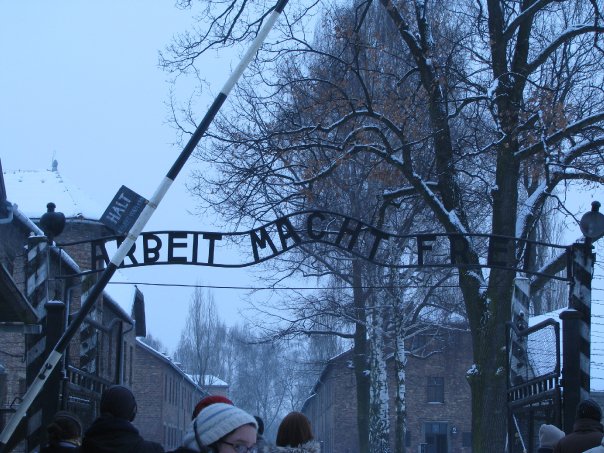
Today, we begin the Divine Mercy Novena which concludes on Divine Mercy Sunday.  After the Good Friday service, we prayed the first day of the novena.  And I couldn’t help but remember another time when I had prayed the Divine Mercy Chaplet.  It was about six years ago and I stood on the cold, snowy ground of the Auschwitz concentration camp.

20564_10150090441715484_4833116_n

For the sake of His sorrowful Passion, have mercy on us and on the whole world.

We had already toured Auschwitz I.  There I saw picture after picture of people who had entered that place of death.  Next to each picture was a little card that gave the person’s name, their entrance date, and the date of their death.  But the faces were what became engraved on my heart.  I had heard for years about the number of people who died in the Nazi concentration camps, but to see only a fraction of their pictures changed statistics into human lives.

20564_10150090441720484_7614262_n

In silence, we loaded the bus so that we could go to Auschwitz II.  Here we saw long barracks and miles of barbed wire fences.  And we struggled to understand that human beings did this to other human beings.  We saw cattle cars that humans arrived in and we surveyed the watchtowers that were situated to keep all under surveillance.

20564_10150090441795484_3301914_n

In the last few minutes of being there, we prayed the Divine Mercy Chaplet.  Because what else can you do when surrounded by such a witness to the depravity of humanity?    We could only make appeals to the mercy of God.  I could not offer to God my own merit or good works because they are insufficient in the face of such tragedy.  I can only offer His Son back to Him.

Eternal Father, I offer You the Body and Blood, Soul and Divinity of Your dearly beloved Son, Our Lord Jesus Christ, in atonement for our sins and those of the whole world.

Kneeling during the Good Friday service and during the Divine Mercy Chaplet, I could not help but consider this again.  In the wake of the death of Jesus Christ, I can offer nothing to atone for it.  These hands were not physically there, but my sins were bought and paid for with His blood on that day.  Even if I lived a perfect life, I could not make up for what has been done.  The only offering I can make is Jesus Himself.

A couple years ago, I considered the words of the Divine Mercy Chaplet and I realized that it is truly a mercy that can only come from God.  We plead our cause by offering to God the very One we killed.  In any other situation, this would seem laughably grotesque.  Imagine a murderer asking for clemency from a mother or father by invoking the name of the child killed.  Not simply through their name but asking that through the child’s death mercy and forgiveness will be shown to the murderer.  Such mercy is what can only come from God.

Good Friday comes down to accepting that I cannot do anything.  In the Passion narrative, I am the one calling for His crucifixion and claiming that He is not my king.  And I must say those words because I profess them often enough with my life.  Good Friday isn’t about beating yourself up or trying to make yourself feel lousy.  It is about accepting the role we have played in the death of Jesus Christ.  He didn’t die, though, so that we could wallow in guilt and self-pity.  He came to make us new.  He came to utterly transform us.  He came to take every part of us and to pour His perfect mercy over all the parts of our heart that most need it, yet are too fearful or prideful to plead for it.

Christ says “Give me All.  I don’t want so much of your time and so much of your money and so much of your work: I want You.  I have not come to torment your natural self, but to kill it.  No half-measures are any good.  I don’t want to cut off a branch here and there, I want to have the whole tree down.  I don’t want to drill the tooth, or crown it, or stop it, but to have it out.  Hand over the whole natural self, all the desires which you think innocent as well as the ones you think wicked–the whole outfit.  I will give you a new self instead.  In fact, I will give you Myself: my own will shall become yours.” (Mere Christianity, p. 166)

Eternal God, in whom mercy is endless and the treasury of compassion–inexhaustible,  look kindly upon us and increase Your mercy in us, that in difficult moments we might not despair nor become despondent, but with great confidence submit ourselves to Your holy will, which is Love and Mercy itself.
(Closing prayer for the Divine Mercy Chaplet)

It doesn’t have to be perfect

It doesn’t have to be perfect

It doesn’t have to be perfect.

I’m sitting in my college Honors class.  The two hour class occurs twice each week and is entirely discussion based.  We are reading the classics and then we discuss them, seated in a circled with annotated copies of Western Civilization’s greatest works at hand.  I cannot bring myself to talk and I feel helpless as class after class passes and I say nothing.  The longer my silence goes, the more convinced I am that the first time I say something, it must be brilliant.  It must be perfect.  It must redeem the previous hours of silence.  But with such pressure, how can I ever speak?  After a class mid-way through the semester, one of my peers tells me that I have things to say, I just need to say them.  The perfectly sculpted answer never comes into my head, though.

It doesn’t have to be perfect.

It is my senior year of college and I am sitting in my boyfriend’s car.  It doesn’t matter what the question was that he had just asked me.  It wasn’t a one time occurrence.  He asks me a question and the little introvert retreats into her mind.  Maybe the question really required some deep thought, but sometimes it was just trying to come up with the perfect way to phrase my response.  Sometimes we sat there for fifteen minutes, the silence heavy and my brain actively trying to arrive at perfection.  I was asked to just say something and I found it difficult.  It needed to be just right.  It should be a perfect answer after twenty minutes of deep thought.  

It doesn’t have to be perfect.

But I want it to be perfect.

Twice over the past week it has been presented to me that it is alright that something is not perfect.  I am an idealist through and through.  While I live in this reality, my mind is often caught up in a world of what should be.  After a talk I recently attended, there was a bit of discussion.  One of the women who attended shared a bit of her heart with the group and one of the guys there responded to her.  There was an exchange of dialogue and then a couple beats of awkward silence, the group trying to transition to the next subject.   I found that the awkward transition bothered me.  My idealistic self wanted the conversation to flow naturally, for people to share their hearts and for everyone to respond in the perfect way.

It doesn’t have to be perfect, Trish.  

Humanity is a sea of imperfection.  I should be used to it: I’m a little pool of imperfection.  And yet I find myself wanting for things to play out as they do in the movies or in book: perfectly scripted where everybody knows their cues.  But it is fine for things to not be perfect.

Then I went to a retreat and there were a few times when people were able to share a little witness of what they had received in prayer.  When people got up to speak, I felt sorry for them if they seemed a bit nervous.  Yet I found myself internally willing them to not be nervous and hoping they would say everything perfectly.

It made me pause: what is my hopeless addiction to things being perfect?  I’ve scripted and re-scripted how I meet the man I will marry.  I look through food blogs and I pin recipe after recipe of perfectly photographed culinary delights.  I imagine running race after race to become perfectly in shape.

It doesn’t have to be perfect.  In the midst of someone’s suffering, some words spoken in comfort are far better than the nothingness while you seek for perfection.  When hungry, something adequate is far better than the perfectly pulled together meal that never happens.  When training for a race, the ugly flailing of limbs is better than waiting for perfection to spontaneously take root in you.

I am now beginning to understand the phrase that a dear priest would say repeatedly: if something is worth doing, it is worth doing badly.  So he was quoting dear G.K. Chesterton, but I will always think of him with that phrase.  And now I am getting it.  At the time I probably thought: wouldn’t it be best to do it well?  Of course, if one can do it well, they should do it well.  But some things, one must simply do, whether or not they do it well.  If the race is worth running at all, then I should do it, even if I do poorly.  If the class is worth teaching, then I should teach it, even if I don’t do it perfectly.  If the words are worth speaking, I should speak them, even if I fumble and don’t find the exact phrasing I want.

Chesterton and that dear priest were advocating trying, even if you failed.  That has not been my life motto.  Mine would be pretty close the opposite.  “If something is worth doing, think about it for a long time until you think you can do it perfectly, otherwise don’t do it at all because it might not be quite right.”  A bit of a different worldview, I would say.

I cannot advocate the absolute crushing of the ideals I have, but I can propose that the ideals should be remembered as something to strive for, not the intended starting point.  The goal isn’t to be imperfect, but it is impossible to plan to arrive at perfection immediately.  Instead, the reality of humanity must be taken into full account.  It is acceptable to stumble and fall along the way, as long as we keep getting back up and moving forward.  If I come to terms with the imperfection that is naturally within others, perhaps I can give myself greater permission to come to terms with the imperfection that is overflowing within me.  Instead of masking it, I could acknowledge it and then set about pursuing something more, something better.   

Reality isn’t perfect.  It is flawed, messy, and doesn’t follow a neat set of rules.  But it is what I have.

If life is worth living at all, then it is worth living badly while in the pursuit of something great.  And this little heart of my deeply needs to just live without the strain of perfection.  Jesus said His yoke is easy and the burden is light.  Being perfect is not a part of that easy and light.

I’m not perfect and I don’t need to be…yet.

Encounter

Encounter

“You’ll enjoy it.  You’ve been excited for this talk since you heard about it.  You don’t go out much…you really should go out tonight.”

This wasn’t me trying to convince a friend to go out.  This was me trying to convince myself to go out last night for a theology talk at a bar.  Shouldn’t be that hard of a sell except I have one little quirk: sometimes my introvert takes over.  Going to bed early or spending the night at home reading or doing some needed homework sounded like lovely alternatives to going out to talk to people.

Introverts like social interactions (humans are social beings…and introverts are humans), but it doesn’t take much for me to prefer a quiet evening.  Or at least just a few friends and not a potentially crowded room where I would engage in the ever-hated small talk.  But I did it.  I went.  Initially, I was annoyed that I was an introvert and it took so much convince myself to go out.  But, gradually, I forgot about it and enjoyed the evening.

When I got home, I listened to a voicemail from a friend and I had to laugh.  She was telling me about how that evening she went out to a party with co-workers.  For a couple days she had not been herself, but after an hour of talking to co-workers at a crowded bar, she left happier.  We’re both introverts and so we get the lack of desire to do social things sometimes.  But a question she posed in the voicemail resonated with me.  She said, “Why, Trish, why would going and talking to my co-workers at a crowded bar change things/make me happier?”  (I paraphrased it a bit, but that is the gist.)

My first thought was because we need community.  On our own, we can become isolated and it can be a bit miserable to be lost inside your own head.  But community brings us outside of ourselves.  I was grinning as I listened to my friend ask this question because I had just experienced the fruit of being with people.  It wasn’t that I was with my best friends or that it was the most fun I ever had.  Rather, it was the experience of the encounter.

What is amusing to me is that the talk I attended focused around the fact that Christianity is not a set of rules but is an event, an encounter with a person.  We are Christians not because we follow the Christian code of conduct (although Christ definitely asked us to live in a certain way and how we live does matter) but because we have encountered the person of Jesus Christ and have been changed because of it.  This encounter with Jesus can happen through our encounter with other people.  We experience the presence of God in a situation and it can seem magnificent, but it is acknowledging a truth that is constant: God is here with us.  He is dwelling among us.  We can find Him in one another, experiencing the same person of Jesus Christ even though He has the face of a stranger.

One of my Lenten goals/penances is to personally encounter my students more.  It is so easy to have them come in, sit down, ask the class a general question about their weekend, and then launch into the subject at hand.  And it is important to actually teach them something substantial.  However, I have a desire to know my students.  Small talk doesn’t come naturally to me, so I am making an effort to have a little conversation with different students.  Today, I talked to one of my quieter students who seems to just be slipping by in the class.  It isn’t that the grade is low, but the student seems to not have close friends or reach out to many people.  So we talked briefly.  She was one of the first ones in my classroom and we talked about her job that she was working at this weekend.  In the midst of this conversation (neither very monumental nor very deep), I was struck by the encounter.  It was something small, but it was something.  She didn’t bare her soul to me, but she shared something about herself that I didn’t know before.  We found something we had in common and we shared it with each other.

We are communal beings and in encountering each other, we can encounter Christ.  That is why a trip to a noisy bar with co-workers can transform us from glum to joyful.  It wasn’t where we went or even what we talked about or what we imbibed.

It was the encounter.

Tangible

Tangible

The Lord understands the need we have for the tangible.

We have a soul gifted with intellect and free will.  In this way, we share in the likeness of God.  Yet we also have bodies and this is no small part of who we are.  We are not to have a Puritanical mindset that declares the body is bad.  Our bodies matter.  This physical world matters.  And God reaches out to us in the midst of what we know and understand.

Over the past few days, I have soaked in the beauty of the tangible in the Catholic faith.  On Ash Wednesday, we have a cross of ashes inscribed on our foreheads.  We hear, “You are dust and to dust you shall return.”  Remember, remember the brevity of life.  It is hard to miss the symbolism–our bodies will return to dust, like the dust from which Adam was formed.  Our life is fleeting and we do not hold within ourselves the meaning for our own existence.  Civilizations and generations will return to nothing.  We are called to remember that our treasure should rest in something other than these earthen vessels, something that will survive time.

Even as we are told to look beyond the physical, the very means of this heavenly gaze is found in the physically tangible.  The black ashes that seal your forehead.  The words we hear that speak of the end for our physical bodies.  Physical signs point to spiritual realities and truths.

That evening I went to a funeral home for my uncle’s wake.  My four year old nephew wanted to touch my ashes and so I tried to keep him at an arm’s length.  When he saw me the next day at the funeral, he noted that the thing on my forehead was gone.  Sometimes kids have the appropriate response.  Familiarity leads adults to see the ashes as commonplace, but my nephew was intrigued by the smudge on my face.  In a way, he saw that the ashes said something significant.

At the funeral there were numerous tangible elements.  The body is reverenced in a way that might surprise us if we pause to think about it.  No longer is this the person we knew, but yet we bring the body into the church.  The casket enclosing the body is nearest the altar, as we hope that this person is nearest the throne of God, participating in the eternal Wedding Banquet of the Lamb.  We cover the casket with a white cloth, remembering their baptism into the death of Christ and into His everlasting life.  The pallbearers, an honor given to a few friends or relatives of the deceased, carry or follow the body from the church to the hearse and from the hearse to the grave site.  This isn’t a task relegated to people paid to help with the funeral, but rather is seen as an honor.  The importance of the body causes us to have a committal ceremony where we place the body into the ground.  We mark it and return to visit this place even though the body will return to dust and the person as we knew them does not remain.

Our physical body matters.  The physical world matters.  The Catholic Church has a beautiful tradition of keeping this in mind.  Whether it is investing in beautiful basilicas or commissioning great works of art, the Church sees the beauty in calling to mind the spiritual through the physical.  Other churches see it, too, but I would say the Church has a deeper understanding.  Weekly, we come together to be nourish by the Bread of Life, by the Body of Christ.  We enter a room or a box and we hear the words that declare that our sins are forgiven.  In entering the the mystical Body of Christ, we are plunged into water as a sign of the cleansing of our soul.

The Catholic Church is all about the incarnational.  Jesus Christ entered into the physical and the tangible.  Of course, we can say that God would completely understand human nature even if He never took it on because He is all-knowing.  But it adds a depth when we acknowledge that He chose to take on human nature so that His knowledge would be experiential and His experience salvific.  

By doing this, He shows us that holiness is pursued through the physical and the spiritual realms.  It isn’t only about the soul and deep meditative prayer.  It isn’t necessary to retire to a desert cave to live on little food and spend days in ecstasy, although He does call some to that life.  The Church has the spiritual and the corporal works of mercy.  It is not enough to admonish the sinner, we must also give drink to the thirsty.  It is insufficient to teach/instruct the ignorant (although important and, technically, my job) but we must also bury the dead.  In the Catholic tradition, we have the great both/and.  We are called to pursue the delicate balance of body and soul, both seen as important aspects of who we are as human beings.

At times, we want to accuse God of being silent or distant.  We ask Him why He does not reveal more of Himself to us or why He requires such faith to believe in Him.  Yet He gives us many signs of His presence with us.  The sanctuary candle that burns in every Catholic church, indicating that the King of Kings is present.  A hand raised in absolution also involves a voice audibly telling you that all is forgiven.  The nearly scandalous declaration of love and sacrifice found in each depiction of the crucifixion.  We belong to a church that firmly declares that Christ walked with us yesterday and still walks with us today in a very concrete way.

God knows what we need.  We have one foot on earth and one in heaven.  And He meets us in both ways.  He is a God who is tangibly with us.  Emmanuel.  God with us.  Our foreheads have been sealed with ashes where we declare that we have sinned and that we are destined to return to dust.  He encounters us, mercifully, in that declaration.  We seek Christ in this desert walk, in these forty days of sacrifice.  How will we tangibly encounter Him?  How will our body and soul be in the union they were created to live in?  

Tireless

The Lord isn’t tired of you.

If He hasn’t tired of me, then I know He isn’t tired of you.

Don’t we sometimes assume He is, though?

I apply human attributes to God and figure He must want to respond to me as I want to respond: grabbing me by the shoulders, slightly shaking me, and telling me to snap out of it.  Or something along those lines, sometimes more or less intense.

He is unfailingly patient.  God is able to endure our imperfections better than we are.  Where we can be short-tempered and over hasty, God is slow and long-suffering.  I think I am a fairly patient person, but at times I am the most impatient with myself.

He waits for us.

It is a struggle to extend that same act of kindness to myself.  To wait for my heart to catch up, to wait for my mind to grasp the concept, to wait for my body to gain the strength.  We want it right now and we think we should be able to conquer all now.  Sometimes, though, we need to accept that we are in a specific place.  Instead of being angry with my heart, I can acknowledge where it is struggling and be patient with it.  Instead of frustration over what my body can’t now accomplish, I can see the difficulties and move forward gradually.

The heart is probably the most difficult for me to wait for.  I want it to quickly recover or never get wounded.  The Lord, in His inscrutable wisdom, gave me a heart that is very tender.  And life can be pretty rough on such a heart.  Having a tender heart isn’t a coveted aspect in our culture.  Instead, we are taught to not care what others think, to do our own thing, and to take whatever doesn’t kill you and let it make you stronger.  But sometimes it just hurts.  So I find myself fighting against the desire to shield my heart behind indifference or coldness.  Or I use my best-learned defense: sarcasm.

I will fight, nearly to the death, in defense of sarcasm being a valid sense of humor.  When used in the right situations, I think it is fantastic.  However, I will admit that I use it to shield my little heart all too often.  If my heart can’t handle the pain of honesty or sincerity, it will hide behind quick remarks and witty comebacks.  In the moment, it is a fight or flight instinct and I guess I choose both: fly away with the tender heart and fight with words of steel.  I know that it will not help my heart, but sometimes the conditioning takes over with little regard to what I should do.

The goal is to tell myself, “Trish, today you will not hide your hurt behind sarcasm.  You will be sincere and meaningful in your words.  And you, impatient one, will be patient with your own heart.  It is a gift.”  Perhaps, someday, I will listen to myself.

I need to be reminded that God sees me in a way that is different than I would initially imagine.  In Isaiah 43: 4-5a, God speaks to Israel of a love that is unsurpassed by any other.  It can be helpful to remember that this covenantal love also extends to us today.

Because you are precious in my sight, and honored, and I love you, I give people in return for you, nations in exchange for your life.  Do not fear, for I am with you…

He is present, long-suffering, patient, and waiting for you.  Not for you to drag your feet, but for you to let all the many conflicted parts of yourself come together.  To wait for your heart to catch up to where the situation requires it be and to not be frustrated that it isn’t there yet.  To remind the head that there is more to life than what makes complete sense.  God is working in the midst of your broken chaos right now and He isn’t letting it stop Him from doing what needs to be done.

Though He is moving forward in your life, He isn’t leaving any part of you behind.  Because despite all of it (the situations, the emotions, the problems, the pride, etc.), He isn’t tired of you.