Why are you walking the Camino?

“Why are you walking the Camino?”

After hearing someone’s name and country of origin, this is the next general question to ask.  Yet it is a very personal question to be asked so early on.  I never quite knew how deep to go or even how to phrase my reasons entirely.  So when people asked I generally told how it worked out for me to come this summer rather than my deeper reasons for walking the Camino.  If the question seemed to be asked too flippantly, then I didn’t want to bare my soul to someone I hardly knew.  I am a melancholic, after all, and the perfect words never quite seemed to find themselves on my tongue at the appropriate moment.

Despite my reservations, some people were remarkably open about their reasons.  One young man I met said that he was walking for redemption.  I never asked him what he meant by that but it sounded deep.  A young woman was looking for her heart.  An older woman said she was walking for forgiveness–to forgive herself or nature…something.  One man was walking out of thanksgiving.  Others were looking forward to a new stage in their lives or hoping to initiate a change.

I walked the Camino for Love.  Naturally, part of me hoped to find “the one” on my walk, implausible though it might be.  What I really wanted, though, was to find a deeper love with Jesus.  While the Camino is traditionally a pilgrimage to a holy site, modern Camino walkers are typically not walking for religious reasons.  They are searching and seeking after something but they don’t fit into neat religious groups.  Perhaps I underestimated my fellow walkers, but I didn’t foresee a very interested response if I said I was walking across Spain so that I could fall deeper in love with the Lord.

While part of me understands the different reasons to walk the Camino, I often found myself thinking that I knew of no other sufficient reason to walk the Camino other than Jesus.  My heels and the balls of my feet developed large, painful blisters that reappeared day after day.  I can think of little else that would motivate me to repeatedly stick a needle into my foot and then to walk seven hours on sore feet.  The ache in my feet was manageable when I knew that I was offering it up for something and that this pain was aiding someone else.  It would have been entirely different to just endure the pain as part of the adventure.

Why did I walk the Camino?  I walked it for Love.  I walked it because in prayer Jesus tenderly calls me “My Heart” and I wanted to fall deeper in love with that Sacred and Eucharistic Heart.  I walked it for a time of peace and solitude.  I walked for Jesus.

The Post before "The Camino Memoirs"

I have returned from walking the Camino de Santiago.  And I plan to write lots about it.  But not quite yet.  However, in anticipation of those writings, the next few weeks will more than likely be filled with what I will now dub “The Camino Memoirs.”  You will not fully understand my Camino because so much of what the Lord did was just for me, just for my heart.  Nevertheless, I will try to give you a glimpse into the beauty, the toil, the graces of walking across Spain for a month.

Until then–I realized that the Camino is life.  Each day is another day laboring in the vineyard, filled with beauty and sacrifice.  And each day takes us one day closer to Heaven.

To Know God and Speak of Him

Before I started teaching I remember speaking to a priest about my lack of knowledge and experience.  I was worried I wouldn’t be able to answer all of their questions and would find teaching to be too much for me.

“Do you trust that the Church has the answers, though?  That your students couldn’t come up with a question that would prove the Church wrong or that she hadn’t thought of?”
“Absolutely.”

Father seemed to look at me as if that was enough.  So I would be delving into teaching a subject that I didn’t know everything about but I believed that the Church could answer every objection.  In other words, what was the worry?

That realization, that nothing my students or anyone could do or say would change my trust in the Church, was a necessary one.  Even if I don’t know the answer now, I believe there is an answer.

I have a few students who are over the Church.  They don’t want anything to do with religion and their perception is that mandatory theology classes are killing them.  I graded a journal the other day and some of the things the student wrote made my heart ache.  He was writing words that spoke strongly of his dislike for the Church, his disbelief that Christ was there or listening, and his dislike at even having to keep a prayer journal.  What may have surprised him was how I read his words.  When he talked about Christ not listening, I pictured a hurt little boy too closed off to even accept the comfort Christ was offering.  As he described his desire to do whatever he wanted and not follow the Church, I envisioned reckless parties and a continued desire to fill an aching hole within himself, all the while refusing the only true means of fulfillment.

I don’t know how to prove the existence of God.  I can give them different arguments for God’s existence but I cannot give to them my experience of God or the fact that I know, without a doubt, that God is present and that He loves me.  In many ways, I am baffled by disbelief.  I understand that I am a teacher and I am supposed to help them through these things, but it is not something I have experienced myself.  Sometimes I was angry at God, sometimes I felt He didn’t care about me, but I always thought He was there.  I see my students aching for God and yet not even willing to acknowledge the ache.

When I hear their questions or their critique of the Church I wonder how we can see things in such a different light.  I see a loving Mother and they see rules.  I see a tremendous love story and they see someone uninterested in their lives.  It doesn’t make me doubt my faith or doubt God.  Rather, it makes me desire, somehow, someway, to give them my faith, to help them understand God, to trust in Him.  I haven’t figured it out yet, but there must be a way.

Holding Up the Falling Apart

How do we transform a culture?

I have very few ideas but I see a great need for it to take place.  When I see the hardened, embittered faces of my students as we have a discussion about something the Church teaches, there is a tendency to despair.  How can these youth of 17 or 18 already have such a distaste for a Church I love so ardently?  It is hard to determine if this is the fruit of their teenage angst and rebellion or if it is the result of a culture that is paganizing our youth right in front of us.

And who is to blame?  I know it isn’t necessary to point the finger.  Maybe it isn’t even helpful.  But there must be someone who is failing which leads to us having this mounting problem.  Is the school failing?  What is the responsibility of the school in regards to nourishing the faith?  Is the parish failing?  How much is the result of poor catechesis from the parish and diocese?  Are the parents failing?  How much is blamed on the parents not modeling the faith for their children and how much is due to their own faulty knowledge of the Church and her teachings?

I don’t know who is mainly to blame but I do know that we all reap the negative consequences of a society that is becoming increasingly pagan.  And if a specific group isn’t doing their expected share, there must be a way for the others to step up and help fill in the gaps.  Obviously it would be ideal for the main education to come from parents who are ardently in love with their faith and on fire for Jesus Christ.  In this ideal world they would also be supported by wonderful extended families, solid priests, evangelizing parishes, and a diocese that takes holiness seriously.  And of course this would include authentically Catholic elementary, middle, and high schools as well as universities and religious orders.

Somewhere, though, the ball is getting dropped.  The result is that I face a classroom full of seniors in high school who already seem jaded and hard-hearted.  (Not all of them, granted.)  It seems almost like a futile effort.  I feel so easily frustrated and hurt when they express a disdain for the Church.  They eye her suspiciously and know that she must be looking for ways to box them in, for ways to steal their joy and fun.  And with this mentality there seems to be little I can do to sway them.

The other day I found myself talking to one of my senior classes about the Church’s teaching on homosexuality.  Their faces were hard and critical.  A few had smug looks or mocking smirks.  My heart ached for them, trapped in their culturally indoctrinated mindset.  How do I reach them?  How do I explain that the Church is not bent on hatred but solely on love?  How can I shatter their misconceptions of the Church?  So I told them that even if they don’t understand what the Church teaches, even if they don’t agree with what the Church teaches, that they strive to believe that the Church loves them and desires the best for them.  She isn’t trying to think of rules to trap them but is giving them guidelines to live in true and authentic freedom.  Trust that she is acting out of love and not like a tyrant.  Because that changes everything.

There is a delicate balance between realizing it doesn’t rely on me and yet desiring enough to do what I can with what the Lord has given me.  Because it is so easy for me to simply chalk the world up to ridiculous and then retreat to my Catholic bubble.  But this world falling apart does affect me.  Even if I try to isolate myself from it all, it will impact my life because it is impacting the world and I live in it.  And hopefully someday I will have kids and I cannot simply tell them to hide from the world for their entire lives.  Jesus said something that seems to contradict that lifestyle.  Something about being light and salt to the world.  The Lord has given me a mission and it is my duty to fulfill that mission to the best of my ability.  So when I try and the world still seems to all fall apart, I can rest in the knowledge that God knows, God cares, and God has a plan.  Even the falling apart is resting in His hands.

Autumn
The leaves are falling, falling as if from far up,
as if orchards were dying high in space.
Each leaf falls as if it were motioning “no.”

And tonight the heavy earth is falling

away from all other stars in the loneliness.


We’re all falling. This hand here is falling.

And look at the other one. It’s in them all.


And yet there is Someone, whose hands

infinitely calm, holding up all this falling. 

Rainer Maria Rilke     

In the Waiting

The “crucify Him!” of Good Friday gives into the waiting of Holy Saturday.

I always find it difficult to speak those words.  Inwardly, I rebel.  I don’t want Him crucified, I don’t want to be one of the crowd yelling for the death of the One who loves me.  Yet what other role is there to play in the Passion narrative?  Peter denies Christ three times.  Judas betrays Christ for money.  Pilate is intrigued by Jesus yet still washes his hands of Jesus and hands Him over for death to appease the crowd.  The Pharisees rile the crowd and they yell for the death of Jesus.  In the words listed in the Passion narratives at Palm Sunday and Good Friday, there is no one to defend Jesus.  None speak on His behalf.  So I must cast my lot with the crowd and speak the words that I too often live out.

We suffer through the Passion with Jesus on Good Friday.  Not fully, of course, but we enter into it more.  We try to make it a reality, an event to experience today, not simply a fact of our faith.  At Good Friday service we reverence the cross.  I pictured myself at the foot of the cross, looking up at Christ.  At times I am clinging to the cross, kissing His feet.  Other times I am crumpled on the ground in agony.  Or I am embracing Mary, trying to understand her sorrow.  At one point I was Our Lady, cradling Jesus in my arms, my broken heart questioning why this must happen yet remaining steadfast in my hope.

He dies and is buried.  There is an emptiness I feel with all of this.  There is a strangeness in the tabernacle, open and empty.  There is a sense of deprivation.  I don’t understand what the apostles felt, but I catch a glimpse of it.

We enter then into the waiting of Holy Saturday. In a way, this is worse than Good Friday.  Good Friday involves action–we are walking with Jesus to the cross, we are watching Him be crucified, we are mourning Him and cradling Him in our arms.  But on Holy Saturday He is buried and He sleeps.  My soul is waiting for the “Alleluia” of Easter but it is not here yet.  I try to imagine the starkness of Holy Saturday for the apostles and Our Lady.  Jesus is dead and buried.  They do not understand that the Resurrection will take place.  Perhaps Holy Saturday is bleaker than Good Friday.  While yet alive, there was the hope that angels would come and rescue Him or that He would come off the cross of His own volition.  Holy Saturday is filled with memories of the Passion, reliving the moments when they betrayed the Christ, and wondering what the future holds.

Did that happen?  Did He truly die?  Is this how the story ends?  Did we follow this man for three years, see Him perform many wonders, listen with burning hearts to His words, only to see Him die the ignoble death of a criminal?  What is God’s next move?  Did evil really triumph?  Where is hope?

Easter Sunday cannot be understood yet.  It is beyond what they expect.  Living in the hours after the death of Jesus, they are wondering how life can ever be the same or even continue.  We can experience Holy Saturday in the same way, too.  Yes, we know the next step in this story: Christ rises from the dead.  Yet in our own lives, we do not know the next step.  We often experience a Good Friday and then think it ends with Holy Saturday.  It is difficult to wait.  It is difficult to be patient and to let God bring something gloriously beautiful and incomprehensible from the ruined ashes of our situation.

Between “Christ has died” and “Christ has risen” there is a tension.  Perhaps much of our life is spent in this tension of living between death and resurrection.  The waiting has a purpose though.  It is preparing us for the joy that is to come.  We simply need to have the patience to sit with Our Lord in the tomb.  He will rise–we know this truth.  In this moment, in this Holy Saturday of our lives, we need to wait in this moment of death, in this apparent loss of everything we hold dear, in this aching lack.  Christ is meeting us in this lack.  And He is preparing our hearts for the joy that He will pour into them.  The joy will be made all the more wonderful by the experience of the agony of waiting, suffering, and dying with Him.

Christ will rise.  For now, let us wait at the tomb with Him, deepening our desire for Him.  Let us wait in the tension that is bringing about our salvation.

No Greater Love Meditation

No Greater Love
My hands are clenched, uselessly grasping at the stones and dust beneath them.  My face is buried in my arms, tears streaming down, body trembling.  I do not feel the sharp rocks that I kneel on or the beating sun rays on my cloaked back.  I feel only anguish and sorrow.  The tears are all wept and I remain crouched, afraid to look up and see.  Everything seems to happen quickly but the moment drags on in agony.
            I thirst.  My heart clenches at the sound of His voice.  It is both loving and tortured.  Although dreading the sight, I slowly raise my head.  He is looking at me, peering into my eyes, reading my soul.  I feel terror at all He can see there—my sins, my shortcomings, my foolishness.  Yet His eyes remain soft and tender despite the overall appearance of pain around Him.  I glance to the ground where my hands are unconsciously reaching into the dust, sifting through pebbles.  When I return my gaze to Him, He is still studying me.
            I thirst.  My lip trembles uncontrollably and a tear courses down my cheek, over the dust of the day’s trials.  He looks as though He wanted to caress the tear away but His hands were unable to reach.  A man reaches up a sponge on a hyssop branch with wine on it.  He tastes it but turns back to me.  In His eyes I can see He was not satisfied.
            ‘What do You thirst for?’ I pondered to myself.  His eyes pierce my heart.
            ‘I thirst for you, my beloved.’  I am taken back.  His lips are dry from no water and heavy exertions, His back bleeding from whips, His hands and feet pierced by nails.
            ‘You thirst for me?’  I ask silently, willing Him to hear me.
            ‘Yes, I thirst for your love.  I desire to be loved completely by you.  Will you not give it?’ His eyes are pleading.
            ‘What can it mean to You?  I am so little.”  He looks away briefly, but returns His gaze, His eyes brimming with tears.
            ‘It means everything, little one.’  Weeping, I close my eyes.
            ‘Yes.  You have all my love.’  Opening my eyes, I see the joy in His. 
            It is finished.

            ‘Hardly, it is just beginning.’  He looks approvingly at me.  I press my face into my arms again, weeping.  When I quiet, I sit up and lovingly gaze at my Eucharistic Jesus, crucified in a monstrance for love of me.

A New Reference Point

College seems to be my constant reference point for things.  At times I have to remind myself that I am not going back to my undergraduate years, that this isn’t an extremely long vacation, that this life that I am living right now is, in fact, reality.  My memories of college are so vivid and life seemed to be filled with so much learning, wonder, and beauty.  These days are filled with those things, too, they just happen to filled with a lot more day-in-day-out routine.  Some of the best stories that I tell for classes are ones where I was gallavanting around Europe for a semester or feeling hard-core praying outside an abortion clinic in downtown Pittsburgh.  Now I look up and realize I have been teaching high school for nearly two years.  In some ways, it feels like forever.  Yet it also feels like it has happened so fast.  Was it really two years ago that I was preparing to graduate?  That I was living on a campus teeming with young Catholics?  These days I am invigorated to spot another person below 40 at daily Mass.

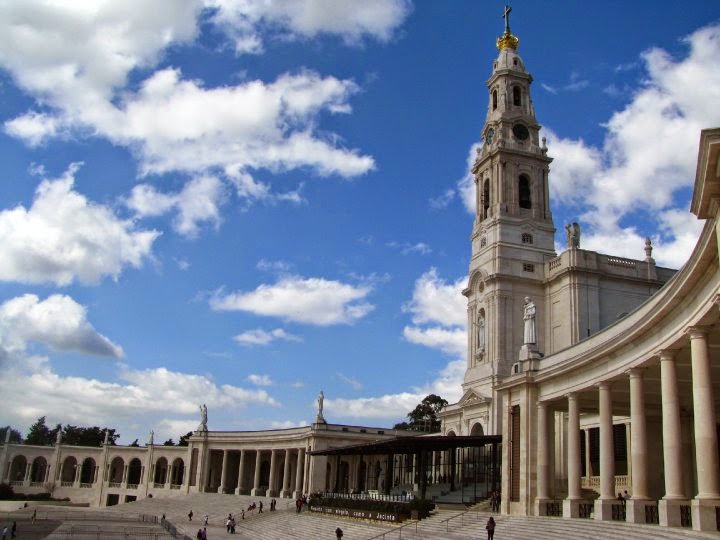
This Palm Sunday four years ago, I was soaking up the sun from the steps of the basilica in Fatima.  It was the start of a ten-day break and I would then travel to Madrid to work with the Missionaries of Charity during Holy Week.  I experienced vividly the providence of the Lord on that trip.  While the Lord provides for me everyday, I recognized it and relished it more at that time.  It seemed to be in such magnificent ways.  The Lord provided a train at the appropriate time.  He provided a kind Portuguese family that drove us from the train stop to the town of Fatima.  He was constantly looking out for us and giving us glimpses of beauty along the way.

The same is true for my life today but it seems to be less spectacular.  My students participated in a discussion I tried to lead.  My meeting with my principal went better than expected.  I didn’t feel like dropping into my bed at 3:30.  I managed to stay awake for a whole holy hour.  Little things.  Things that don’t feel extraordinary or all that spectacular.  That is my life.

It is easy to feel a little trapped.  I teach high school students in a not-too-small town but one that seems a bit stifling anyway.  My heart doesn’t long for a metropolis or an accolade laden teaching career.  I simply desire to be fulfilled.  In many ways I feel fulfilled but in many ways I feel a lack. I cannot help but at times looking around me and wondering when it will be my turn…for so many things.  I’m young but I feel so old sometimes.

I need a new reference point.  College continues to fall further into the past with each passing day.  I cannot go back there, as much as I may wish to some days.  The future I imagine may not be at all as I expect when it finally comes around.  All I truly have is the present and even that I do not really possess.  Christ needs to be my new reference point.  Friends will come and go, family members will pass away, gifts will fade, and abilities will be lost.  But Christ is ever-new.

The Mass: The Glory, the Mystery, the Tradition : A Book Review

The Eucharist is the source and summit of the Catholic faith.  As such, it is perfectly fitting that Cardinal Donald Wuerl and Mike Aquilina would co-write a book to teach the faithful about this crucial aspect of their faith.  Published near the time of the implementation of the new Mass translation, it guides the reader through the Mass step-by-step.

The first half of the book seeks to help the reader grow in greater knowledge about the history of the Mass, the different names for the Mass, the people involved, and the different materials used in the celebration of a typical Mass.  By covering this aspect first, they are setting the stage for the Mass to be understood in a new way.  Pictures are included to help the reader visualize the specific vessels used in Mass or the way different parts of the Mass would actually look.

Once the stage is set, the materials are identified, and the faithful are equipped with the necessary background knowledge, the authors launch into a thorough walk through of the Mass.  Each aspect of the Mass, from the simple opening prayer to the purification of the vessels after Communion, is explained and presented in a way that is both easy to grasp and yet provides knowledge that helps deepen one’s spirituality.  After reading through what the prayers mean, it is difficult to view the Mass in the same way.  I will find myself at Mass hearing a specific line in a prayer or watching the priest do something and will recall the greater significance from the book.

If the Eucharist is the “source and summit” of the Catholic faith, it is necessary to understand it as fully as possible.  Reading this book ensures that you will be able to grasp more fully the nourishment that is being offered to you through the saving Bread of Life that is Jesus Christ.  The book ends with sending you out to actually live out the Eucharist and to live out the closing words of the Mass: “Go forth, the Mass is ended!”

**I received this book free through “Blogging for Books.”

The Date Was March 19th

The date was March 19, 2004.  I was a young teenager about to experience one of the greatest sacrifices of her life.  The sacrifice would begin on this day and continue for the rest of her life.  This was the day my sister entered a cloistered Carmelite monastery.  While I didn’t know exactly what to expect, I knew that it would be difficult and I knew that I didn’t want it to happen.  My family went to Mass in the morning and then out to eat at a restaurant.  We drove to the monastery, helped my sister into her postulant garb, and took some pictures.

I ruined the pictures.  I wanted to go last and so I let the others go first.  Each produced a lovely last picture with my sister.  When I got there, my dammed emotions overflowed in a torrent of tears.  My picture was terrible with both my sister and I having red eyes and trembling smiles.  We gave our last hugs and my sister entered the cloister.  To my knowledge, that would be the last hug I would ever bestow on her.  This was an incredibly difficult knowledge to accept.  I cried quite a bit and mourned the loss of the sister I loved so dearly.  I love each of my siblings for different reasons.  But this sister was the one who seemed to know me the best.  For my young melancholic self, that was a gold mine.  While six years older than me, she took the time to read me books with her delightful accents, build make-believe forts outside that I would imagine lavishly in my mind, and would eventually try to teach me Latin during one of our summer school sessions.  I loved her deeply and fiercely.

My mother will sometimes describe having a daughter enter religious life to losing a daughter to death.  One of the differences is that people will congratulate you on your sister’s vocation (or look at you curiously) but will never understand the internal mourning that is taking place.  I am a huge proponent of religious vocations but I try to be sensitive and understanding to the suffering that the family is certainly enduring.  While it is a great joy and blessing, it is also a sacrifice.  And the sacrifice is felt by all involved.

The date was March 19, 2014.  My sister had now been in the monastery for a decade.  In her mind I am still the young teen that I was instead of a young adult teaching high schoolers.  This is the day that she will move from the convent about an hour from our home to a new monastery being founded about six hours from home.  However, this day is one of rejoicing for me but still mixed with some sorrow.  My sister is saying goodbye, perhaps forever, to the religious sisters she has lived life with for the past decade.  I am saying goodbye to monthly visits at the monastery with my sister.

However, I am saying hello to wrapping my sister in a tender embrace.  My parents and I had the great privilege of helping the sisters move north and begin to set their monastery in order.  I rolled a cart outside of the convent and then I saw my sister.  This isn’t the first time I’ve hugged her since her entrance a decade ago, but each embrace is cherished and sweet because I know how rare they are.  I am near her and talking to her but she is the one who will initiate the hug first.

“Remember 10 years ago today?”  I’ve been thinking of this day so much as the day I will help my sister move that I had momentarily forgotten the significance of the day.  I briefly flash back to the young girl with tears streaming down her face as the convent door separates her from her sister.  I remember.

This day there will be no tears.  Those will come a couple days later when I must say goodbye to her again.  Today I am reveling in the joy of simple things.  Riding in a van with my sister driving and seeing her eyes in the rear view mirror as she looks back at me.  My sister stopping by the room I am working in and smiling briefly at me.  Going out for lunch at a restaurant and hearing her order her food.  Watching her fill the van’s tank with fuel as we stop briefly.  Meeting her eyes during supper conversation or seeing her appreciate one of my quieter inputs to the conversation.  The things that are so easy to take for granted, the things that I didn’t even realize were gifts until I experienced their deprivation.

As I was at the new monastery, moving boxes and unpacking various items, I would see my sister and think, “This is how it should be.”  This is what it would be like if my sister was like most sisters.  There was also the realization that everything I did was simply to put her once more outside of my grasp.  I was cutting open boxes and sorting through bubble wrap so that my sister could be enclosed in a cloister again.  Yet I was thankful for the grace of those few days.  For a short while I was able to be with my sister in a way that I hadn’t been for 10 years.  I could see her living joy, I could feel her arms embrace me in a hug, and I could be with her for this time.  I was not bitter or unaware of these manifest blessings.  Most families of sisters in cloistered orders can only dream of this privilege.

While I was helping for the few days, I was preparing myself for the end.  I was trying to soak up the experiences of the present so as to endure the remaining years ahead.  “Heaven will be amazing,”  I thought to myself on numerous occasions.  Of course it will be because we will be in communion with Our Lord, but also because I will be reunited with people I love so dearly.  I will see the joy that has been stored up while I sacrificed and cried on earth.

On the final day I felt unprepared to leave.  The sisters gathered to send us off and my sister was the first to give the hugs.  I wanted to save her for the end but it wasn’t to be.  Instead we embraced and it was far longer than usual.  Her arms were firmly around me and she kept them there when she would usually not.  I couldn’t stop the tears and soon I was shaking with tears.  I could feel her nod her head.  She understood.  She also suffered.  It is not as though the family only suffers.  The sister suffers, too.  She must give up all else to follow her Beloved.

“You are gaining great merits.”  I wasn’t certain how to respond to that as I looked at her through reddened eyes, tears coursing down my cheeks.  I know the reward will be great in Heaven.  “And every one who has left houses or brothers or sisters or father or mother or children or lands, for my name’s sake, will receive a hundredfold, and inherit eternal life.”  (Mt. 19: 29)  So while she left me and it wasn’t my choice, I claim that verse for all who have offered siblings or children to the religious life.  It is a sorrow and a joy that is impossible to put into words.

I left the convent and drove most of the six hours home.  The first couple hours were marked by sobbing and then eventually silent conversation with the Lord.  Unlike a decade ago, I wasn’t accusing Him of taking my sister away unfairly.  I wasn’t even upset really.  My conversation went more like this, “It hurts, Lord.  My heart hurts and this sacrifice seems too much at times.”  The last decade has assured me that God provides and that God knows best.  I was able to view this time not as my right but as a grace that I did not expect.  “It is a privilege I think not of” kept coming to mind and I was certain it was a quote from something but I don’t know what.  It was the Lord’s gift to me and I was hesitant to let it run its natural course.

March 19th.  It is a day that is etched into my memory.  Each year the Church celebrates St. Joseph, the protector of the Church, the guardian of the Virgin, the terror of demons.  And each year I celebrate his life as well as my sister, Sr. Mary Joseph.  It is a day of gratitude.  It causes me to remember what the Lord has done in my life and the great graces that He has bestowed upon me.

All of this toil on earth will be worth it.  Someday, I pray, I will come to the Heavenly Banquet of the Lamb.  I will meet my Beloved face to face and be filled with such a joy that my earthly heart would burst if it hadn’t been widened.  He will lead me to a place at the table and I will look about at the faces there with eyes shining with tears of joy.  Among the glorious faces around me I will see hers, my beloved sister.  She will be radiant with joy, intoxicated at being in such intimate communion with Our Lord.  I will look at Jesus, sitting beside me and gazing at me with eyes of complete understanding.  And I will say, “My Lord, if I had known on earth the joy that suffering would produce, I would have gladly suffered more.”

This is what I must remember now.  I am allowing the Lord to prepare my heart for the joy that is to come.  Praised be Jesus Christ!  Now and forever!