They Have No Wine

They Have No Wine

“They have no wine.”

It isn’t a question. It isn’t even really an ask.

Rather it is a simple statement from a mother to her son. At the wedding feast of Cana, Mary makes the needs of the wedding couple known to Jesus. But how could He not have already known? Yet she models so beautifully the role of every Christian: to present our needs and the needs of others to the Lord. She does this with simplicity (she doesn’t muddy it up by telling Jesus how to remedy the problem) and full of trust (since her next words are to the servants, ‘Do whatever he tells you.’).

“They have no wine.”

Sometimes I think that I just keep presenting the same thing to the Lord over and over again. While in many ways that is true, there is also a sense in which it isn’t true enough. I am the one who gets tired of asking. I am the one who grows weary with bringing to the Lord that which He already knows better than I do. Unlike Mary, I am less convinced that He will hear my plea and respond generously to me. Instead, I find it necessary to instruct the Lord in how he might fulfill my need. I have the perfect idea for how the Lord might work in my life, if only He would listen.

Jesus, however, is secretive with His plans, hiding from us what the future holds, likely (for nearly all of us) for our own good. He has plans which I cannot fathom, ways to fulfill my longings which I could not guess, even if given thousands of years to do so. And His plans have the benefit of being good and perfect, rather than my own short-sighted idea of what might be good for me.

Continue reading “They Have No Wine”
Our Lady of Lourdes

Our Lady of Lourdes

“What color was the towel?”
“How big was the towel?”
“How was it wrapped around you?”
“What color were the walls?”
“Was the bath made of marble?”
“Were the walls taupe?”
“How large was the bath?”

I knew what they were doing.  

Sometimes students love to get their teachers off track and launch into tangents.  It works even better if the teacher enjoys talking about particular topics.  I recall a specific teacher in middle school who would tell the same stories over and over again.  And we loved to let him because it meant that we wouldn’t move on with other work.  As a teacher, I now understand a little more how one could repeat the same story to the same class and not remember.  If I, a “veteran” teacher of five years, struggle to remember if I told this story this year or to this class period, then a teacher of 30-40 years should definitely have a greater struggle.

We were talking about private revelation.  It is difficult for me to remember how much I knew at their age, but I was surprised at what they did not know.  I mentioned Lourdes, Fatima, scapulars, and Miraculous medals, receiving blank stares for many of them.  So I started to talk a bit more in-depth about Lourdes.  Once they found out that I had actually been there and been in the baths (“Can just anyone go?”), they had many questions.  Some were deeper (“Did you go to receive healing of body, mind, or spirit?”) and others were more surface level (“Do they reuse towels?”).  And when genuine interest (even if merely for the sake of not doing more classwork) is shown in the area of faith, I find it hard to not answer questions. Continue reading “Our Lady of Lourdes”

Beloved Fatima

Beloved Fatima

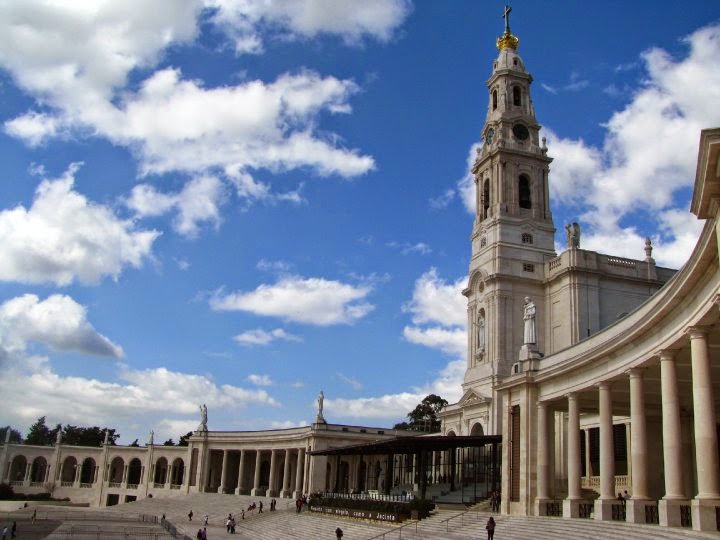
My sister said that the closer we got, the larger my smile became.  I couldn’t help it.  I was returning to a place that I had visited twice before and it had a certain feeling of coming home.  The bus pulled up and let us out, excitedly spilling onto the platform before setting out on our mission.

I had returned again to my beloved Fatima, Portugal.  This was the second “Marian bookend” of my Camino in the summer of 2014.  Prior to walking the Camino, we had visited Lourdes.  Now, we were on a celebratory trip to Fatima.

2d2d8-fatima Continue reading “Beloved Fatima”

Growing a "Yes" Within

Confession: I don’t always enjoy praying the Rosary.

In fact, I often avoid it because it takes me so long to pray it by myself and I want to spend my prayer time doing other things.  That might be borderline blasphemous to some Catholics, but that is honestly how I feel sometimes.

Last night, however, I decided to pray the Rosary.  I told myself that I could stop and pray with a given mystery if I felt drawn to it.  It was a minimal-commitment Rosary, if you will.

The joyful mysteries were the mysteries for the day.  I tried to mentally enter into the mysteries: what if I was Mary and experienced the Annunciation or needed to travel to Bethlehem for a census?  The interesting thing was that instead of Jesus being who was developing within me, it was a “Yes.”

Before prayer I had gone for a run and part of the time I was thinking, “Lord, help Your will to be my will.”  So as I reflected on these mysteries, I thought of this desire to follow God’s will as a “Yes” that is grown within oneself.  This “Yes” was what Mary spoke at the Annunciation–a “Yes” that took on flesh and entered into humanity, but a “Yes” nonetheless, one that she said with her whole self, every day.

The “Yes” does not lead to immediate results, however,  Mary’s “Yes” took nine months of quiet growth before it was born into the world.  Similarly, our “Yes” may not be evident after the first day.  It might take months to begin to show.  But when it does, it will noticeably transform us, even though it might remain hidden.  We might labor to give birth to this “Yes” with our whole selves.  But what struck me was the presentation in the temple.  Even after we have grown this “Yes” within us and labored for it to bear fruit, the results are still not our own.  We present the fruit of our “Yes” to the Lord to do with as He wills.  Nothing remains our own.

After giving ourselves to this “Yes” and presenting it back to the Lord, we might still struggle to understand and find this “Yes” in the confusion of our lives.  Mary had to seek after the “Yes” in accepting to become Theotokos–the God-bearer, she looked for Jesus in the temple, and she stood sorrowfully taking in this “Yes” hanging on the cross.  It was a “Yes” that filled her entire life, one of complete obedience to the will of God.

My reflection on the joyful mysteries of the Rosary filled me with a renewed desire to nurture this “Yes” within myself.  Not in one area of my life, but in all areas.  Without even thinking about it too much, when I imagined this “Yes” filling my life, I knew it would be accompanied by an undeniable and nearly uncontainable joy.

A “Yes” to the Lord involves sacrifice, that is true, but it leads us to a deeper peace and joy than only saying yes to our own will.  It fills us and gives true life.

But he said, “Blessed rather are those who hear the word of God and obey it!”  (Luke 11:28)