Speak Truth

Speak Truth

There is something about truth that attracts.

It isn’t because the truth is always what we want to hear.  Many times, it is the exact opposite.  Truth, however, spoken ardently and sincerely can be a powerful force, a compelling and crushing beauty.

Challenging someone with unadorned truth can provoke change.  And it can be a testament to the great love and respect the truth-teller has for the other.  These reflections I’ve had spring from a rather unlikely source: I watched a movie. Continue reading “Speak Truth”

Love never ends

Love never ends

“Why would the Lord be frustrated with you?  What would that accomplish?” my spiritual director asked me during our last meeting.

While I had spent days being frustrated with myself (and assuming the Lord was, too), I had never looked at it in quite that light.  And in some ways, I didn’t want to.  It was easier to assume that the Lord was throwing up His hands and sadly shaking His head in my direction.

“Why would He be frustrated with you?”

Because it seems like He should be.  I am–why wouldn’t He be? Continue reading “Love never ends”

Surrendering

Surrendering

One of my friends and I were looking at a listing of the different “definitions of Hell” based on a person’s Myers-Briggs personality type.  There were a few that seemed to fit well with me, but the one that stood out was for the INTJ personality.  “Every time you open your mouth to say something intelligent, something entirely idiotic comes out instead.”

We agreed that the scenario would be pretty awful.  Then I remembered when I had my four wisdom teeth removed.  I was awake for the procedure, but my mouth was injected and numbed so that I couldn’t feel pain.  Afterwards, my mom came in to see me.  For some reason, it was incredibly important for me to convey to my mom that I was still perfectly logical, even with all of the pain meds. Continue reading “Surrendering”

Thirst

Thirst

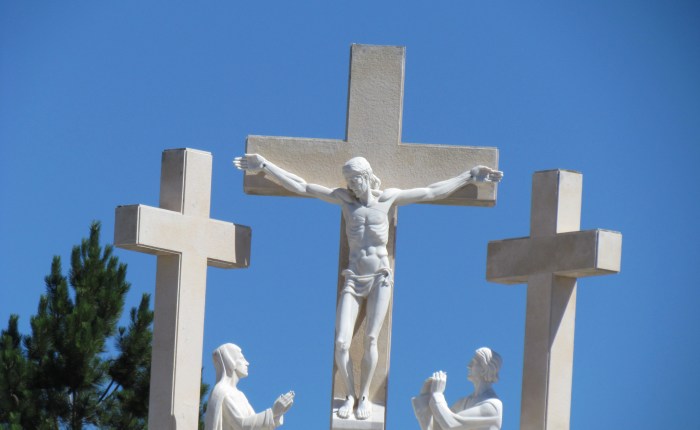
Today, during my sophomore classes, we prayed the Stations of the Cross.  Though I’ve prayed them many times before, God seems to repeatedly sow new meaning into the lines.  Phrases I hadn’t before realized, come to life in a startling way.

The thirst of Christ struck me in prayer today.

“My God, my God, why have you forsaken me, far from my prayer, far from the words of my cry?  O my God, I cry out by day, and you answer not; I cry out by night, and there is no relief for me.  All my bones are racked.  My heart has become like wax melting away within my chest.  My throat is dried up like baked clay, my tongue cleaves to my jaws; they have pierced my hands and my feet; I can count all my bones.”  (Ps. 21/22, The Way of the Cross)

I’ve grown up hearing about Bl. Mother Teresa saying that Christ was thirsting for our souls while on the cross.  And that took on a new depth today and will be something I will return to throughout this Holy Week.

For a few brief seconds, I was able to imagine the intense thirst of Christ.  I considered a couple moments in my life where I have felt extremely thirsty, when my tongue seems to stick to my mouth.  The instances have been few and far between.  I had always passed over these words with little thought, but today I was unable to.  I could imagine Christ’s dry mouth and His tongue sticking to His jaws, as He tried to peel it away to speak a few words.  He longed for a little water.

This thirst Christ had was one aspect of His intense suffering.  He also had the scourging on His back, His hands and feet were pierced, His head was seeping blood as the thorns bit into His scalp, and He was repeatedly pushing Himself up to take in some air.  His thirst was one part of the physical agony.  But it struck me.  For a few seconds, I imagined, to a degree, that thirst and my heart seemed unready to take in the rest of the Passion while surrounded by a bunch of teenagers.

A new depth of thirst was realized.  If I now have a greater understanding of His physical thirst, how much deeper was His thirst for souls.  Even more than for a cup of cool water, Christ was longing for our souls.  The intensity of such a thirst pains my heart.  Here Christ so deeply desires my heart and I am slow to give Him it in its entirety.  May a new thirst fill my own heart for the Lord.  May the intense thirsting of Christ on the cross be my new attitude toward Christ Himself.

As a deer longs for flowing streams, so my soul longs for you, O God.  My soul thirsts for God, for the living God.  When shall I come and behold the face of God?  (Ps. 42)

Their Eyes

I live for the moments when their eyes look like they did yesterday.  When I’m opening my heart because for a few moments it feels safe with a class, and their eyes are fastened on me.  I want to read the stories that are written there.  I want to profess my love for them even though it is all heightened and strengthened by the moment.  A few seem on the verge of tears, but all appear to grasp my sincerity and my desire to impart this knowledge to them.

I’m discerning on my feet if I should tell them about that powerful prayer experience I had a couple weeks ago.  And I do.  I talk about spiritual direction and share what I learned from it just the day before.

Maybe some are annoyed with my long preaching session, wondering if it is going to be required knowledge for the test.  But I cannot tell that those thoughts are running through their minds.  I can only see their eyes.  They are pools of experiences–hurt and joy.  And I desire to sit down with them and hear all the stories.  I don’t always feel that keen desire, sometimes I forget that their experiences are just as real as my own.

I’m trying to speak truth into situations that I do not know or understand, but I know they are in them.  Because I’m in similar situations.  It is part of the human condition.

The simple truth I desired to impart was this: Jesus knows.  He knows what it feels like to be in their shoes and to experience the pain they feel.  I spoke about how all of Jesus’ friends abandoned Him at the moment He most needed them.  He knows what it is like to feel betrayed and left alone.  He suffered for the sins and sufferings of the entire world, throughout all of history.  And He did this so that when we come to something that seems too much, He can tell us that He already passed through this, too.

And I asked them to find Jesus in the midst of it all.  How is Jesus loving you in this situation?  He is present in death, in their parents’ divorce, and in the betrayal of a friend.  He is loving us through every situation.

A priest pointed this out to me the other day–I told him I was seeking to see each experience as God trying to convert my heart and he included that each experience was God loving me.  How quick I am to shift the focus just enough that it distorts the image.  It is different to experience all as a means for my own conversion and quite another to see it as an avenue of His love.

“I don’t understand,” one student says.  “How can you find Jesus loving you in your parents’ divorce?”

And I don’t have a clear answer.  I can’t give them a Scripture passage or a Catechism reference to answer it nicely.  Instead, I must tell them that I don’t know how Jesus is seeking to love them in their difficulties, but I know that He is doing it.  That we need to open our hearts, to not pull back when we are wounded and to open them to the Healer.  I am speaking to myself as much as I am speaking to them.

Reminding them that Jesus is present in all, reinforces that belief in me.  All I’ve experienced He has already experienced and has thus sanctified the experience.  And each experience is a new way to receive His love.

All can be seen through the eyes of Love.

Follow my blog with Bloglovin

The Good Thief

Jesus said to his disciples: “Be sure of this: if the master of the house had known the hour when the thief was coming, he would not have let his house be broken into.  You also must be prepared, for at an hour you do not expect, the Son of Man will come.”  (Luke 12: 39-40)

Jesus compares His Second Coming to a thief coming at night.  As the Gospel was being proclaimed at Mass, I was struck by the phrase “he would not have let his house be broken into.”  Of the many ways Jesus could describe His Second Coming, He chooses at this time to say that He is like a thief who breaks into a home.  Obviously, the master of the house would want to protect himself against any thief forcing entrance into the house.  The immediate connotation is a negative one: be prepared so Jesus doesn’t break in.  What is the other option?

In John’s Gospel, Jesus is the Good Shepherd and also He is the door.  Entrance through His door means salvation.  But He mentions a thief and says that a thief doesn’t enter through the door but comes only to steal, kill, and destroy.  So is Jesus like a thief or is He a door?

What about if He is actually both?  Jesus stands at our hearts, knocking, gently persistent, asking for entrance into the deepest recesses of our being.  We choose if we open the door to Him or not.  He waits, patiently.  Yet there will come a day when waiting is no longer an option, when our refusal to acknowledge Him will come face-to-face with the reality of Who He is.

Will you open the door for Him?  If not, He will not be kept out and He will find a way in, like a thief, stealing through the chinks in our armor, stealthily slipping into the cracks in our fortress.  Yet if Jesus came to give us life, how could He also come to “steal, kill, and destroy” like a thief?  To us in the midst of our sinfulness, the act of taking away our addictions, habits, and struggles will seem like thievery.  It may seem like it is killing and destroying us to be stripped of that which we have made to be our personal god.  An experience of authentic self-denial can help us see the death that must occur when we have not opened wide our hearts to Christ.

He will break into our house.

That experience of a break-in will be unique, but He daily breaks into our world.  He isn’t hiding, but He isn’t forcing us to acknowledge Him today.  He is breaking into my world through the sky filling with a sunrise palette.  He is breaking into my world through the student who insists on keeping a ten-minute running commentary during a surprise fire drill.  He is breaking into my world by placing me in difficult situations I never thought I would have to encounter.

I can recognize His breaking in, or I can pretend like it never happened.  He can be a door or a thief.  Either way, He will enter into my life, it is simply a matter of method and perspective.

And so we strive to let the Good Thief in through the Door.

The One who persistently calls your name, knocks on the door of your heart, and ushers you into an abundant life.

He will come again whether it be His Second Coming on earth or at our death.  We will encounter Him in His glory and realize, with total certainty, who He is.

Do you want the Thief or the Door?

Follow my blog with Bloglovin

Where is Jesus in it?

It is painfully beautiful to be alive.

I’ve experienced the piercing blade of beauty.  It makes you wince and feel more alive all at once.  The delicate blanket of fog that covers the lake nestled amidst the Swiss Alps.  A sunrise view atop a radio tower on a mountain in Austria.  Glorious fields of grain stretching to the horizon.  The crinkled eyes of a loved one when they are smiling.  Late nights spent talking with a friend you haven’t seen for too long.  In these moments, the beauty strikes our hearts and it is easy to see, take in, and embrace the glories of being alive.

Sometimes the emphasis seems to fall more on the side of pain as opposed to beauty.  Yet in most moments (I’m not certain if I can argue for all moments yet), one can find beauty in the pain, if one is willing to look for it.

The beauty found in the pain of: waking up early for work, a morning run with a dear friend when talking takes far too much effort, a heart overflowing with all sorts of emotions, and speaking difficult words that later bring peace.

And then there are the moments where life seems to blindside you, where the pain is evident but the beauty is masked.

A young person I barely knew recently died.  I guess I am uncertain what type of response I expected to have.  My heart ached and a heaviness filled it.  At one point, as captive tears broke free, I wondered if this is what it means to have a mature heart, one that can feel pain even when the tragedy doesn’t really change one’s life.  The pain didn’t just last for a few moments but seemed to linger, clouding my thoughts and casting a pallor over the next couple days.

It was uncertain how he died, but I kept imagining the different scenarios I was told.  At Mass on Saturday, I couldn’t help it.  My brain insisted on replaying the possible options, my heart aching with each dramatic death I imagined.  I hoped that maybe I would be able to speak to my spiritual director about it and gain his perspective.  Then I realized that I already knew what he would say to me.

He would ask, “Where is Jesus in it?”

So I tried it.  “Where is Jesus in this tragedy?”  I replayed the awful images but inserted Jesus into the mental video.  There He was–walking right beside the boy, tears coursing down His face, gently whispering his name.  It was a painfully beautiful experience as I watched Him carry him.  Soon I was including a guardian angel and the Blessed Mother into the picture.  It was transforming the scene.  The tragedy was still there, but the beautiful pain was making an appearance.

This truth that I had learned before was once again re-impressed on my heart: Christ never leaves us.  Regardless of what we do, how far we try to run, or what we tangibly experience, Jesus is always present, gently whispering our names, and desiring to enter into the wounds we try so hard to fill with insufficient medicine.

Throughout life, none of us walks or falls or lives alone.  Christ is always there in the midst.  And that is what makes life painfully beautiful.

“There is no evil to be faced that Christ does not face with us.  There is no enemy that Christ has not already conquered.  There is no cross to bear that Christ has not already borne for us, and does not now bear with us.”     -St. John Paul the Great

Why are you walking the Camino?

“Why are you walking the Camino?”

After hearing someone’s name and country of origin, this is the next general question to ask.  Yet it is a very personal question to be asked so early on.  I never quite knew how deep to go or even how to phrase my reasons entirely.  So when people asked I generally told how it worked out for me to come this summer rather than my deeper reasons for walking the Camino.  If the question seemed to be asked too flippantly, then I didn’t want to bare my soul to someone I hardly knew.  I am a melancholic, after all, and the perfect words never quite seemed to find themselves on my tongue at the appropriate moment.

Despite my reservations, some people were remarkably open about their reasons.  One young man I met said that he was walking for redemption.  I never asked him what he meant by that but it sounded deep.  A young woman was looking for her heart.  An older woman said she was walking for forgiveness–to forgive herself or nature…something.  One man was walking out of thanksgiving.  Others were looking forward to a new stage in their lives or hoping to initiate a change.

I walked the Camino for Love.  Naturally, part of me hoped to find “the one” on my walk, implausible though it might be.  What I really wanted, though, was to find a deeper love with Jesus.  While the Camino is traditionally a pilgrimage to a holy site, modern Camino walkers are typically not walking for religious reasons.  They are searching and seeking after something but they don’t fit into neat religious groups.  Perhaps I underestimated my fellow walkers, but I didn’t foresee a very interested response if I said I was walking across Spain so that I could fall deeper in love with the Lord.

While part of me understands the different reasons to walk the Camino, I often found myself thinking that I knew of no other sufficient reason to walk the Camino other than Jesus.  My heels and the balls of my feet developed large, painful blisters that reappeared day after day.  I can think of little else that would motivate me to repeatedly stick a needle into my foot and then to walk seven hours on sore feet.  The ache in my feet was manageable when I knew that I was offering it up for something and that this pain was aiding someone else.  It would have been entirely different to just endure the pain as part of the adventure.

Why did I walk the Camino?  I walked it for Love.  I walked it because in prayer Jesus tenderly calls me “My Heart” and I wanted to fall deeper in love with that Sacred and Eucharistic Heart.  I walked it for a time of peace and solitude.  I walked for Jesus.

In the Waiting

The “crucify Him!” of Good Friday gives into the waiting of Holy Saturday.

I always find it difficult to speak those words.  Inwardly, I rebel.  I don’t want Him crucified, I don’t want to be one of the crowd yelling for the death of the One who loves me.  Yet what other role is there to play in the Passion narrative?  Peter denies Christ three times.  Judas betrays Christ for money.  Pilate is intrigued by Jesus yet still washes his hands of Jesus and hands Him over for death to appease the crowd.  The Pharisees rile the crowd and they yell for the death of Jesus.  In the words listed in the Passion narratives at Palm Sunday and Good Friday, there is no one to defend Jesus.  None speak on His behalf.  So I must cast my lot with the crowd and speak the words that I too often live out.

We suffer through the Passion with Jesus on Good Friday.  Not fully, of course, but we enter into it more.  We try to make it a reality, an event to experience today, not simply a fact of our faith.  At Good Friday service we reverence the cross.  I pictured myself at the foot of the cross, looking up at Christ.  At times I am clinging to the cross, kissing His feet.  Other times I am crumpled on the ground in agony.  Or I am embracing Mary, trying to understand her sorrow.  At one point I was Our Lady, cradling Jesus in my arms, my broken heart questioning why this must happen yet remaining steadfast in my hope.

He dies and is buried.  There is an emptiness I feel with all of this.  There is a strangeness in the tabernacle, open and empty.  There is a sense of deprivation.  I don’t understand what the apostles felt, but I catch a glimpse of it.

We enter then into the waiting of Holy Saturday. In a way, this is worse than Good Friday.  Good Friday involves action–we are walking with Jesus to the cross, we are watching Him be crucified, we are mourning Him and cradling Him in our arms.  But on Holy Saturday He is buried and He sleeps.  My soul is waiting for the “Alleluia” of Easter but it is not here yet.  I try to imagine the starkness of Holy Saturday for the apostles and Our Lady.  Jesus is dead and buried.  They do not understand that the Resurrection will take place.  Perhaps Holy Saturday is bleaker than Good Friday.  While yet alive, there was the hope that angels would come and rescue Him or that He would come off the cross of His own volition.  Holy Saturday is filled with memories of the Passion, reliving the moments when they betrayed the Christ, and wondering what the future holds.

Did that happen?  Did He truly die?  Is this how the story ends?  Did we follow this man for three years, see Him perform many wonders, listen with burning hearts to His words, only to see Him die the ignoble death of a criminal?  What is God’s next move?  Did evil really triumph?  Where is hope?

Easter Sunday cannot be understood yet.  It is beyond what they expect.  Living in the hours after the death of Jesus, they are wondering how life can ever be the same or even continue.  We can experience Holy Saturday in the same way, too.  Yes, we know the next step in this story: Christ rises from the dead.  Yet in our own lives, we do not know the next step.  We often experience a Good Friday and then think it ends with Holy Saturday.  It is difficult to wait.  It is difficult to be patient and to let God bring something gloriously beautiful and incomprehensible from the ruined ashes of our situation.

Between “Christ has died” and “Christ has risen” there is a tension.  Perhaps much of our life is spent in this tension of living between death and resurrection.  The waiting has a purpose though.  It is preparing us for the joy that is to come.  We simply need to have the patience to sit with Our Lord in the tomb.  He will rise–we know this truth.  In this moment, in this Holy Saturday of our lives, we need to wait in this moment of death, in this apparent loss of everything we hold dear, in this aching lack.  Christ is meeting us in this lack.  And He is preparing our hearts for the joy that He will pour into them.  The joy will be made all the more wonderful by the experience of the agony of waiting, suffering, and dying with Him.

Christ will rise.  For now, let us wait at the tomb with Him, deepening our desire for Him.  Let us wait in the tension that is bringing about our salvation.