Nothing Again Would Be Casual and Small

Nothing Again Would Be Casual and Small

Each Sister of Life wears a medal that has inscribed on it a fragment of poetry by Fr. John Duffy.  The line is from the poem “I Sing of a Maiden” and it speaks about the Annunciation.

“And nothing again would be casual and small.”

The author is speaking of the Blessed Mother conceiving Our Lord.  Yet the fact that the Sisters of Life carry this line near their hearts makes me think it must relate to their lives and my life, too.

Generally, though, my life feels casual and small.  Despite my desires for great and wonderful adventures and experiences, much of my life is composed of the ordinary and seemingly insignificant.  What does it mean that nothing is casual or small?

In a way, I think Jesus speaks to this when he remarks on the widow’s gift to the temple treasury.  Jesus and the apostles watch people come and give large gifts of money, but the poor widow puts only two small coins into the treasury.

Truly, I say to you, this poor widow has put in more than all those who are contributing to the treasury.  For they all contributed out of their abundance; but she out of her poverty has put in everything she had, her whole living.  

Mark 12:43-44

In a simple comparison of amounts, is the widow’s gift small?  Yes.  What makes it stand out to Our Lord?  The fact that despite her poverty, she still gives everything.  

Most of us are comfortable giving generously when we know we will still have ample for ourselves.  And I’m not going to lie and tell you that I live any differently.  While I donate money, I do not “give until it hurts.”  I give when it is comfortable or when I feel like it or when I remember.  Generosity is not a hallmark of mine.  When I was in elementary school, my dad would give my younger sister and I an allowance.  Conservative in nature, I always pocketed my money and saved it for a future purchase, probably a book or something.  My younger sister would spend her money nearly immediately, stocking up on some candy or treat at the gas station convenience store.  Yet while she was quick to spend, she was also quick to share.  I, on the other hand, would primarily buy things for myself and was slow to share them with others.

Jesus is commending the poor widow’s generosity with her finances, but I think there are deeper truths we can discover here.  Things that might point to how nothing is casual or small.  Several weeks ago, this was the Gospel at Mass and I left identifying myself largely with the widow.  Not because of her generosity, but because of her apparent littleness. Continue reading “Nothing Again Would Be Casual and Small”

Saints and Sinners: The Indelicate Reality of Christ’s Church

Saints and Sinners: The Indelicate Reality of Christ’s Church

In college, I took a course called “Theology of the Church” and the professor made certain to cement a specific truth in my mind.  He spoke frequently of how the Church is the spotless Bride of Christ, without blemish or error.  Yet he spoke just as often about how the Church is stained and tarnished, filled with sin and weakness.  Each Catholic must come to terms with this dichotomy if he or she desires to fully understand this living organism we call the Catholic Church.

The saints are beautiful models of following Christ and seeking holiness in the midst of a chaotic world.  For most of the difficulties we face in life, we can turn to a specific saint who had similar struggles.  There are saints who had difficult relationships with their parents or children, saints who were falsely accused, saints who had superiors who treated them unjustly, saints who lost loved ones, saints who experienced poverty, saints who struggled with drinking or drugs, saints who battled anger and violence, and saints who people thought were foolish or incapable.

IMG_5994

Yet we know the Church is not merely comprised of saints.  I belong to the Church and I am most definitely not a saint yet.  So while it is easier to focus on the virtues and gifts of the saints, we also know we are a Church filled with sinners.  We have sinners in the pews, in the choir, in the streets, at the altar, in the diocesan offices, in the Vatican, and in the chair of St. Peter.  Each of us, on our journey to become the saints God desires, must fight our own battles as we acknowledge our sinfulness.  The goal is not to make perfect masks that cover up our imperfections.  Rather, we seek to let Christ into our deepest sins and allow Him to transform us.

IMG_5323

It is with this knowledge of myself, as a sinner striving to be a saint, that I can recognize this reality within the Church herself.  She is perfect: Christ instituted her, the Holy Spirit guides her, and the Father welcomes her members into Heaven, one by one.  Yet she is us: flawed, broken, dragging our weary hearts to Calvary and to Heaven.  All of the romantic notions I have about the Church and her beautiful, soul-shaking theology necessarily contrast painfully with the reality of the Church that I see around me.  Reality is certainly not so romantic and not so obviously beautiful.  Nonetheless, it is still the Church I love.

When we encounter scandal in the Church, it is helpful to remember this inherent dichotomy, one that existed from the beginning of the Church, yet one which will end when we are purified and in Heaven.  While I love quite fiercely different humans within the Church, I also know that my love for the Church is not solely based on these humans.  My spiritual director is wise and I find myself able to share the workings of my heart with him.  My pastor leads me to a deeper understanding of how to encounter Christ in the daily moments.  Yet even should these priests fail me, I would not stop loving the Church.
Continue reading “Saints and Sinners: The Indelicate Reality of Christ’s Church”

Build Up the Ancient Ruins

Build Up the Ancient Ruins

After finishing a silent retreat, I opened my Bible to where I had some papers sticking out.  I had marked this section because of the first three verses of Isaiah 61.  They were the Scripture verses my college women’s group considered “our” passage.  While they speak beautifully about the Spirit of the Lord and how it works in us, my attention was attracted to the following verse.

“They shall build up the ancient ruins,
they shall raise up the former devastations;
they shall repair the ruined cities,
the devastations of many generations.”
(Isaiah 61:4)

For the first time, I read this verse and realized the great hope attached to it.  I look at the world around me and I see a lot of things falling into ruin.  This isn’t the result of one generation but of many generations over the years, the buildup of human sin over the course of human history.  Yet here in Isaiah, the Lord is promising to re-build that which is ruined.  And Isaiah isn’t saying the Lord is going to do this all apart from us, but rather that He will use us to re-build and raise up new things.

I cannot help but think that this new life will come from the way the Spirit of the Lord will move.

The Spirit of the Lord God is upon me, because the Lord has anointed me to bring good tidings to the afflicted; he has sent me to bind up the brokenhearted, to proclaim liberty to the captives, and the opening of the prison to those who are bound; to proclaim the year of the Lord’s favor, and the day of vengeance of our God; to comfort all who mourn…

(Isaiah 61:1-2)

When we allow the Spirit of the Lord to work in and through us, He will re-build the broken world in which we live.  I see it already happening in small ways.  On the silent retreat, I was primarily surrounded by moms, several of them visibly pregnant with another child.  It is beautiful to think of how families will be strengthened and renewed simply by their mother’s dedication to her faith.   Continue reading “Build Up the Ancient Ruins”

The Burden of Perfection

The Burden of Perfection

When Jesus appeared to His Apostles after the Resurrection, His hands, feet, and side still bore the marks of the crucifixion.  His glorious, death-conquering body held the holes that won salvation.  To be certain, His body was different than it was before.  He was strangely appearing and disappearing, passing into locked rooms, and yet still able to eat and be touched.  Dying and rising had changed His body.  Gone was the appearance scarred beyond human recognition.  However, His body still showed where nails and a spear had pierced Him through.  Why was that?

There are several theological reasons, but I would like to focus on one minor, personal reason.  I would argue that Christ kept His wounds to destroy our image of perfection.  Here is the conquering King, the One who has fought death and won and yet–He still shows signs of this arduous battle.  As the commander of this battalion, as the King who leads His people into battle, Christ is not unaware of the price of this fight.  Our whole lives seem to be a battle towards Heaven.  Christ doesn’t need perfect looking soldiers; He simply needs faithful ones.

The burden of perfection is one we place upon ourselves.  We want lives that are neat and tidy, yet none of us have it.  Sometimes we brand others as perfect, but that is only because we see portions of their lives and not the whole of it.  And when we expect this perfection from them, we encourage them to fake it instead of living authentically.

Often, when I tell people that my two older sisters are religious sisters, I can see them mentally placing my family in a certain type of box.  Years ago, I gave my witness in preparation for a summer of catechizing youth, and one of the critiques I received was that teens probably couldn’t relate to my story.  While I understood what they meant, I couldn’t help but take it a bit personally.  My story of an aching heart being separated from my sisters was not something they deemed relatable.  Since then, I have discovered that it is something to which others can relate.  Perhaps they don’t have siblings in religious life, but many have experienced anger and frustration with God and a plan you never wanted for your life. Continue reading “The Burden of Perfection”

When Simplicity Must Be Chosen

When Simplicity Must Be Chosen

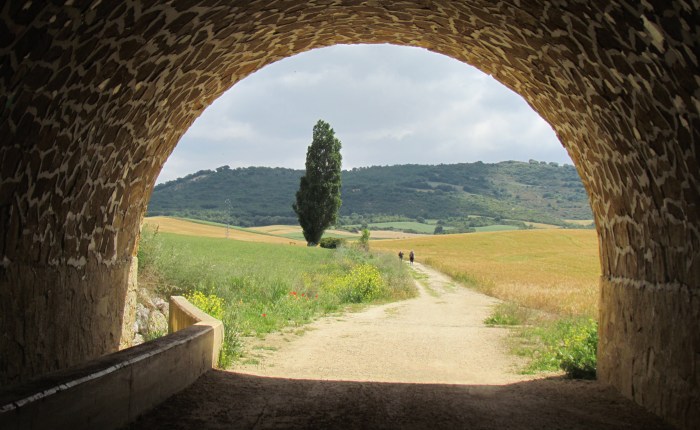
Nearly three years ago, I strapped on a hiking backpack and walked five hundred miles.  As I walked El Camino de Santiago, people crossed my path who were completing the pilgrimage for the second or third time.  While beautiful, I wondered why people would complete this trek multiple times.  Once will be enough for me, I thought.

Yet now and again, I find myself longing to be on some dusty trail in the midst of the Spanish countryside.  It isn’t because of my love for travel, although I suppose that does play a role.  My desire to be on the Camino for a second time stems largely from my desire for simplicity.

On the Camino, it is easy to be simple.  In fact, it is almost a requirement that one be simple.  On your back, you carry all of your clothes, sleeping bag, toiletries, etc.  Everything you think you will need along the Way, you must plod every blessed mile with it fastened to your back.

Sometimes it annoyed me to live so simply.  I wanted a different outfit to wear.  I was surprised at how much I found myself longing for a real towel and not the travel towel I would use each day.  At times I wished to simply remain in the same place for more than an evening.  There were several things that made me not like living simply.

Yet, in a very authentic way, I realized my heart was made for simplicity.  When my closet of clothes overflows and the laundry basket is full, when my bookshelves no longer have room for the books I insist on buying, or when I find myself shopping online for things I realize I do not need, I remember that my heart is a simple heart.  Yet I wish simplicity was forced upon me instead of needing to be chosen.

My possessions have a weight and I want to be free.

Sitting in a cluttered room, I find myself slightly jealous of my older sisters and their vows of poverty.  To be free to be poor.  I know I romanticize poverty, but there is a longing in my heart for less.  And in that less, I know I will find more.

But the Lord answered her, “Martha, Martha, you are anxious and troubled about many things; one thing is needful.  Mary has chosen the good portion, which shall not be taken away from her.”

Luke 10:41-42

For over thirty days, I walked the Camino and if I did it again, I would pack less.  There is a simple beauty in choosing between two outfits.  There is a simplicity found in needing to walk a few miles each day.  I’ve never been so aware of my feet before.  And rarely have I felt like I’ve spent the entire day just being and walking in the Lord’s company.  Those lovely, simple things make the Camino something I wish I could be doing right now. Continue reading “When Simplicity Must Be Chosen”

Why I Will Drink Coffee on Sundays

Why I Will Drink Coffee on Sundays

In my youth, giving something up for Lent meant you didn’t have it from Ash Wednesday until Easter Sunday.  When one of my sisters came home from college, she revealed a secret: you can have the things you gave up for Lent on Sundays.  She claimed it was a “mini-Easter.”  At the time, though, it seemed like cheating and an excuse for people who couldn’t handle giving something up for the entirety of Lent.  I didn’t need a cheat day, I reasoned, I was strong enough to last all of Lent.

Over the past few years, I have come to realize the wisdom in allowing Sunday to be a relaxed day in the midst of a penitential season.  There is a particular wisdom found when I remember my own temperament.

I like a good challenge.  Tell me I can’t do something and I will probably try to do that thing (if I care enough).  I’m stubborn and prideful to a fault.  So when I tell myself that I can go without coffee for the entirety of Lent, I start to feel a little smug.  It sounds challenging and I can already feel a sense of pride within myself.  Of course, it is a sacrifice for the Lord and yet I am quick to make it about what I can do.

However, if I acknowledge that I will go six days without coffee and then break that fast on Sunday, it is hard to get overly prideful about that.  Really?  That’s it?  Six days?  And I find myself almost convincing myself to “be strong” and go through all of Lent without it.

The purpose of Lent, though, is not to build up my ego and pat myself on the back for all of the difficult things I did.  Hopefully, Lent is a time of challenging ourselves and saying no to our own habits and desires.  Yet if I walk into Mass on Easter Sunday, bursting at the seams that I was able to forego a long list of comforts, I might miss the fact that Jesus is the one saving me. Continue reading “Why I Will Drink Coffee on Sundays”

Unrestricted Access to My Heart

Unrestricted Access to My Heart

Jesus, looking at him, loved him and said to him,
“You are lacking in one thing.
Go, sell what you have, and give to the poor
and you will have treasure in heaven; then come, follow me.”

Mark 10:21

It is because Jesus loves this young man that He challenges him.  By many standards, this man has done all that he has been asked to do.  He has kept the law since his earliest days.  Yet, he comes to Jesus to ask what he must do to inherit eternal life.  Either he wants to be affirmed in how excellently he has kept the law or he feels there is something more to which he is called.

Jesus looks at him with that gaze that pierces through the heart and is filled with a great love for this young man.  The authenticity of His love compels Him to call the young man to something greater.  Jesus tells the young man to put aside everything of this world and to follow Him.  It is out of love that He invites the young man to run with reckless abandon in the race for Heaven.

Yet the man leaves saddened.  Though he follows the law, he is unwilling to set aside everything for the Kingdom of Heaven.

Jesus issues His challenges out of love, but they vary based on the person.  Some He invites to follow Him and they cannot, refusing to leave behind possessions or family.  Others long to follow Him and He tells them to remain home, sharing the Good News among their own people.  When it comes to living in God’s will, there seems to be no one-size-fits-all approach for the Lord.  His will is customized to the individual and it often seems to be contrary to what we want.

This is why the life of contemplation is the boldest and most adventuresome of undertakings, for what could be more radical, more truly earth-shattering, than the willingness to be dismantled and created anew, not once or twice in a lifetime, but day after day?

The Way of the Disciple, Erasmo Leiva-Merikakis

He is not satisfied by things done half-way.  Our souls, though we may attempt it often enough, cannot be half His.  The young man wanted to comfortably follow the law and yet Jesus calls him to a life he did not expect.  Sell everything?  Why?  Where is that in the law? 

While I may be tempted to mentally chastise the young man (Jesus was asking you to follow Him!  How could you not?!), I must admit that I am he. Continue reading “Unrestricted Access to My Heart”

The Church Wants to be in Your Bedroom

The Church Wants to be in Your Bedroom

I’ve heard the complaint that people want the Church to stay out of their bedrooms.  The truth of human sexuality is not something people want to be bothered with when it comes face-to-face with their ordinary, everyday lives.  Contraception, IVF, sterilization, surrogacy,  and a host of other ethical problems are not what people want from the Church.  It is almost as if they were to say, “Just give us the church service and leave the rest of my life to me.

In which case, I am compelled to ask, “What exactly did you think the Church was?”

Rather than overbearing, the Church desires to guide us in every aspect of our lives because God cares about every aspect of our lives.  Jesus is Lord over all, even the parts of our life we struggle to give to Him.  Especially those parts.

The “Catholic world” has a lot more to it than churches.  It’s also a world of libraries and bedrooms, mountains and the seaside, galleries and sports fields, concerts halls and monastic cells–places where we get glimpses and hints of the extraordinary that lies just on the far side of the ordinary…

(Letters to a Young Catholic, George Weigel)

The Church isn’t trying to artificially insert itself into the different facets of life.  As the Bride of Christ, she seeks to be where Christ wants to be, which is everywhere.  It could be easy to convince ourselves that Jesus doesn’t care much about business ethics or our literary choices or who shares our bed.  We can separate those from that hour on Sunday as if Jesus can only see what happens in “His house.”  Jesus, however, wants to be involved in our work, leisure, relationships, and daily habits because He wants to transform those areas into means of sanctification.

We want to give Jesus the areas of our life that are easy to surrender.  Jesus wants the areas of life that we struggle to admit aren’t flawless.  He wants them, flaws and all.  When He spoke about taking up our cross and following Him, it wasn’t simply the cross of getting up Sunday morning and making our way to Mass.  It was about allowing Him into every part of our lives–our thoughts, our dreams, our free time, our business practices, our interactions with other people, and, yes, our sexuality. Continue reading “The Church Wants to be in Your Bedroom”

Maybe Friendship Could Change the World

Maybe Friendship Could Change the World

Not too long ago, I went out for supper with a friend.  There were couples and families out at the restaurant, but I was struck by the groups of women there.  One long table was filled with women who appeared to be out celebrating some event.  But there were at least two other booths of women and it made my heart glad to see them there.

Between bites of food and conversation, I would glance over at the booths of women.  They were already seated by the time we got there and, after we had a leisurely meal, they were still there when we left.  Perhaps it seems strange, but seeing these groups gave me encouragement.  What they were doing was simple: it was a handful of women out for food and drinks.  I never saw them photograph themselves or their food.  Instead, they were talking and listening to one another.  I couldn’t hear their conversation and I didn’t want to, yet it was obvious that it wasn’t superficial banter.  Different ladies would speak and the rest would listen intently.  It was obvious that they were drawn together by bonds of trust and friendship.

Did they speak about work successes or any difficulties involved?  Did they discuss dating relationships or family matters?  Were they discussing ideas or the state of world affairs?  I don’t know, but I am convinced they were discussing matters that they held close to their hearts.

I will never argue that I am the best at maintaining or building friendships, but I know that true, authentic friendships add a richness to life.  While I had friends in high school, I think my first experience of deep friendships happened at college.  I’m not one to have lots and lots of friends or share deeply with many people, but I found a great joy in entering into intimate friendship with people who pursued the same values I did. Continue reading “Maybe Friendship Could Change the World”

The Best Defense is Encountering Love

The Best Defense is Encountering Love

You can, in the broadest terms, call it “Catholic culture.”  However it’s described, though, it’s not something you simply argue yourself into.  Rather, it’s something you experience aesthetically as well as intellectually, with the emotions as well as the mind, through friendships and worship and experiences-beyond-words as well as through arguments and syllogisms.

“Letters to a Young Catholic” by George Weigel

Something I am intent on drilling into my students this semester is that Christianity is necessarily a life of encounter.  It is the tremendous beauty of being able to experience an authentic and lived relationship with Christ while also delving into the rich intellectual tradition of the Church.  Catholicism is chock-full of the “both/and” that makes life so simple and yet so deep.

I teach high school Theology to sophomores and seniors, making it somewhat safe to assume that I am not an advocate of an anti-intellectual, touchy-feely Christianity.  Specifically, one of my courses is apologetics, which is teaching how to defend the faith against attacks.  And there are many, many attacks launched against the Church in every age, no less in this one.  Defending the faith, though, is not merely done through well-chosen words or precisely articulated statements.  These are helpful, but much of the battle is done through actions.  If my students do not love the Church, they will be far less inclined to defend or understand Her.

I am well aware that the love I have in my heart for the Catholic Church is not the norm.  My students need to encounter more than the beauty of truth to be convinced.  I read the Church’s teachings and my heart stirs with the acknowledgement that these are profound truths.  Often when my students hear the Church’s teachings, they hear how their freedoms are being minimized or that they are being told what not to do.  However, if they love the Church, they will see that She is a mother caring for and protecting Her children, even if they do not always understand.

This is where the necessity of encounter comes in.  Catholicism, in Our Lord’s great wisdom, is a faith filled with the tangible.  We hear the words of absolution at Confession, we feel (and smell) the oils at Baptism and Confirmation that claim us as members of the Church.  The incense, like our prayers, rises up to the Heavens as we adore Our Lord in the Eucharist.  On pilgrimage, we travel to the places where the bones of the Apostles and saints of the Church rest.  Oddly, we touch our rosaries and prayer cards to their tombs, praying that we will follow the Lord’s will as radically as they did.  We light candles before altars, hoping that our intentions will be continually presented to Our Lord’s throne.  As George Weigel says throughout Letters to a Young Catholic, there is a grittiness in Catholicism.  In this book, he also says the following:

Catholicism does not rest on a pious myth, a story that floats away from us the more we try to touch it.  Here, in the scavi [excavations under St. Peter’s], we’re in touch with the apostolic foundations of the Catholic Church.  And those foundations are not in our minds.  They exist, quite literally, in reality.  Real things happened to real people who made real, life-and-death decisions–and staked their lives–not on stories or fables but on what they had come to know as the truth.

To be Catholic, George Weigel argues and I concur, means to live in reality.  And as someone who so often feels that people think my ideals mean that I don’t live in reality, that is uplifting to hear.  Being Catholic means living in the greatest love story while also fighting the greatest battle of all time, primarily because it transcends time.  As a romantic with more than a touch of stubbornness, these intertwining elements make the Church my perfect home.  It is not merely a battle of the wits, arguing and defending a supernatural institution to a world rooted in earthly affairs.  It is also, and primarily, an encounter with Love, being transformed by Love, seeking to enter into Love.  If love is not at the heart, all is meaningless and in vain.   Continue reading “The Best Defense is Encountering Love”