A Lesson in Snow

A Lesson in Snow

The evening air is cool, but it feels nice as I lean on my shovel and survey the path ahead.  I’ve been outside for nearly forty minutes and the end is in sight, but not as close as I would have liked.  At my house, we take turns shoveling the lovely snow and I thought it was unofficially my turn to do the honors.  A corner lot with long, long sidewalks make for an impromptu workout and time to reflect.  The front sidewalk is easy and I simply slide the shovel along, emptying it every few feet.  I turn the corner and it gets progressively more difficult.  Finally, I’m looking up the path, realizing that the sidewalk is inches below, under freshly laid snow as well as snow that has been crunched underfoot for days.  So I forge a path of my own, seeking to find the trace of civilization beneath nature’s blanket.

I pause again and it pops into my head.

Shoveling snow is like sin/bad habits–it is easiest to get rid of it right away, rather than wait and do it later.

I smile, wondering if any of the other evening-snow-shoveling-folks are theologizing as they scoop.

Admittedly, I like the reflection, though.  The front sidewalk was easy because it had been maintained and all I needed to do was take care of the most recent snowfall.  But the back sidewalk had been a bit neglected and getting it to the same state as the other required far more work.  Ice needed to be chipped and compacted snow had to be disposed of.  It was work that wouldn’t have been needed if it had been taken care of the first snow.

The same thought can be applied to the spiritual life, particularly in regards to cultivating good habits.  What if when I noticed myself doing something I didn’t like or was bad or was not going to help me grow in my life, I would immediately correct it?  Instead, it is easy to say it isn’t that big of a deal and continue until it becomes a habit.  Then we realize we need to take action, but it is no longer just a tendency or inclination but an ingrained habit.  So we go to work: we chip away at it and look longingly down the path to the time when this flaw can be behind us.

What if we got to work on those little things right now so that later on we wouldn’t have to pour more energy into them?  What if we worked so that little things could simply stay little?  Makes a bit too much sense, probably.

It would mean combating laziness with productive work and using my time well.  Not planning to work on laziness later.  Instead of thinking, “Yeah, I probably should do something else rather than peruse Facebook (again) or watch another movie” and then justifying said behavior anyway, I would get up and go: pray, take a walk, go for a run, read a book, clean my room, lesson plan, grade papers, etc.  This goes back to the whole mentality of sacrificing the easy thing in the present to do what I actually want to do, things that bring me life and fulfillment.

Yet another goal and way to grow in my daily life discovered.  Instead of waiting to tackle little problems or flaws, I should enter into the skirmish now so there doesn’t need to be a full-out war later.

From one person on the frontlines to another: let’s get to work.

Hope’s New Life

Hope’s New Life

There is that lovely feeling rising up in my heart.  It is refreshing and enlivening.

What is it?

Hope.

The promise of something new.  The promise of change.  The desire for tomorrow to surpass what was done today.

Yet how quick I am to fade from hope back to disillusionment or despair.  The feelings I have that encourage change and a new direction are simply feelings: temporal, passing, ephemeral.  I made a list of dreams I want to have fulfilled in 2016 and get excited, yet within a couple days I’m ready to settle.

What I need instead is the virtue of hope, something that actually lasts.

“The virtue of hope responds to the aspiration to the happiness which God has placed in the heart of every man; it takes up the hopes that inspires men’s activities and purifies them so as to order them to the Kingdom of heaven; it keeps man from discouragement; it sustains him during times of abandonment; it opens up his heart in expectation of eternal beatitude.  Buoyed up by hope, he is preserved from selfishness and led to the happiness that flows from charity.”    –Catechism of the Catholic Church 1818

A few months ago, I had this intense feeling of hope.  It didn’t make sense logically because what I hoped for was nowhere in sight, nor did it seem to be soon in coming.  The feeling was so strong, though, that I knew it was from the Lord.  Yet I also knew, from past experiences, that sometimes the Lord will provide an abundance of something for me because in the near future, there will be a seeming lack of that very thing.

When I started sidewalk counseling outside an abortion clinic in Pittsburgh, I was filled with overwhelming joy and peace after the first three times.  It was strange because I had prayed there for a couple years and never felt those emotions so intensely while there.  The Lord was giving me the reassurance I would need when those feelings subsided.  And they did: when the joy and peace were absent, I felt the closest I’ve ever been to depression.  I ached and felt hollow within.  If it wasn’t for those weeks of intense joy when logically I should have felt sorrow, I might have quit sidewalk counseling.  I didn’t because I knew the Lord had convinced me of my course of action through consolation.

So a few months ago, when I felt this overwhelming sense of hope (or, as I called it at the time, “joyful anticipation”), I was thankful for that gift from the Lord, yet also a little concerned for what might be ahead.  “Thanks, Jesus, for this wonderful joyful anticipation.  I love this feeling.  But…what is going to happen later?”  The hope lingered and I basked in it.  I told myself to remember this intensity of hope because it would pass, as all feelings do.

And they passed.

I found myself wishing I could quit life for a while and simply step out of the day-to-day grind.  I wanted the Lord to deliver His promise now, because I wanted it now, not later.  With the feeling of hope absent, the future no longer seemed quite as bright and cheery.  I was left wondering if I hadn’t made it all up.  Yet when I thought about what I had felt, I could still feel this deep certainty that it was true.  The thing hoped for is not yet a reality, but I know the Lord will remain true to His promises, even if I must wait.

True hope is not a feeling that comes and goes, depending on the day.  It is steadfast and enduring.  Hope persists when logic and appearances suggest that it is fruitless.  It is what the Israelites depended on as they waited for their long-desired Messiah.  It is hope that led the three wise men to journey miles in anticipation of a king preceded by a star.  As the early Christian martyrs were led to their deaths, it was hope that enabled them to look with love at the very ones who wielded the sword or the stone or the nail.

Hope isn’t a different perspective to have on life: hope is to have a new life.

“The one who has hope lives differently; the one who hopes has been granted the gift of a new life.”   —Spe Salvi, Pope Benedict XVI

2016 will not be the year that my life becomes perfect or where I will magically change into the person I always wanted to be.  But I do want this year to be one where I am honestly pursuing the best for myself and where the Lord’s will for my life is done more completely than ever before.  I want to read twenty-five books, learn about the constellations, travel to two new states, and many more things.

Primarily, though, my hopes rest in the Lord.  I want to venture into 2017 knowing the Lord in a far deeper way than I do right now.  I want to enter tomorrow with a deeper knowledge and love for Jesus.  I am not promised tomorrow.  All the things I long for and hope for in the future, may never be mine because I may not live to see that day.  But I am here now, and that is where the Lord desires to meet me.

“Although I have lived through much darkness, under harsh totalitarian regimes, I have seen enough evidence to be unshakably convinced that no difficulty, no fear is so great that it can completely suffocate the hope that springs eternal in the hearts of the young.  You are our hope, the young are our hope.  Do not let that hope die!  Stake your lives on it!”   –St. John Paul the Great, WYD Toronto 2002

This year I am embracing this hope that springs eternal in my young heart.  I am taking this hope and letting it lead me into change (though it be difficult) and into newness of life.  Hope, for the Christian, isn’t optional, it is operative.

I need hope.  Not passing feelings, but real, life-sustaining, time-enduring, source from which my actions flow hope.  Anything less is insufficient.

“My soul is waiting for the Lord, I count on his word.  My soul is longing for the Lord more than watchmen for daybreak.  Let the watchmen count on daybreak and Israel on the Lord.”  (Psalm 130)

Why I Am a Catholic

For the last couple days of class for the semester (before preparation for finals), I decided to try something new.  It was an idea I had a while ago, but it just seemed to work to implement it this year.  The section is dubbed, “Why I Am a Catholic.”  After weeks of (hopefully) learning Apologetics, I wanted to have them consider why they are Catholic.  I challenged them to find something beautiful, compelling, or desirable within the Church, even if they struggle with different facets of the faith.

I listed off for them Peter Kreeft’s seven reasons why he is a Catholic.  I read a line from G.K. Chesterton’s “Why I Am a Catholic” essay.  Then, because I wanted this to be real for them, I told them my reason for being Catholic.

In all actuality, it cannot be boiled down to one reason that I am Catholic.  Yet, for the sake of simplicity, I picked what was central to my faith and declared that it was the reason why I was Catholic.  What I didn’t expect, though, was that I would nearly cry in every Apologetics class as I told my story.

Honestly, I was a little annoyed with myself.  “Really, Trish, get it together!  It isn’t as though you have never talked about this before.”  I’m still a little confused, but I think the primary reason is that I was opening my heart to them.

I’ve shared with my students different experiences I’ve had, places I have traveled to, and stories I have heard.  As a Theology teacher, I am daily speaking of persons and ideas that are very close to my heart.  But to open my heart, to share part of “my story,” and to point to something so personal, in a classroom setting, is difficult.

I told them that I am Catholic because of the Eucharist.  Yet I had to give a bit of a back story for why the Eucharist is so pivotal personally, not just theologically.  So I had to go to the beginning of my faith hitting the pavement, nearly the beginning of a heart that aches yet keeps it all tucked away within.

Naturally, it was a story about my sisters.

My two older sisters, specifically.  And my throat became scratchy and I prayed that Jesus would just let me get through these stories without crying.  The feelings I was portraying aren’t ones I typically feel now, but ones that were jettisoned across time from nearly 12 years ago.

When I was in 8th grade, my older sister entered a Carmelite cloister.  She was the one who seemed to know me.  As an introverted melancholic, I’ve always ached to be known.  While she was still my sister, our relationship was dramatically altered.  I could pour out my heart to her in writing, but then I would need to wait months for any sort of response.  I became angry and bitter, yet still had to present a happy exterior, because that was expected of one with a nun for a sister.  When I was a junior in high school, my other older sister joined a different convent about twenty-four hours from home by car.  The feelings of bitterness and anger were once again kindled.

I was teaching myself something that is untrue about God.  Internally, I was learning that God will take from you that which you hold dearest.  Whatever you don’t want to do, He will ask it of you.  I was learning the sacrificial part of Catholicism without the love or joy that must accompany it.

As I’m telling my little stories, I am looking into their eyes.  For once, the classroom is mostly silent and their eyes are on me.  I’m wondering, as my insides quake a little and my hands shake, if they can see that I’m opening up part of my heart to them.  I’m hoping that even though their story is different, that they are open to discovering the beauty of Catholicism, too.

So how do my sisters entering the convent make the Eucharist the reason I am Catholic?  When my sister was entering the cloister, she turned around and said, “I’ll see you in the Eucharist.”  Eighth grade me wasn’t impressed.  That’s nice….but how about you see me on my birthday and at Christmas?  How about you hold my children and are answering the phone when I want to talk?  Despite the minimal impact it made initially, it eventually became a central point of my personal spirituality.

When we go to Mass and receive the Eucharist, we are receiving the Body of Christ.  The Church is the Body of Christ.  When I receive the Eucharist, I receive the entire universal Church, the Church inside and outside of space and time.  As I missed my sisters, I would receive the Eucharist and know that this union that I tangibly experienced in Holy Communion was the deepest union I would have with them.  It was comforting when I went off to college eighteen hours away and I missed my family.  The Eucharist bound me to all my loved ones.  Moving from college back home and being separated from beautiful friends, I found solace in the ties of the Eucharist, bonds that even death cannot break.

Why I am a Catholic cannot be simplified to only one reason for me.  There are many factors and influences, but the central point is the Eucharist, God Himself.

“The difficulty of explaining “why I am a Catholic” is that there are ten thousand reasons all amounting to one reason: that Catholicism is true.”    -G.K. Chesterton 

Be Perfect as Your Heavenly Father is Perfect

Confession: I have a problem with perfectionism.

And I think I am only just now realizing the depths of this noxious weed in my soul.  Perfectionism is easy to portray well and make it seem like a good thing, rather than the lie that it is.  It can actually be stifling.  While I know this theoretically, it is entirely another thing to believe it with my actions.

One memory I have of perfectionism having the upper hand is when my dad was teaching me how to drive.  I was pretty resistant.  Every teenager seems to yearn for the day when they can take the keys and drive to places on their own.  I wanted to drive, but I didn’t want to learn to drive on the manual transmission car that my dad had for me.  With an automatic car, you just drive.  You focus on the road, on the signs, on the other cars, but the rest is condensed to brake and gas pedals.  Manuals will stall and quit at the most inconvenient times: like a small town stop sign after the high school graduation and everyone is behind you on their way to open houses.  If I had any hopes that my dad would give in, I would have tried to avoid learning how to drive that car and wait for him to get me an automatic.  However, I understood the stubbornness of the person with whom I was dealing; he was adamant: learn to drive this car or ride the bus.

The first time he took me out to drive, I probably sat in the car for twenty minutes before we even moved.  My younger sister was sprawled out on the deck, eagerly awaiting my driving experience.  After a few minutes, she went into the house and told my mom, “I would have been long gone by now.”  My mom said that was what she feared.

My dad had demonstrated driving the car, so I could watch him shift.  I was cautious and made him go over what I was supposed to do several times.  Then I repeated it back to him because I wanted to get it right the first time.  I didn’t want the car to start moving and then die, only to have to start the process all over again.  Eventually, I put the clutch to the floor, eased off the brake and onto the gas pedal, and we moved forward slowly.  And then it died.  The process happened over and over again.  I drove up the driveway and out onto the gravel road, running the car in first gear when second would have been kinder to it.

One time while I was still in the early learning stages, my dad asked if I wanted to drive to our property on the other side of the creek.  I said no because I didn’t want to practice.  So he asked my younger sister if she wanted to and, of course, she said yes.

I was furious.  I wanted to get out of the car and walk home.  She was seemingly unafraid to try and fail.  At this point, I found a sudden desire to drive, but it was too late.  I was riding with my 11-year-old sister at the wheel.  To my young melodramatic heart, it was an injustice.  My desire to do it perfectly or not at all was shot to pieces by my sister volunteering to take on the challenge.

I have never actually thought that I could be perfect or that I was perfect.  My flaws (or some of them) are well-known to me.  Perfectionism doesn’t mean I have a room that is always tidy, a desk that is clean and orderly, or that I’m always pulled together.  I have simply tried to avoid making mistakes.  Some of this is a good desire.  We are to strive for excellence.  Other times, it makes the mistakes feel so much more burdensome or weighty then they actually are.  It can lead to feeling hemmed in since any option could result in failure.

Nobody likes to fail, I get it.  But some do it better than others.  I read an article about Stephen Colbert and he had an interesting “motto,” if you will: Learn to love the bomb.  In the midst of failing, learn to love it and not be afraid of it.

To me, that is a crazy notion, one that I want to let him run with into a nice little box of, “Well, he is a comedian, of course that would be helpful in his profession.”  But, in truth, I cannot stand by that.  My mental picture of his motto is like skydiving…without a parachute.  Or one that you don’t know if it will open.  And you are loving the drop, the racing heart, the pit in your stomach that tells you: This. Is. Crazy.

I prefer to be in control.  I’ve never thought of myself as needing to be charge, because most of the time I don’t want to lead anything, ever.  Yet I do love my ability to say no or to not do what others are doing.  Sometimes, I am stubborn simply to be stubborn.  Perhaps it is so that I won’t be seen as just “nice” or a push-over.  I learned the “don’t give in to peer pressure” thing really well.  Few can make me do something I don’t want to do.  I’ll maybe even do the opposite of what you want me to do.  For some reason, I like it to be known that if I’m complying with requests, it is because it is my choice, since I could very well do the opposite.

So what does this have to do with perfectionism?  I spend much of my life refusing to put myself in positions where I might fail.  Activities, relationships, conversations, new experiences: all things that could potentially not end perfectly or require failure in the process of learning are less than palatable to me.  Yes, I know what you are thinking, “But you can’t succeed if you don’t risk something.”  I chalk it all up to logic: why make mistakes when you can avoid them?

Which is all fine until you find yourself in a position that requires a risk.  If you don’t risk, you will definitely lose and maybe God doesn’t want you to just pray it out.  Maybe He wants an action.  Maybe the lesson is in trusting yourself less and trusting more that He can and will pick you up when you fall.  Maybe you are supposed to fail.  Yet the very idea of the risk makes my heart threaten self-eviction.  I want to think of every possible outcome before I take that first step, so I can be prepared if things come crashing down.

Or the risk might turn out to be a successful leap.  It might be worth it, there might be joy, there might be happiness and peace.  What if the risk turned out to produce the best type of reward?

This quote comes to mind:

My melancholic pessimism sneaks up again and whispers, “But, seriously, what if you fall?

As I’ve been writing this, I’ve been trying to think of a way out of a perfectionism that can feel a bit stifling at times.  How do you move beyond it?

“Be OK with failing.”  Sure–but how?
“Put yourself out there.”  Out where?  And when?

This is where the head and the heart are in utter conflict again.

This imperfect soul has no neat conclusion to this dilemma.  I have no solution that can be quickly applied, no wisdom to pull me out of the mire, and no lesson to contrive from these words.

In an attempt to combat this perfectionism, I’m going to end this post imperfectly.

I’m going to be striving for Heaven, but I’m going to fall on my face many, many times.  But Jesus knows that and so I’m trying to be okay with that.

***And, in unexpected irony, of all my blog posts, this post on perfectionism was the most difficult to get to the point where I wanted to publish it.

Because I wanted to at least phrase it perfectly…

The Good Thief

Jesus said to his disciples: “Be sure of this: if the master of the house had known the hour when the thief was coming, he would not have let his house be broken into.  You also must be prepared, for at an hour you do not expect, the Son of Man will come.”  (Luke 12: 39-40)

Jesus compares His Second Coming to a thief coming at night.  As the Gospel was being proclaimed at Mass, I was struck by the phrase “he would not have let his house be broken into.”  Of the many ways Jesus could describe His Second Coming, He chooses at this time to say that He is like a thief who breaks into a home.  Obviously, the master of the house would want to protect himself against any thief forcing entrance into the house.  The immediate connotation is a negative one: be prepared so Jesus doesn’t break in.  What is the other option?

In John’s Gospel, Jesus is the Good Shepherd and also He is the door.  Entrance through His door means salvation.  But He mentions a thief and says that a thief doesn’t enter through the door but comes only to steal, kill, and destroy.  So is Jesus like a thief or is He a door?

What about if He is actually both?  Jesus stands at our hearts, knocking, gently persistent, asking for entrance into the deepest recesses of our being.  We choose if we open the door to Him or not.  He waits, patiently.  Yet there will come a day when waiting is no longer an option, when our refusal to acknowledge Him will come face-to-face with the reality of Who He is.

Will you open the door for Him?  If not, He will not be kept out and He will find a way in, like a thief, stealing through the chinks in our armor, stealthily slipping into the cracks in our fortress.  Yet if Jesus came to give us life, how could He also come to “steal, kill, and destroy” like a thief?  To us in the midst of our sinfulness, the act of taking away our addictions, habits, and struggles will seem like thievery.  It may seem like it is killing and destroying us to be stripped of that which we have made to be our personal god.  An experience of authentic self-denial can help us see the death that must occur when we have not opened wide our hearts to Christ.

He will break into our house.

That experience of a break-in will be unique, but He daily breaks into our world.  He isn’t hiding, but He isn’t forcing us to acknowledge Him today.  He is breaking into my world through the sky filling with a sunrise palette.  He is breaking into my world through the student who insists on keeping a ten-minute running commentary during a surprise fire drill.  He is breaking into my world by placing me in difficult situations I never thought I would have to encounter.

I can recognize His breaking in, or I can pretend like it never happened.  He can be a door or a thief.  Either way, He will enter into my life, it is simply a matter of method and perspective.

And so we strive to let the Good Thief in through the Door.

The One who persistently calls your name, knocks on the door of your heart, and ushers you into an abundant life.

He will come again whether it be His Second Coming on earth or at our death.  We will encounter Him in His glory and realize, with total certainty, who He is.

Do you want the Thief or the Door?

Follow my blog with Bloglovin

Free Will

Why free will?

I have a decent grasp theologically on the role of free will.  It is a necessary aspect of our humanity and God desired us to choose Him rather than to be forced into being with Him.

I wouldn’t have done it this way.

Which is yet another reason (if you needed one) that you can thank God that I am not God.

I am not that generous or that loving to create all of everything and then simply let them choose me or not choose me.  With all power and perfect knowledge, I think I would be a bit more forceful than God.

Currently, the Lord is allowing me to see how little power I actually have.  It should be simple for me to grasp it, but it is taking a while for it to sink into my dense brain.  I cannot make anyone do anything.  Even with the best reasoning, the most loving disposition, and gentle truth, I cannot push someone to do something they don’t want to do.  Or, at least, I cannot make them desire it.  The choice may be clear for me, but if it is not for them, then nothing I do or say can change them.

A brief survey of the culture and the world and I am mentally snatching free will from others, those who don’t use it correctly.  (Of course, I would be one of the first to admit that I would also need my free will revoked on many, many occasions.)  I think I am solving all the problems by removing the ability to choose the wrong.  The multiple choice questions seem to be tripping humanity up, and so I cleverly devise a test they cannot fail: choose A.  No questions, no other options.  Wouldn’t that be perfect?

Obviously, God had something else in mind.  What if it was better to give humanity choices, so that rather than all choosing A (purely for lack of another option), some would choose A because they desired it?  That must yield greater glory to God.  Not a mindless group of robots, but living, breathing, willing beings who follow God because they choose it.

Regardless, my heart still revolts against the reality that I can do nothing to make someone want something.  Perhaps this cardiac revolution is a good thing.  It can teach me that I am little and must always remember that.  It can teach me that my will is the only thing I can actually control and to seek to make it in complete accord with God’s will.  It can teach me that rather than constructing perfect arguments or dwelling in frustration, I can turn to prayer, something that slips beyond the bonds of time and is mysteriously used to further God’s plan.

The gift of free will is a mystery.  As a mere human, I cannot fully grasp why God saw it best to give these finite beings such a gift.

“Here the will of God is done, as God wills, and for as long as God wills.”  –St. Gerard Majella

Independence and Surrender

Our entire lives seem to be a battle between independence and surrender.  We seek independence at an early age and relish it for much of our lives.  My two year old niece enjoys the freedom of saying “no” and running where she wants, when she wants.  My nephews want to help with chores and frequently refuse help for themselves, instead wanting to demonstrate their ability to do it on their own.  As adults, we are quick to forget there is any uniqueness in driving where we want, buying what we want, and living how we want.

Age or misfortune catches up to us and we soon find ourselves losing our independence.  We can fight this inevitable fate, but it will only breed bitterness and malcontent.  Eventually, we must surrender.  In the spiritual life, we can learn this gift of surrender earlier.  Relinquishing control of our lives, realizing that we are not the ones in control or willing our own existence, can prepare us for the gradual physical surrender that must happen.

My grandparents are aging and I see the fighting that takes place within them.  I do not blame their desire to grasp their dwindling freedom or to express frustration at a body that is now turning against them.  The simple freedoms are gradually slipping away–no walking around the block, no trips to the grocery store, no single bed for them to share.  The task of getting ready for bed, something so mundane one often forgets it, is now one that requires help.  Waiting outside their bedroom as they were ushered to bed, I thought of how someday that will be me, helping my parents.  And perhaps someday it will be me, being helped to bed.  Inwardly, I rebel at the thought.  I think that I will break the mold, I will not need the help, I will do it on my own.

When visiting them, I can sense the mounting frustration.  There seems to be both a desire to return to health and a desire to die.  My grandparents have not aged prematurely.  In their late 80s-early 90s, they are as fit as one might expect them to be.  Thankfully, they are ill in body but, apart from a little confusion, sound in mind.  I wonder what to say—do I speak of suffering?  Do I remind them to be thankful of their blessings?  Do I try to lighten the mood?  Mostly, I just listen.  I listen to my grandpa tell me about the picture of grandma now on the piano.  He says he wanted it there because that is how she looked when they met.  Her beauty floored him.  I listen to my grandma talk about one of my many cousins.  Her life for so many years has been about others, even now she finds it difficult to draw conversation to herself.  I listen to my grandpa’s worries and fears.  I listen to my grandma attempt to follow my mom around the kitchen, asking what she needs help with and telling her what to do.

While age has forced my grandparents to lose independence, illness can do the same for others far younger.  I have a friend from college who has been battling a debilitating illness for the last three years.  It causes her intelligent brain to rebel against reading more than a few lines at a time and forces her marathon trained body to be weak and unpredictable.  I refuse to canonize her yet, but I have witnessed the beauty of her striving to surrender herself to God in His inscrutable plan.  Such a situation could easily lead to depression and bitterness, but she is fighting the good fight, ironically by striving to lay down her arms.

How do we surrender?  It is a choice.  We can see physically our limitations.  I can really want to do something yet find myself incapable.  The spiritual limitations are less clear.  With those, we can fool ourselves into thinking they aren’t there or that we have surrendered, simply by virtue of thinking the words once or twice.

In surrendering, we choose to not manipulate the situation, we choose to not be in control.  After years of being told that we can do it and that we are the ones running our lives, it is counter-cultural to step back and release control.  I can drive myself anywhere I want, I can eat whatever food I want, and I can spend my time as I choose.  But I do not will my heart to keep beating, I cannot control the replication of my cells, and I am powerless in making myself continue to exist.  For all the little things I doggedly control, I am incapable of controlling all the major aspects of my life.  Accepting God’s authority in my life is central to becoming the saint He desires me to be.

Lord, help us to surrender, to admit with our lives that we are not the ones in control.  In our inmost being we desire to belong to You and to give ourselves over to You.  Grant us the grace to do so.

“Amen, amen, I say to you, when you were younger, you used to dress yourself and go where you wanted; but when you grow old, you will stretch out your hands, and someone else will dress you and lead you where you do not want to go.”  John 21: 18

What is your withered hand?

“How are we each like the man with the withered hand?”

It was seventh period and my students were, as usual, talkative and eager to laugh with their fellow students.  We are in the midst of learning about the Gospel of Mark and today found us reviewing the story of the man with the withered hand.

One of the goals I have for my Scripture classes is to convince them that this is the Living Word of God and that it should be impacting their lives now.  I tell them that Jesus desires to speak to each of us, today, in this very moment, through events that happened and were written about a couple thousand years ago.

“How are we each like the man with the withered hand?”

It was a rhetorical question and I continued on with one of my little preaching sessions.  The man had a disfigured hand and yet Jesus asked the man to come before the crowd of people and stretch out his hand.  This requires a deep trust that Jesus will be gentle and that He can heal.  The part that the man most wanted to hide from other people, Jesus was asking the man to openly show to Him.

The words seemed to flow naturally from my mouth as I asked them to consider what part of them Jesus desires to heal.

“Perhaps you don’t have physical disabilities.  Jesus wants to provide emotional, spiritual, mental healing.  What if Jesus called you in front of the crowd and asked you, “How is your relationship with your mom?”  Or if He asked you, “How did you feel when your friend betrayed you?”  Jesus wants to come to you in the midst of your brokenness and heal you.  Christ desires complete wholeness for us.”

As I said these words, I was looking at them and their solemn little faces spoke of hurts that I will never know or understand.  Faces that a few minutes before were laughing, now would quickly drop their eyes when mine would rest on their face.  I told them that Jesus desires to heal them.  That whatever part of them they most want to hide from Jesus, is the place He most wants to come.

It was, I believe, a moment of the Holy Spirit working through me.  The room had a stillness to it that revealed an attentiveness that went beyond the typical atmosphere for notes or theological discussions.  I could feel the weight of the room and the weight of the Holy Spirit.  In the momentary pause before I continued on with notes, I thought briefly, “I love talking about healing.”  It was never something I had thought before, but I knew it to be true.  There is a certain life that fills me when I am able to speak about the transforming effect that Christ desires to have on us.

How does Jesus desire to heal your withered hand today?  Let’s let Him do it.  Amen. Amen.

A New Reference Point

College seems to be my constant reference point for things.  At times I have to remind myself that I am not going back to my undergraduate years, that this isn’t an extremely long vacation, that this life that I am living right now is, in fact, reality.  My memories of college are so vivid and life seemed to be filled with so much learning, wonder, and beauty.  These days are filled with those things, too, they just happen to filled with a lot more day-in-day-out routine.  Some of the best stories that I tell for classes are ones where I was gallavanting around Europe for a semester or feeling hard-core praying outside an abortion clinic in downtown Pittsburgh.  Now I look up and realize I have been teaching high school for nearly two years.  In some ways, it feels like forever.  Yet it also feels like it has happened so fast.  Was it really two years ago that I was preparing to graduate?  That I was living on a campus teeming with young Catholics?  These days I am invigorated to spot another person below 40 at daily Mass.

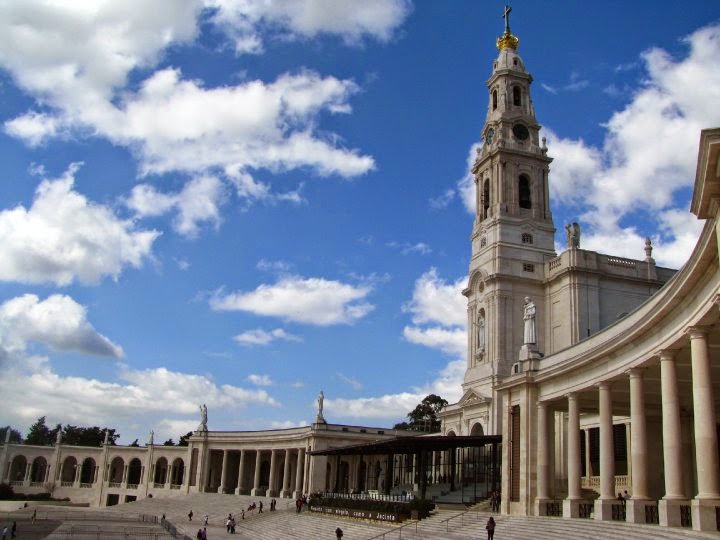
This Palm Sunday four years ago, I was soaking up the sun from the steps of the basilica in Fatima.  It was the start of a ten-day break and I would then travel to Madrid to work with the Missionaries of Charity during Holy Week.  I experienced vividly the providence of the Lord on that trip.  While the Lord provides for me everyday, I recognized it and relished it more at that time.  It seemed to be in such magnificent ways.  The Lord provided a train at the appropriate time.  He provided a kind Portuguese family that drove us from the train stop to the town of Fatima.  He was constantly looking out for us and giving us glimpses of beauty along the way.

The same is true for my life today but it seems to be less spectacular.  My students participated in a discussion I tried to lead.  My meeting with my principal went better than expected.  I didn’t feel like dropping into my bed at 3:30.  I managed to stay awake for a whole holy hour.  Little things.  Things that don’t feel extraordinary or all that spectacular.  That is my life.

It is easy to feel a little trapped.  I teach high school students in a not-too-small town but one that seems a bit stifling anyway.  My heart doesn’t long for a metropolis or an accolade laden teaching career.  I simply desire to be fulfilled.  In many ways I feel fulfilled but in many ways I feel a lack. I cannot help but at times looking around me and wondering when it will be my turn…for so many things.  I’m young but I feel so old sometimes.

I need a new reference point.  College continues to fall further into the past with each passing day.  I cannot go back there, as much as I may wish to some days.  The future I imagine may not be at all as I expect when it finally comes around.  All I truly have is the present and even that I do not really possess.  Christ needs to be my new reference point.  Friends will come and go, family members will pass away, gifts will fade, and abilities will be lost.  But Christ is ever-new.

One airport smile at a time

I love the sea of humanity that is found swimming in airports across the world.  People remain far more interesting than we give them credit for.  Most of the time I claim to be too busy to people-watch and oftentimes I don’t go to places swarming with people, so as to keep with my hermit-like tendencies.  But the airport is one of the very best places to watch people.

There is a strange joy that fills me when I am able to be smiley and joyful in a sea of people.  Some are walking by, oblivious to the world around them, others look harried and rushed, others couldn’t care less that you exist, and the categories stretch onward.  Yet I am struck by their humanity.  Perhaps that doesn’t explain anything at all.

Let me see.  There was the woman with the small child that sat next to me briefly at one of the gates.  She was beautiful, in a tired, motherly sort of way and looked a bit older than I would have expected.  Her daughter was gorgeous, smiling and capturing the attention of others around her.  Her mother was attentive to her, making certain that she didn’t wander into the dangerous traffic flowing past the different gates.  The girl was learning to walk and would run from her mother….fall on the floor…begin again with as quick of steps as she could muster…fall to the floor…start crawling away.

Then there was the man who took a seat in a corner on the ground.  He arranged his electronics in front of himself and seemed fairly absorbed in them.  The little girl saw him from a few feet away, looked at him with interest, and began the journey to him.  Stopping a little bit away from him, she looked at him until he noticed her.  The smile spread quickly across his face and she mirrored him.

A woman stops in the middle of the walkway, trying to figure out where she is going.  She is completely unaware that a little car that transports the elderly/disabled around the airport is right behind her.  And is laying on its horn.  For a couple seconds she is completely still, lost within herself, and the man is beeping the horn, mere inches behind her.  Finally she notices and steps out of the way.

The three men seated next to me at the gate in Chicago are discussing their line of work.  It revolves around computer or system programming for some company.  They travel often.  Most of the time is spent complaining about their bosses or comparing hotel rooms that they are set up in.  One man often stays at the Marriott and another gets the Country Inn and Suites.  Apparently the Holiday Inn is considered low class, too.

A young woman is bound for Tennessee to visit a college.  She briefly inquires if she is at the right gate to a middle-aged woman near her.  That was the entrance into a conversation that lead to the couple’s little girl chattering away to the young lady and talking until their seats in the airplane disrupted them.

Pilots walk by in uniform, pulling behind them expertly packed luggage.  A flock of flight attendants regroup before heading to their next destination.  A worker sweeps up some debris from the carpet and smiles at me when I catch her eye.  A couple walks by, each pushing a stroller, trying to get where they need to go on time.  A woman gazes critically at the ticket counter and remarks about the poor design to me…and to the lady at the desk when she finally gets there.  The lady says a man probably designed it.

Over the intercom a voice announces that first class passengers can now board.  Brian Regan quotes flood my mind as I watch people crushing each other to run out of the plane, as a fervor fills people to get to where they need to go with no mind for what others may be doing, as the desk asks for people to check their oversized luggage planeside.

A man behind me keeps cooing to something/someone and I narrow the options down to a dog or a child.  He has a dog.  I smile at the airport security and anticipate what they will ask of me.  Trying to catch her eye, I smile at the lady at the desk who seems to be a little frazzled yet kind.  I inquire about how his/her day is going when a security officer asks how my day is.

The days I spent in the airport I felt happy and kind.  With this joy, I felt a desire to spread it and be kind to others.  At different points I realized that while I wasn’t changing the world in some huge way, hopefully my mere smile was encouraging someone or speaking words I didn’t know or have.  I often wonder, “Do they know I follow Christ?  Can they tell?  Do they think something is different about me?  Do they notice?”  This should be me every day, not just when I feel like being happy or kind.  But it is a good reminder.  I need to look for the humanity dwelling within the crowd teeming with people.  And in seeing the person, to affirm their individuality and their personhood with the only thing I can in a one second encounter: a smile.