
“My people, what have I done to you or how have I offended you? Answer me! I led you out of Egypt, from slavery to freedom, but you led your Savior to the cross. My people, what have I done to you? How have I offended you? Answer me! For forty years I led you safely through the desert. I fed you with manna from heaven, and brought you to a land of plenty; but you led your Savior to the cross. What more could I have done for you? I planted you as my fairest vine, but you yielded only bitterness: when I was thirsty you gave me vinegar to drink, and you pierced your Savior with a lance.” (Reproaches of Good Friday)
Good Friday is a day of worlds colliding. We acknowledge the death of Our Lord and our role in it, but we also recall this as the glorious means for our salvation. The cross is an instrument of torture and yet we take time to exalt the cross, coming forward on bended knee to kiss Our Savior as He is fastened to it.
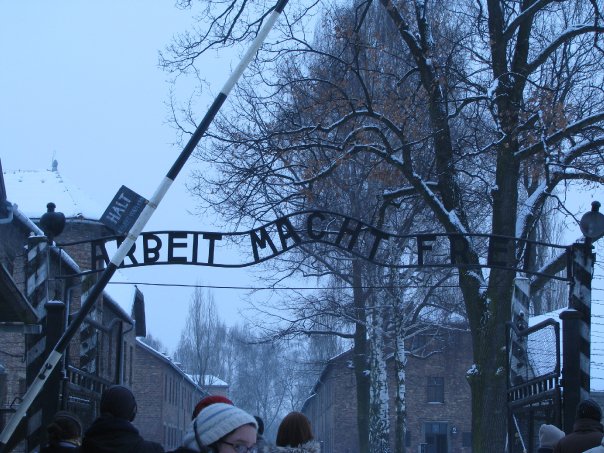
Today, we begin the Divine Mercy Novena which concludes on Divine Mercy Sunday. After the Good Friday service, we prayed the first day of the novena. And I couldn’t help but remember another time when I had prayed the Divine Mercy Chaplet. It was about six years ago and I stood on the cold, snowy ground of the Auschwitz concentration camp.
For the sake of His sorrowful Passion, have mercy on us and on the whole world.
We had already toured Auschwitz I. There I saw picture after picture of people who had entered that place of death. Next to each picture was a little card that gave the person’s name, their entrance date, and the date of their death. But the faces were what became engraved on my heart. I had heard for years about the number of people who died in the Nazi concentration camps, but to see only a fraction of their pictures changed statistics into human lives.

In silence, we loaded the bus so that we could go to Auschwitz II. Here we saw long barracks and miles of barbed wire fences. And we struggled to understand that human beings did this to other human beings. We saw cattle cars that humans arrived in and we surveyed the watchtowers that were situated to keep all under surveillance.

In the last few minutes of being there, we prayed the Divine Mercy Chaplet. Because what else can you do when surrounded by such a witness to the depravity of humanity? We could only make appeals to the mercy of God. I could not offer to God my own merit or good works because they are insufficient in the face of such tragedy. I can only offer His Son back to Him.
Eternal Father, I offer You the Body and Blood, Soul and Divinity of Your dearly beloved Son, Our Lord Jesus Christ, in atonement for our sins and those of the whole world.
Kneeling during the Good Friday service and during the Divine Mercy Chaplet, I could not help but consider this again. In the wake of the death of Jesus Christ, I can offer nothing to atone for it. These hands were not physically there, but my sins were bought and paid for with His blood on that day. Even if I lived a perfect life, I could not make up for what has been done. The only offering I can make is Jesus Himself.
A couple years ago, I considered the words of the Divine Mercy Chaplet and I realized that it is truly a mercy that can only come from God. We plead our cause by offering to God the very One we killed. In any other situation, this would seem laughably grotesque. Imagine a murderer asking for clemency from a mother or father by invoking the name of the child killed. Not simply through their name but asking that through the child’s death mercy and forgiveness will be shown to the murderer. Such mercy is what can only come from God.
Good Friday comes down to accepting that I cannot do anything. In the Passion narrative, I am the one calling for His crucifixion and claiming that He is not my king. And I must say those words because I profess them often enough with my life. Good Friday isn’t about beating yourself up or trying to make yourself feel lousy. It is about accepting the role we have played in the death of Jesus Christ. He didn’t die, though, so that we could wallow in guilt and self-pity. He came to make us new. He came to utterly transform us. He came to take every part of us and to pour His perfect mercy over all the parts of our heart that most need it, yet are too fearful or prideful to plead for it.
Christ says “Give me All. I don’t want so much of your time and so much of your money and so much of your work: I want You. I have not come to torment your natural self, but to kill it. No half-measures are any good. I don’t want to cut off a branch here and there, I want to have the whole tree down. I don’t want to drill the tooth, or crown it, or stop it, but to have it out. Hand over the whole natural self, all the desires which you think innocent as well as the ones you think wicked–the whole outfit. I will give you a new self instead. In fact, I will give you Myself: my own will shall become yours.” (Mere Christianity, p. 166)
Eternal God, in whom mercy is endless and the treasury of compassion–inexhaustible, look kindly upon us and increase Your mercy in us, that in difficult moments we might not despair nor become despondent, but with great confidence submit ourselves to Your holy will, which is Love and Mercy itself.
(Closing prayer for the Divine Mercy Chaplet)

 Seeking After His Heart