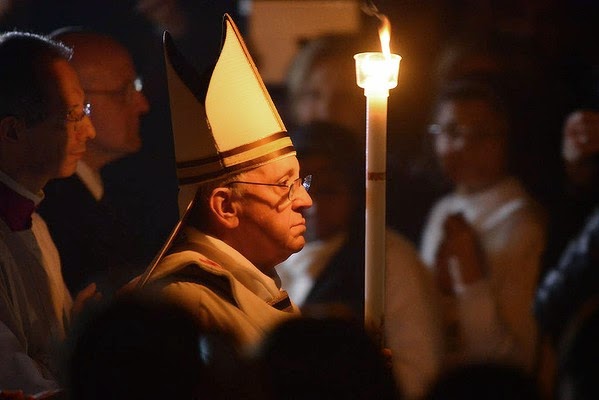
The Triduum is an experience for all of the senses. While I’ve never been anything but Catholic, I cannot imagine another church matching the beauty of the Triduum and the way the liturgies invite us into the Pascal Mystery.
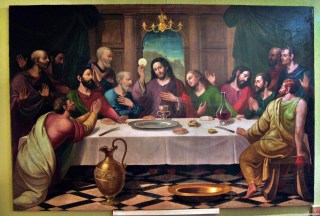
Holy Thursday begins with joy and beckoning us to the table of Our Lord’s Last Supper. I can imagine Christ bending low to wash my feet as the priest in persona Christi stoops to wash the feet of the young men called forward. After the Eucharistic prayer, I approach the priest to receive from him my Lord, the Word made flesh and remaining in the appearance of bread and wine. Tonight, I am an apostle from another century, experiencing the Last Supper and encountering Christ in a tangible way. My senses are alive as the Eucharistic procession weaves its way around the church. An incense thurible fills my nose with the sweet, rich odor I link only to the Eucharist. The priest is embracing Jesus as we sing Pange Lingua Gloriosi. Our Lord is carried to an altar and the faithful are invited to come and wait with Him.
I fulfill my role of a disciple well. In the intimately dim chapel, I wait with Jesus and I drift off to sleep at times. Can I not wait one hour? Apparently not. It is beautiful to see the others in adoration, praying with Jesus before He is hidden from us, when the stark reality of the Pascal Mystery will become more obvious. Then the time of waiting in the Garden is over and we depart in silence. Talking seems inappropriate. Nearly anything seems inappropriate on such an evening.
 Good Friday is spent anticipating and remembering the Passion of Jesus. The simplicity of the Good Friday service is unnerving and striking. I can always feel an ache in my heart. The tabernacle is left open and I am continually reminded that He is gone. Approaching the cross so as to venerate it, I am questioning where to kiss Jesus. My stomach feels the hunger of fasting and I kiss the crucifix with the kiss of Judas, with the kiss of John the beloved. Good Friday fills me with a longing and with a sorrow. The rest of the world seems to be continuing at its typical pace but I cannot carry on as normal.
The waiting of Holy Saturday is difficult. Christ has been crucified and laid in the tomb. He has yet to rise, though. Fasting is not obligatory yet the feasting of Easter is still premature. We wait. Waiting is perhaps the focal point of Holy Saturday and it makes it all the more difficult.
Yet the Easter Vigil will arrive with its dark and quiet entrance. A fire lit and from it, a flame passed to light all the candles in the darkened church. There is a stillness of expectation. We know the story, we know Christ will rise, and yet we are waiting for it to be lived out, to be fulfilled in this sacrifice. Darkness turns into light. As a church we are led through salvation history, to hear how God remains ever-faithful and is responding to the longings and yearnings of His people in an unforeseen way. We are reminded that we are a part of something far larger than ourselves or our parish. We are united to a Church that is truly universal and timeless. Joy mounts in my soul as we continue through the Mass. As the beautiful music announces a living reality in my life: Christ has risen. He rose 2,000 years ago and He rises today in my heart. The highest feast of the Church is celebrated with all the pomp owed to a King who mounts a cross as a throne and gives Himself as the food for the wedding banquet.
Easter Sunday is bright and joyful, a renewal of the joy felt the night before. While Easter Vigil tends to hold a heavy joy for me, Easter Sunday is a light, uplifting joy. The sun must shine on such a day and if it does not, the joy of the feast becomes a light of its own right. The lilies decorate the Church and we sing words that we have refrained from saying for weeks. It adds a depth to the joy that would not be found if one simply arrived at Easter without the Lent. The Easter Sunday celebration continues for the Easter Octave, each day the Church repeating the joy of the resurrection. Liturgically, we celebrate the Easter Mass repeatedly. We cannot move on, we must make it known that this is the highest of all celebrations.
The Triduum and Easter season are for all of the senses. Breathing in the incense from the Eucharistic procession, waiting with Jesus in the Garden, saying the words of the angry crowd as Jesus is condemned to death, kissing the cross of Our Lord, waiting as Jesus is held in the tomb, lighting our candle from the Easter candle representing the light of Christ Himself, and singing with exultation the joy central to the Catholic faith: we worship a God made man who rose from the dead. The Triduum calls us to live out the final days of Christ and to enter into the mystery by which we are saved. In a beautiful combination of music, art, sights, and sounds, the Church transports us to the time of Jesus Christ. Or, perhaps, she causes us to acknowledge that the Passion, Death, and Resurrection of Jesus are truly timeless events that we experience now through the beauty of the Body of Christ, the Church in her tri-fold magnificence.